
Breathing new civilian life into Canada's struggling legions - Toronto Star
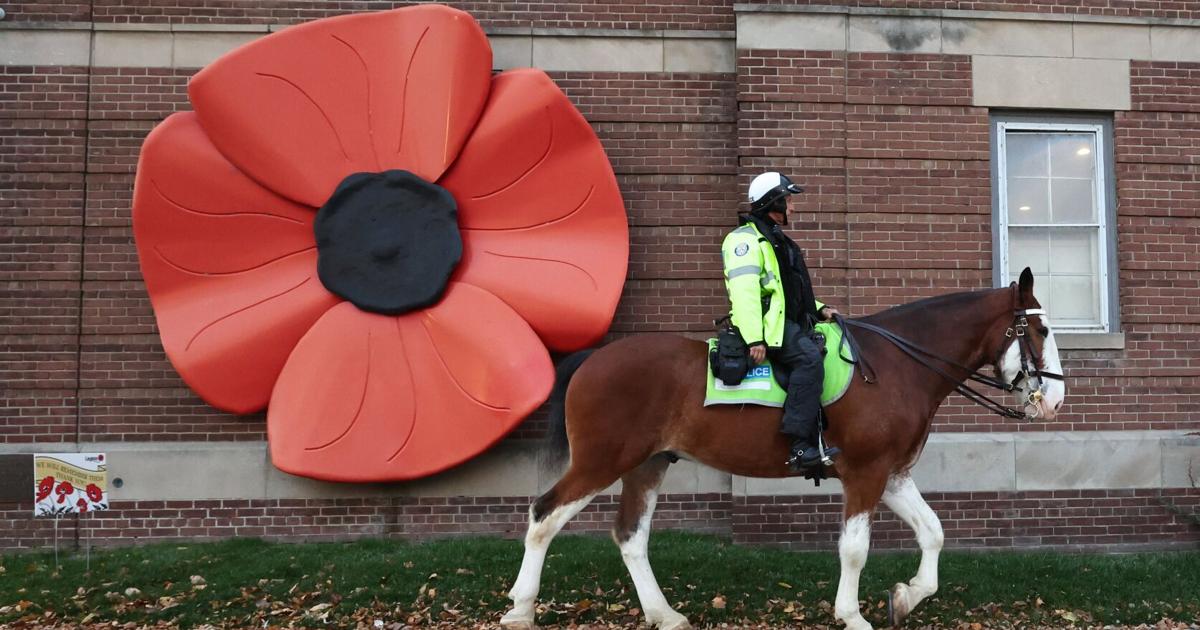
The legion's new campaign added 130,000 members so far this year, 100 years after its incorporation in 1926.
A mounted police officer walks past the branch. This year the Candian Legion turns 100. The Legion has recently opened its doors to more civilian members as the number of veterans dwindles.
At the front of a plain square room, silent actors use hand motions to convey the routine, discipline and repetition of military service.
They mimic weapons drills and polishing boots, signal incoming helicopters and stand at attention before telling their stories.
The audience leans into the performance.
“I’m young. He’s younger,” says one actor, a retired medic. “I hold onto his wrist, not just to know when the end happens, but to offer some kind of touch until the end happens.”
The performance captures the crushing repetition of military life, punctuated by the horror of combat, the carnage of an improvised explosive device.
The show, at the Royal Canadian Legion Branch 344 on Lake Shore West on the Friday before Remembrance Day, is a production of the MiCiv Project, which brings military and civilian artists together, at a time when the civilian population of the Canadian Legion has surged.
One hundred years after it was incorporated in 1926, the Royal Canadian Legion — which advocates for the welfare of military members, veterans and their families, and operates legion halls across the country where they can gather — undertook a membership drive. The campaign has added 130,000 members in 2026 so far, bringing the total to 300,000. They did it with a simple offer: First year of membership is free; if you pay for a second year — about $55 online — you’re entered in a draw to win a Ford F150. Existing members are entered if they renew.
“It has just taken off like wildfire,” said Lynn McClellan, president of the Ontario Provincial Command of the Royal Canadian Legion, based in Elora. “I heard that a lot of these folks are within the ages of 40 to 60, which is really encouraging.”
Canadian Armed Forces veteran Andrea Greening performs at Branch 344 as part of the MiCiv Project (military, civilian) on Nov. 6.
Even with the offer, legion membership in Canada’s largest veterans organization is only half of what it was in 1982-84, when it totalled 600,000. Hundreds of branches have been closed over the decades, down to 1,350 across the country today.
“Without opening our doors to everybody, the branches would be closing far faster than they already are,” said Alan Roy, a veteran and president of the Royal Canadian Legion Branch 101, in Etobicoke.
With 1,040 members, 101 is the largest legion in Toronto and one of the few still operating seven days a week.
“We can’t seem to encourage the newer veterans, the newer soldiers, to come into the branch.”
Legions, for those who have never been in one, are generally free-standing buildings, with fairly utilitarian spaces, where members can drop by for a drink, or in some spots, play darts, pool, euchre, or dance to a live band on a Friday night.
At the legion’s Branch 344 on Lake Shore West, veterans and perfomers Marc Torchinsky, middle, and Andrea Greening, right, chat with a civilian member of the legion, Laura Rutherford. Military and civilian artists gathered to tell their stories through movements for the MiCiv Project on Nov. 6.
They are humble. At 1395 Lake Shore Blvd., framed pictures of soldiers, Spitfires, Lancasters and destroyers deck the walls, highlighting the exploits, tragedy and heroism of local veterans.
At Royal Canadian Legion Branch 101 in Etobicoke, glass cases hold guns, gas masks, bayonets and artillery shells, as well as the cribbage boards that were a popular pastime in trenches and mess halls for soldiers and sailors in the First World War.
The displays aren’t meant to glorify war. The mementos are kept as a sacred tribute to the men who held them in their hands.
Many of the people connected to legions today have deep military roots.
Roy is a veteran whose grandfather fought in the first and second world wars. His father fought in the second, along with all his uncles. Roy wears a poppy, with a black string of mourning drawn through it in support of the four Canadian Armed Forces members killed on Oct. 17 in a fast-moving grass fire that overtook troops during a training exercise at CFB Wainwright.
The legion held a blood drive in support of the injured.
Live bands play here every Friday night. There are dart boards, pool tables, euchre tournaments, bus trips to the casino. They rent their hall to community groups to earn money to keep the lights on. Legions are not-for-profit.
On Friday night, a table of middle-aged women were whooping it up next to the band Redpath Traffic.
“If the band is good, we’re here,” said Debbie Fitzgerald. “If not, we go to bingo.”
At a table nearby were two new members, Kim and Jay Perry.
Jay says they joined due to the recent surge in patriotism in the country.
“We wanted to do something to support Canada.”
Veteran and Branch 101 president Alan Roy looks into one of the historic displays at the branch in Etobicoke.
Legions support and advocate for veterans and work closely with their communities, sponsoring local sports teams and supporting local charities. They run the annual poppy campaign.
After being incorporated in 1926 to serve veterans of the First World War, the legion was expanded to include veterans of the Second World War, the Korean War, the RCMP and modern Canadian Armed Forces personnel.
In 1973 membership was opened to families — sons, daughters, spouses and parents of veterans. Today, anyone over 18 can join.
Laura Rutherford joined 16 years ago, though she has no familial connection the military.
“I sincerely value what our veterans have done and are continuing to do,” said Rutherford.
She had just moved to the city when she joined on a whim.
“I didn’t know a soul in Toronto. I came here for work. And this place has become my surrogate family.”
Cassandra Anderton is the president of Branch 344.
“This is such a huge part of my life and it has brought me more than I can ever express.”
Cassandra Anderton, president of the Royal Canadian Legion Branch 344, whose grandmother was president for more than 25 years, says membership offers an antidote to being online.
“Being able to sit and have conversations with people, especially in a world where we’re enveloped in our technology, this is where you make connections,” she said.
Younger veterans say they want a wider variety of programs — they want activities that get them outdoors, more activities that aren’t centred around a bar.
Pamela Sweeny, executive director of The Royal Canadian Legion Ontario Provincial Command, says the success of the membership drive has proven that the legion is still relevant. About 60 per cent of the new members are under 60. She said legion branches are being encouraged to offer new activities for new members — like video game nights and bands that younger members want to hear.
“You have to listen to fresh new ideas. Now that we have this wonderful opportunity, we’re focused on retaining those wonderful people that have joined.”
Francine Kopun is a Toronto Star journalist and senior writer, based in Toronto. Follow her on Twitter: @KopunF

