BRICS 2026: Global attendees, key agendas, and geopolitical stakes. - IOL
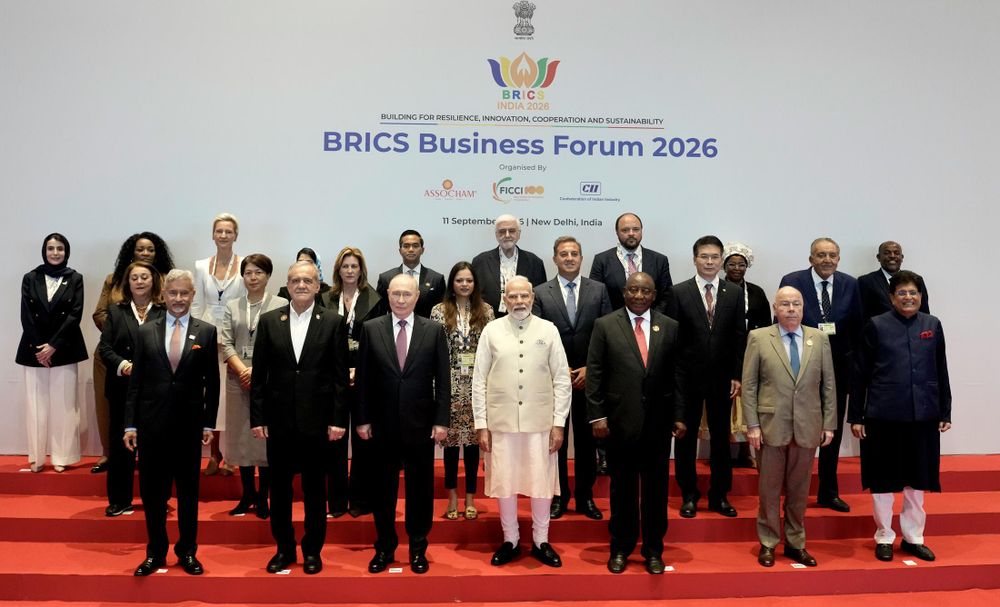
Indian Prime Minister Narendra Modi in a group photograph with BRICS leaders during the BRICS Business Forum 2026 on the sidelines of the 18th BRICS Summit at Bharat Mandapam, in New Delhi.
THE 18th BRICS Summit has officially commenced in New Delhi, India, bringing together a formidable assembly of leaders from across Asia, Africa, the Middle East, and Latin America.
Hosted by Prime Minister Narendra Modi under India’s 2026 chairship, the two-day gathering highlights the bloc’s massive expansion, representing nearly half of the global population and a substantial share of international commerce.
The summit’s attendance roster reflects the broad geopolitical reach and internal diversity of the contemporary Global South.
Among the prominent heads of state in attendance are Russian President Vladimir Putin, Iranian President Masoud Pezeshkian, South African President Cyril Ramaphosa, Egyptian President Abdel Fattah el-Sisi, and Indonesian President Prabowo Subianto.
Most notably, Chinese President Xi Jinping’s arrival in New Delhi marks his first visit to India since 2019, serving as a critical moment for bilateral engagement. Other key leaders present include Ethiopian Prime Minister Abiy Ahmed, Malaysian Prime Minister Anwar Ibrahim, and Thai Prime Minister Anutin Charnvirakul.
Several nations are represented by their sitting heads of state, including Cuba’s Miguel Díaz-Canel, Nigeria’s Bola Tinubu, and Uzbekistan’s Shavkat Mirziyoyev. Meanwhile, Brazil is represented by Foreign Minister Mauro Vieira, and the United Arab Emirates has sent Abu Dhabi Crown Prince Sheikh Khaled bin Mohamed bin Zayed Al Nahyan.
United Nations Secretary-General António Guterres is also participating, alongside a robust contingent from partner nations such as Belarus, Bolivia, Kazakhstan, Nigeria, and Vietnam.
Beyond formal protocol, the summit unfolds against a volatile backdrop of international friction, most notably the ongoing conflict involving the United States, Israel, and Iran, alongside persistent energy market shocks across Asia.
Because BRICS operates on a strict consensus-building model, requiring every member state to approve joint declarations, negotiators face intense diplomatic hurdles in crafting statements that address regional instability without alienating key members.
Iran is expected to push for explicit declarations regarding the West Asian crisis, testing the group’s ability to maintain unity amidst active geopolitical divides.
For host nation India, the summit provides an indispensable diplomatic venue to manage its complex relationship with China. Despite long-standing sovereignty and border disputes along the Line of Actual Control, both nations recognise the value of institutional mechanisms like BRICS to maintain high-level communication.
As foreign policy analysts note, ongoing cooperation and unresolved territorial tensions frequently coexist within the bloc. Xi’s presence in New Delhi allows both Asian giants to demonstrate that strategic competition does not preclude pragmatic engagement on shared global priorities.
Economic workstreams remain central to the New Delhi agenda, with member states continuing their strategic push toward new payment systems and de-dollarisation. Driven by the goal of reducing vulnerability to external financial shocks and Western sanctions, countries across the bloc are steadily expanding the use of national currencies in bilateral trade settlements.
Egyptian officials and other member representatives have highlighted the growing momentum behind local-currency frameworks.
Furthermore, the New Development Bank (NDB) has prioritised this transition, allocating significant portions of its financing portfolios, spanning the Indian Rupee, South African rand, and other member currencies, to fund sustainable infrastructure projects across the Global South.
Reforming legacy international bodies forms another foundational pillar of the New Delhi discussions. BRICS members have consistently argued that post-World War II institutions, such as the United Nations Security Council, the International Monetary Fund, and the World Bank, fail to reflect the economic and demographic realities of the modern multipolar world.
By advocating for structural overhauls, transparent governance, and equitable voting rights, the grouping seeks to amplify the collective voice of developing nations.
As the two-day summit progresses through closed plenary sessions, business forums, and outreach dialogues with partner countries, the overarching objective remains clear.
The New Delhi meeting is not merely a celebration of institutional expansion, but a rigorous testing ground for whether a large, diverse coalition can effectively coordinate economic policy, manage geopolitical rivalries, and steer the future of international trade and governance.
* Phapano Phasha is the chairperson of The Centre for Alternative Political and Economic Thought. The views expressed here do not reflect those of the Pretoria News.