BRICS leaders oppose forced displacement of Palestinians from Gaza, urge conflict prevention amid wars in Iran, Ukraine
Direct Source Verification:
This story is aggregated from The Express Tribune (tribune.com.pk). Full reporting rights and copyright belong to the primary publisher.
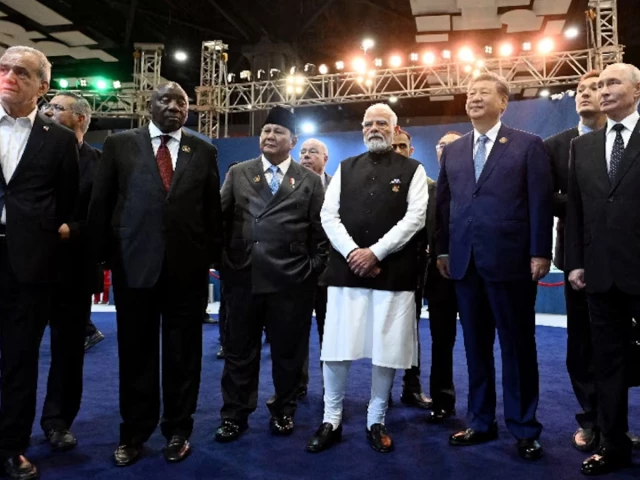
New Delhi Declaration voices concern over Gaza violence, nuclear conflict risks and attacks on civilian
BRICS leaders on Saturday called for greater efforts to prevent and peacefully resolve conflicts amid the wars in Iran and Ukraine, while opposing any forced displacement of Palestinians from the Gaza Strip.
The calls were included in the New Delhi Declaration, unanimously adopted on the first day of the bloc's two-day summit in the Indian capital.
Expressing "deep concern" over continued violence in Gaza despite the October 2025 ceasefire agreement, BRICS leaders called for an end to "any policies aimed at forced displacement of Palestinians from the Gaza Strip".
The declaration also expressed "concern regarding arrangements that may prejudice the inalienable rights of the Palestinian people and legitimise or prolong occupation".
"We reaffirm that a just and lasting solution to the Israeli-Palestinian conflict can only be achieved by peaceful means and depends on the fulfilment of the legitimate rights of the Palestinian people, including the rights to self-determination and return," it said.
The bloc also rejected "any unilateral measures that seek to alter the legal and historical status of occupied Jerusalem".
"We urge full respect for the sanctity of all religious sites and holy places in the city and for the rights of all to access and to observe their religious rites without hindrance," the New Delhi Declaration said on Saturday.
The bloc also condemned attacks on the UN Interim Force in Lebanon (UNIFIL) installations and personnel, emphasising that "such attacks are a violation of international law".
Noting the "current global context of polarisation and distrust", BRICS members called on the international community to respond to challenges and related security threats through "politico-diplomatic measures to lower conflict potential".
The bloc also stressed the "need to engage in conflict prevention efforts, including through addressing their root causes".
"We encourage the active role of regional organizations in conflict prevention and resolution and support all efforts conducive to the peaceful settlement of crises," the declaration said.
BRICS leaders also expressed concern over the growing risks of nuclear conflict and called for disarmament, arms control and nonproliferation.
The declaration voiced "serious concern" over "deliberate attacks" on civilian infrastructure and peaceful nuclear facilities.
"Nuclear safeguards, safety, and security must always be upheld, including in armed conflicts, to protect people and the environment from harm," it said.
Condemn unilateral trade measures
The BRICS leaders noted that the multilateral trading system "has long been at a crossroads".
"The proliferation of trade-restrictive actions that are inconsistent with World Trade Organisation (WTO) rules, whether in the form of indiscriminate rising of tariffs and non-tariff measures," the statement said.
"We voice serious concerns about the rise of unilateral tariff and non-tariff measures which distort trade and are inconsistent with WTO rules," it added.
The BRICS bloc condemned the imposition of unilateral coercive measures that "are contrary to international law, and reiterate that such measures, inter alia in the form of unilateral economic sanctions and secondary sanctions, have far-reaching negative implications for human rights, including the rights to development, health and food security, of the general population of targeted states, disproportionately affecting the poor and people in vulnerable situations, deepening the digital divide and exacerbating environmental challenges".
Xi urges BRICS peace role in Middle East
Chinese President Xi Jinping urged the BRICS bloc to be a peacemaker in the Middle East conflict, in an address to a summit of member countries in New Delhi.
China will work with other BRICS members in that role, as the war "does not serve the common interests of the international community", state-run CCTV quoted Xi as saying.
BRICS, originally comprising Brazil, Russia, India, China and South Africa and expanded to include Egypt, Ethiopia, Indonesia, Iran and the United Arab Emirates, was set up in 2009 to challenge a world order dominated by the United States and its Western allies.
Its members account for more than 40% of the world's population and almost a quarter of the global economy.
The Chinese leader called the bloc a "leading group" in the Global South and a model of self-reliance among emerging and developing countries that should promote innovation-driven development.
He said China would assume the BRICS chairmanship next year and host the 19th BRICS summit, according to CCTV.
In a meeting with Indian Prime Minister Narendra Modi on the sidelines of the summit, Xi said China views ties with India from a "strategic, long-term perspective", state-run Xinhua News Agency reported.
China and India can learn from each other's strengths and achieve shared development, Xinhua quoted Xi as saying.
Xi's visit to New Delhi, his first to India in seven years, should further the diplomatic thaw between the giant neighbours, but there are few signs as yet that their business ties will improve, analysts said.
China and India fought a brief war in 1962, setting the backdrop for a wary relationship since then, which soured after a 2020 border skirmish killed 20 Indian and four Chinese soldiers. Still, ties have improved in recent years, especially since Modi visited China last year and as both nations grapple with volatile relationships with the US.
Original Source
https://tribune.com.pk/story/2628925/brics-leaders-oppose-forced-displacement-of-palestinians-from-gaza-urge-conflict-prevention