BRICS summit leaders urge 'maximum restraint' in Middle East

Xi Jinping is expected to meet Narendra Modi at 5.45 p.m. local timeImage: Mukhtar Khan/AP Photo/picture allianceAdvertisementSkip next section What you need to knowWhat you need to know BRICS has reportedly reached a consensus, a joint declaration is expected to be released soon Modi will meet China's Xi on the sidelines of BRICS today Putin and Modi discuss a wide range of issues, including the Ukraine-Russia conflict, energy cooperation and trade across several sectors Modi again urges Putin to end the war in Ukraine Modi calls for maritime trade to be protected during bilateral talks with Iranian President Masoud Pezeshkian in New Delhi Pezeshkian warns Iran coming under 'critical, dangerous' US economic pressure Here is a roundup of some of the top headlines from the BRICS Summit 2026 in India:
Tired of missing our real-time updates? Click here to add us as a Preferred Source on Google. Then tap the "Star" or "Preferred" to keep DW News at the top of your feed.
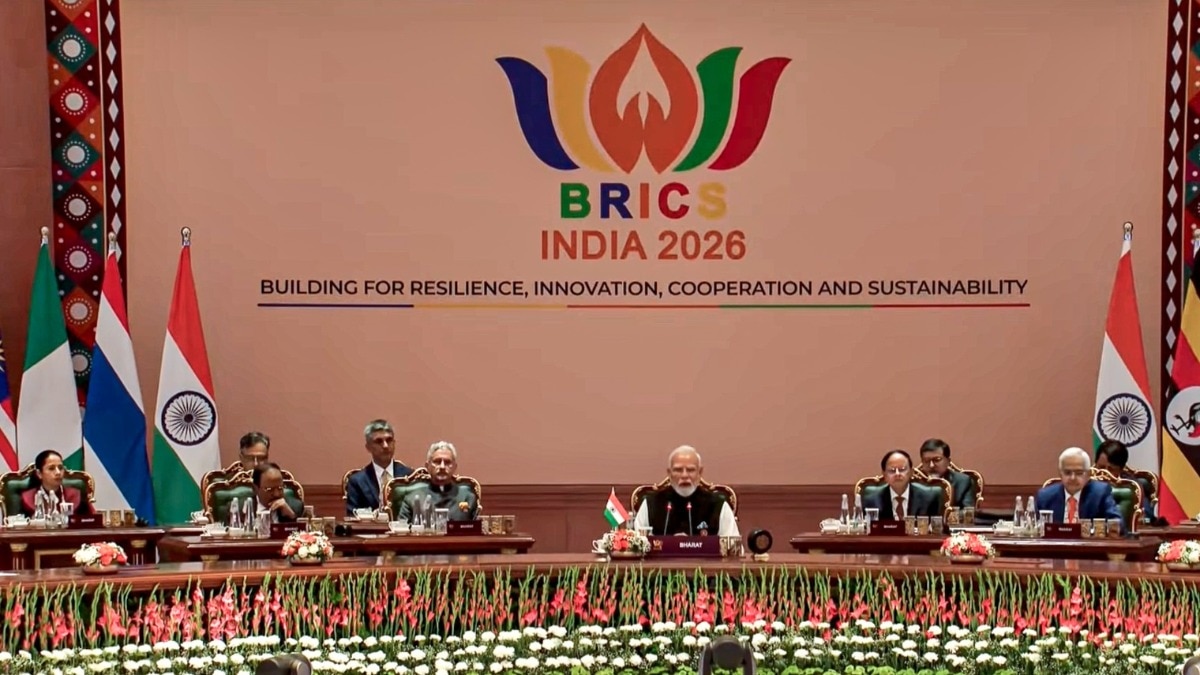
On the first day of the BRICS Summit, Indian Prime Minister Narendra Modi announced the adoption of a joint declaration.
The joint declaration adopted by the BRICS coalition stresses on the need to cooperate to maintain the smooth flow of global trade, supply chains and energy.
"We express deep concern over the continued escalation of tensions in Middle East/West Asia and, recalling our respective national positions, call for exercising maximum restraint, as well as avoiding actions that could further aggravate the situation," the statement read.
The member states have reiterated their commitment to peaceful resolution of international disputes through dialogue, consultation and diplomacy.
The declaration also advocates for a multilateral approach that respects diverse national viewpoints and positions on crucial global issues.
The bloc expressed its concern about the growing risks of nuclear danger and conflict.
"It’s all done," Indian prime minister Narendra Modi said. And what he meant was this: BRICS has an approved joint declaration for 2026. The leaders agreed on the text of the Delhi Declaration on day one of the summit after their plenary session.
It is important to keep in mind that, for the first six months of the Iran war, the grouping of Global South nations failed to issue a joint statement. The US-Israel-led attack on Iran has put enormous strain on the bloc.
The war directly involves three BRICS members: Iran, the UAE and Saudi Arabia. But not as allies. Iran has attacked the UAE and Saudi Arabia, seeing them as proxies for the US.
The war has been devastating for the Global South, which BRICS represents. Think oil and fertilizers — and food security.
The compromise now found in Delhi appears to be a joint declaration condemning unilateral wars, without naming any country.
That is rather low-key — but perhaps better than nothing, especially for BRICS chair India, which can claim this as a diplomatic victory. As former UN diplomat and prominent Indian foreign policy voice Shashi Tharoor had told me before the summit:
"There is very little doubt that all the BRICS members have not necessarily upheld the UN Charter, the inviolability of borders, the sovereignty of member states of the UN, and the inadmissibility of the use of force to settle international disputes."
The BRICS countries now number 11 and represent about half of the world’s population. And when economies are measured by what people can actually buy, they account for around 40 percent of global economic output.
So BRICS leaders feel they have a strong case for criticizing western political hegemony and the dominance of the US dollar. They argue that global institutions such as the UN, the International Monetary Fund and the World Bank no longer reflect the rising power of emerging economies and the Global South.
In his opening address, Indian Prime Minister Narendra Modi said that reform of the UN Security Council cannot wait any longer.
Speaking during the BRICS Summit, Chinese President Xi Jinping said that the Middle East war, sparked by US-Israeli strikes on Iran in late February, does not serve the world's interests, Beijing's state media reported.
"As the situation in the Middle East and the Gulf region continues to evolve, the war there has caused serious losses to people across the region," state news agency Xinhua quoted Xi as saying in New Delhi, which is hosting the 18th BRICS summit attended by leaders including Iranian President Masoud Pezeshkian.
It "does not serve the common interests of the international community", Xi said, according to Xinhua.
In his closing remarks for the first session at the BRICS Summit, Indian Prime Minister Narendra Modi announced the BRICS group of nations unanimously adopted a joint declaration on Saturday, the first day of their annual summit in New Delhi.
Reuters news agency, citing four anonymous sources, had earlier in the day reported that members of the BRICS coalition have agreed on a joint declaration which does not name any country but will condemn unilateral war by any country.
The members include Brazil, Russia, India, China, South Africa, Egypt, Ethiopia, Indonesia, Iran and the United Arab Emirates.
As leaders gather in New Delhi for the 2026 BRICS Summit, talk of "de-dollarization" is everywhere. But Anuradha Mitra Chenoy, Professor and former dean at School of International Studies, Jawaharlal Nehru University, argues the real story is more modest, and more interesting.
Every BRICS summit now comes with the same headline: is this the moment the bloc finally dethrones the US dollar? For Chenoy, the question itself is the problem.
"The debate is often overstated," she told DW. BRICS countries, in her reading, are not on a mission to replace the dollar. What they are doing is settling more of their bilateral trade in local currencies — a shift that has less to do with ideology than with practicality. It cuts transaction costs, speeds up payments, and makes trade more predictable for businesses that used to route everything through dollars by default.
If there’s a political edge to this trend, Chenoy locates it elsewhere, in how the dollar itself has been used as a tool of coercion. US sanctions, tariffs, and the freezing or outright confiscation of foreign reserves have all pushed countries, particularly across the Global South, to think harder about their exposure to the American financial system.
That calculus matters most for heavily indebted developing economies. By trading directly in local currencies with partners like India, China, Russia, and South Africa, these countries can sidestep some of their need to hold dollars just to settle trade. The payoff, Chenoy says, is twofold. Firstly, lower transaction costs, and secondly, in some cases, less reliance on dollar-denominated debt.
New Delhi has backed greater use of local currencies and cross-border payment mechanisms within BRICS, even as it keeps its economic relationship with Washington firmly intact.
For Chenoy, It’s also not a new one. She points back to the Rupee-Ruble trading arrangement India ran with the Soviet Union decades ago — a reminder that local-currency trade has deep roots in Indian economic policy, long before "de-dollarization" became a buzzword.
Chenoy says what’s actually happening inside BRICS — not a coordinated campaign to topple the dollar, but a pragmatic hedge that countries are spreading their financial risk across more currencies and more systems, one bilateral deal at a time.
Modi met with Abu Dhabi's Crown Prince Sheikh Khaled bin Mohamed at the BRICS Summit in New Delhi.
The two leaders met at Hyderabad House in New Delhi, where they sought to further strengthen their Comprehensive Strategic Partnership.
The United Arab Emirates became a full member of BRICS in January 2024, along with Egypt, Ethiopia, Iran and Saudi Arabia.
Modi and Sheikh Khaled welcomed the announcement by UAE-based International Holding Company (IHC) to invest in the development of an $11.5 billion (€9.91 billion integrated greenfield aluminium project in Odisha.
The project is expected to be India's largest integrated aluminium investment and position Odisha as a global hub for aluminium manufacturing.
The bilateral meeting between Modi and Abu Dhabi's Crown Prince comes amid growing India-UAE cooperation, particularly in the areas of trade and energy security.
In a post on X, India's Ministry of External Affairs spokesperson Randhir Jaiswal said in the meeting, "the leaders reaffirmed commitment to deepening of the India-UAE Comprehensive Strategic Partnership."
Indian Prime Minister Narendra Modi held bilateral meetings with the Ethiopian PM Abiy Ahmed Ali and Malaysian PM Anwar Ibrahim on the sidelines of the ongoing BRICS Summit.
Modi thanked both the country heads for their participation in the event and reaffirmed strengthening the bilateral Strategic Partnership with both Malaysia and Ethiopia.
Modi's meeting with Abiy Ahmed Ali built further on his historic maiden bilateral visit to Addis Ababa, Ethiopia last year. The two leaders discussed improving cooperation in defence and economic sectors.
In the bilateral meeting with Ibrahim, both the leaders reviewed the results of Modi's visit to Malaysia earlier this year. A significant outcome of Modi's trip was Malaysia's agreement to the establishment of Consulate General of India in Kota Kinabalu, Sabah — a move that will increase India’s diplomatic and consular outreach in the region.
Following his meeting with Modi, Ibrahim in a post on X said, "we agreed to continue the momentum of the close Malaysia-India relationship and to strengthen the friendship rooted in a long history and warm ties between the peoples of both nations.
The BRICS summit is packed with bilaterals for Indian Prime Minister Narendra Modi. Yesterday, he walked hand in hand with Iranian President Masoud Pezeshkian and hugged Russian President Vladimir Putin.
Today, he has already met the prime ministers of Ethiopia, Malaysia and Vietnam, as well as the Crown Prince of Abu Dhabi. More meetings are to follow as the clock counts down to 5:45 pm local time. That is when Modi is scheduled to meet Xi Jinping. And that's a big thing — especially for Indian media, which are broadcasting live around the clock.
Modi and Xi have, of course, met several times in recent years on the sidelines of multilateral summits — at the BRICS summit in Kazan in 2024, and at the SCO summits in Tianjin in 2025 and Bishkek just two weeks ago. But Xi has not been to India since 2019. This will be his first visit to the country in seven years.
Relations between the two Asian powers froze after a deadly clash in 2020 along their disputed Himalayan border, known as the Line of Actual Control. Direct flights and visas were suspended, while political engagement and trade ties suffered a major setback.
Today’s meeting could mark another step in the cautious thaw between the two nuclear-armed Asian powers, which have spent years drifting apart. But beneath the expected smiles and handshakes, deep mistrust remains — especially over their disputed border and over who gets to shape the future of Asia.
India's huge trade deficit with China might surface in discussions. Bilateral trade has nearly doubled in five years, but so has India's dependence on Chinese imports. Trade between the two countries reached $151.1 billion (€130.22 billion) in the 2025–26 financial year, making China India's largest trading partner. But the imbalance is striking: India imported $131.6 billion worth of goods from China, while exporting just $20 billion.
And when it comes to BRICS,India has no appetite for turning the bloc into an anti-Western platform that could jeopardize its relationship with the United States. A trade agreement with Washington is still pending, and India remains dependent on US technology. At the same time, China has become the world’s second-largest economy.
The elephant in the room here at BRICS 2026 in New Delhi, of course, is the US president. While Trump continues to threaten India with sanctions and tariffs for doing business with Iran and Russia, he is taking a softer line with China as he tries to get closer to Xi.
For New Delhi, then, the challenge is to deepen ties with China without drifting too far from the US — and to use BRICS to strengthen India's room for manoeuvre without turning it into an anti-Western alliance.
China's President Xi Jinping landed in Delhi this morning to attend the 18th BRICS Summit and hold talks with Indian Prime Minister Narendra Modi.
"At noon on September 12, local time, President Xi Jinping arrived in New Delhi by special plane. He will attend the 18th BRICS summit at the invitation of Indian Prime Minister Narendra Modi," Chinese state broadcaster CCTV said.
This is Xi's first visit to India since 2019, marking the biggest step toward normalizing ties between the two Asian powers, which took a major hit when India and China locked horns in the deadliest clash in over four decades over the disputed border in Ladakh's Galwan Valley.
The two countries have also sparred over Arunachal Pradesh's geographical names.
Xi's visit now signals the importance accorded by China to BRICS as well as maintaining ties with India.
Ahead of Xi's visit, in a post on X, China's ambassador to India Xu Feihong said that China will work with India to "properly handle differences" and "be friends enjoying good-neighborliness and partners helping each other succeed."
Modi and Xi are scheduled to meet on the sidelines of BRICS at 5.45 p.m. local time (1215 GMT). In their meeting, the two leaders are expected to focus on bilateral trade and border issues.
We are resuming our coverage of the BRICS Summit 2026, taking place in New Delhi at the Bharat Mandapam.
Indian Prime Minister Narendra Modi held bilateral meetings with Russian President Vladimir Putin, Iranian President Masoud Pezeshkian and UN Chief Antonio Guterres on the eve of the BRICS Summit.
Modi and Putin reaffirmed their ties. Both the leaders discussed key regional and global issues including the conflicts in the Middle East and the Ukraine war which was referred to as "conflicts in the Black Sea region."
In his meeting with Pezeshkian, Modi thanked the Iranian leader for his participation in the summit "despite the challenging circumstances" for Iran, which is at war with the US and Israel.
Modi also reiterated that "all issues must be resolved through dialogue and diplomacy."
It's past midnight in New Delhi, so we are pausing our coverage for tonight.
We will be back on Saturday for the start of the two-day BRICS leaders' summit.
New Delhi's "America Plus" approach sees India deepening its ties with China and Russia, while also trying to keep BRICS from turning into an anti-Western platform.
But with BRICS both growing in size and increasingly troubled by internal divisions, the forum might limit Narendra Modi's diplomatic gains.
Find out more about India's diplomatic balancing act between BRICS members China and Russia and the West in this report by DW's Mural Krishnan.
India's Prime Minister Narendra Modi again appealed to Russian President Vladimir Putin to enter negotiations to end the war in Ukraine.
During their meeting in New Delhi on the eve of the BRICS summit, Modi told Putin that dialogue and diplomacy are the right way to resolve conflicts, the Indian Foreign Ministry said in a statement.
Russia's war in Ukraine and its impact on shipping in the Black Sea have affected India, a major buyer of Russian oil and grain. Indian sailors have also been caught up in drone attacks.
The war, which the Indian Foreign Ministry has referred to as conflicts "in the Black Sea region," is on the agenda for the two-day summit.
India has adopted a typically pragmatic approach to the conflict, seeking to balance ties with the West and with Russia.
However, during an August meeting of the Shanghai Cooperation Organization (SCO) in Kyrgyzstan, Modi urged Putin to end the war, which was in its fifth year.
The BRICS summit 2026 takes place in Delhi this weekend. Unlike last year, Vladimir Putin and Xi Jinping are expected to attend. Can India keep the expanded bloc united?
Find out more in this report by DW's Arthur Sullivan.
Indian Prime Minister Narendra Modi has met with Iran's President Masoud Pezeshkian on the eve of the BRICS leaders' summit.
According to a statement by India's Foreign Ministry, Modi thanked Pezeshkian for taking part in the summit "despite the challenging circumstances" for Iran, which remains at war with the US and Israel.
Despite that conflict and economic pressure from the US to cut trading ties, India has sought to balance maintaining its relationship with Tehran and with Israel and Arab Gulf states.
Modi called for regional peace and stability to be restored and maintained and for maritime trade routes to be protected, amid the US and Iran's competing blockades of the Strait of Hormuz.