Bruce Arthur: B.C. court right to absolve founders of Drug User Liberation Front - Toronto Star
The B.C. Supreme Court concluded that DULF kept people alive and did no public harm, Bruce Arthur writes.
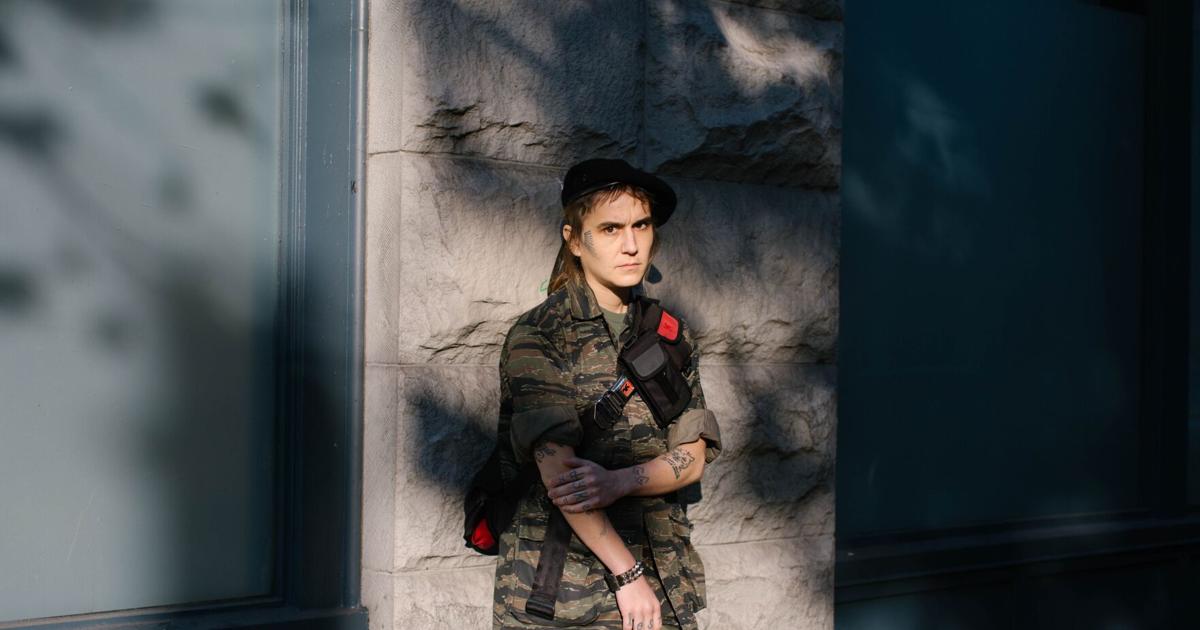
Eris Nyx is a co-founder of the Drug User Liberation Front, which provides tested and labelled drugs to a small group of people.
Bruce Arthur is a columnist for the Star. Follow him on Twitter: @bruce_arthur.
If you ever watched “M*A*S*H,” set in mobile field hospitals in the Korean War, the familiar drumbeat underneath the wisecracks and humanity is triage in the face of an insoluble problem. More wounded, bad conditions and shortages, trauma, exhaustion. In a way “The Wire,” about urban life in Baltimore, was like that, too.
For those working in public health on Vancouver’s Downtown Eastside, the locus of the nation’s drug crisis, that is familiar. Of the 50,000-plus overdose deaths in Canada in the past 10 years, almost a third of them happened in B.C. So in 2022 two public health workers with real links to the community, Jeremy Kalicum and Eris Nyx, offered a radical solution: the Drug User Liberation Front, or DULF.
They bought illicit heroin, cocaine, and methamphetamine over the dark web, secured it, tested it for purity and labelled it appropriately, and sold it to the program’s 43 habitual adult drug users, at cost. It was not a secret. The B.C. Ministry of Health supplied a storefront and designated it as an overdose prevention site, the group received provincial funding and the Vancouver Police Department was aware. But under provincially approved terms, without a federal exemption, they were never exempt from trafficking charges, either.
“I think it was very brave,” said Elaine Hyshka, an associate professor and Canada Research Chair in Health Systems Innovation at the University of Alberta’s School of Public Health who specializes in drug research and policy. “Honestly, they were willing to move the conversation forward at a time when people were scared to stick their neck out, and to say, obviously all the things we put in place have not worked to date.
“To me, that is public health: understanding there are actions that could be taken that could, you know, immediately save lives and moving forward.”
When the blowback hit — the judgment mentions a 2023 Economist article and Conservative leader Pierre Poilievre specifically, but there was a wave of opposition — the BC NDP government pulled the rug, the VPD moved in, Kalicum and Nyx were arrested, and were convicted of drug trafficking in 2025.
The B.C. Supreme Court vacated their convictions Tuesday, and declared Section 5(2) of the Controlled Drugs and Substances Act (CDSA) to be invalid, based on section 7 of the Charter of Rights and Freedoms, which guarantees the right to life, liberty, security of the person, and section 15, which promises equal protection under the law. B.C. Supreme Court Justice Catherine Murray gave the federal government six months to amend the legislation, barring an appeal to the federal Supreme Court.
The decision cites expert evidence to conclude that DULF kept people alive, and did no public harm. (All 43 DULF participants lived while in the program.) And because there is no path to safe street drugs under current law, the Charter outweighed current law.
Murray is being criticized by opponents of safe supply — conservatives, largely — and it is fair to worry about policy by jurisprudence. But so many criticisms of safe supply seem to never actually grapple with the crisis itself. There are those who oppose both supervised consumption sites and public displays of drug use; who oppose supportive housing and visible homelessness; who support rehab as a panacea, without acknowledging research that shows rehab without adequate supports increases fatalities, because those who relapse have a reduced tolerance for drugs.
So the impossibly complex crisis festers and grows. Nobody thinks buying drugs from criminals and selling them to addicted people is the optimal societal solution; it was just an attempt to stitch together one life raft in an ocean. Across the country there is never enough safe supply, supportive housing, rehabilitation, employment support, health care, or for that matter, law enforcement to actually address the crisis. Every public drug policy requires triage.
But addicted people remain citizens with rights, and like the Insite ruling of 2011 regarding safe injection sites, the law has changed. In 2024 and 2025, wastewater data showed metro Vancouver’s fentanyl levels to be 12 times higher than Toronto, Montreal, Edmonton, Saskatoon, Halifax, Prince Albert, and Moncton combined.
This is still a societal battle over public acceptance of something other than the old drug war. But what is the counter-argument to harm reduction, imperfect as it is? It’s hard to see a conservative alternative beyond moralizing-based policy: a call for more enforcement, the elimination of harm reduction, a massive increase in involuntary treatment, and presumably the use of the notwithstanding clause when involuntary treatment is found to violate the Charter. Oh, and maybe some more hostility towards the judicial system.
Maybe the real world needs to be wrestled with at street level, and then in the courts.
During the judgment Murray — a former prosecutor who was the presiding judge when the pair were convicted — told the defendants, “You selflessly put yourself to the side for this cost, and it’s something most people wouldn’t do. I applaud you, for what you’ve done. I think you should be very proud of yourselves, and it’s people like you who make a difference. And you just did.”
Error! Sorry, there was an error processing your request.
There was a problem with the recaptcha. Please try again.
You may unsubscribe at any time. By signing up, you agree to our terms of use and privacy policy. This site is protected by reCAPTCHA and the Google privacy policy and terms of service apply.
Opinion articles are based on the author’s interpretations and judgments of facts, data and events. More details
Bruce Arthur is a columnist for the Star. Follow him on Twitter: @bruce_arthur.