Building Shakti microprocessor was not about engineering, but trust: Kamakoti
Every country that has ever built its own microprocessor has had to survive a peculiar stretch of time, the years between announcing the thing and proving it, when the only honest answer to the question "will this actually work" is a shrug and a promise. India spent those years too. What it cost, by the account of the man who led the effort, had almost nothing to do with silicon.
"To build trust is the challenge," Professor V. Kamakoti, Director, IIT Madras, told India Today Digital in an exclusive interview at the institute's campus, describing what it really took to turn Shakti, India's own microprocessor, from a laboratory design into something the country would actually use.WHAT IS THE SHAKTI MICROPROCESSOR?
A microprocessor is the thinking part of any computing device, the small slab of silicon that carries out instructions, the brain inside a phone, a laptop, a satellite or a defence system. For decades, India designed almost none of its own, buying them instead from companies abroad, which meant the most critical component in the country's machines was always somebody else's design.
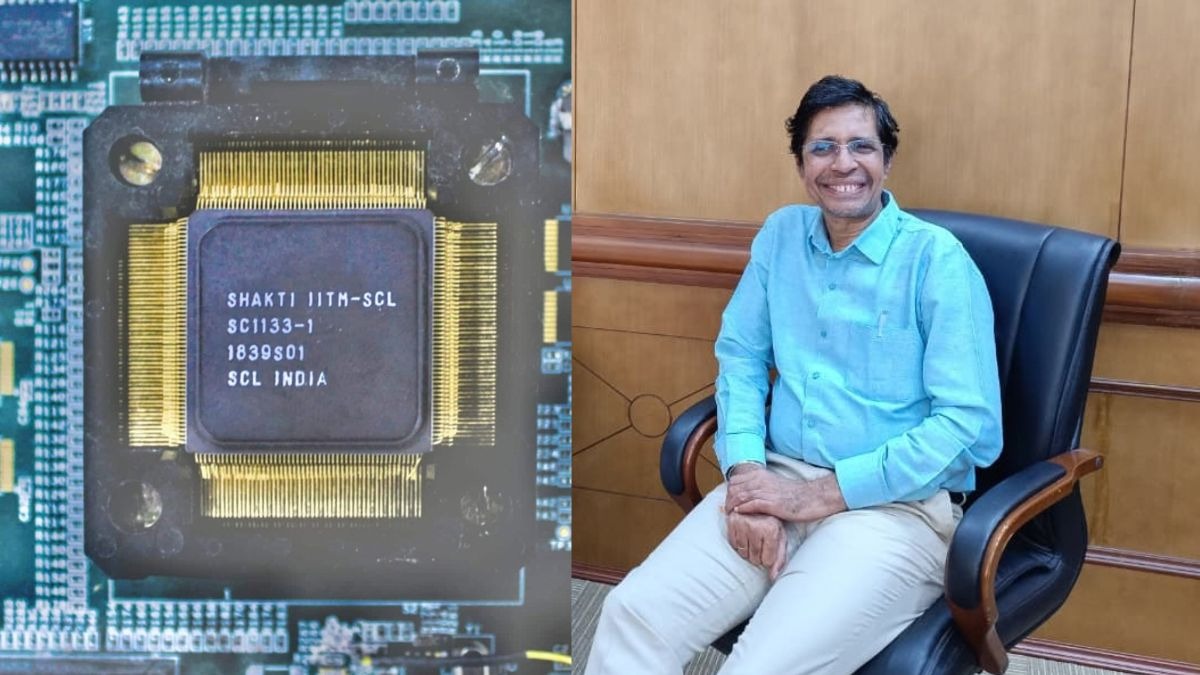
Shakti was IIT Madras's answer to that, a family of processors designed and built in India. It is based on RISC-V, an open instruction set architecture, meaning the basic rulebook a chip follows is freely available rather than licensed at heavy cost from a foreign corporation. That openness is precisely what made an indigenous Indian processor possible without paying for permission to build it. Shakti is a family of processors designed in India, built on the open RISC-V architecture. (Photo: IIT Madras)
Only a handful of countries have ever attempted this. China has built its own LoongArch architecture through Loongson, alongside a substantial national push into RISC-V. Russia has pursued its Elbrus line and newer RISC-V work. The European Union runs its own European Processor Initiative for much the same reason.
What unites them is not commercial ambition but sovereignty, the recognition that a nation which cannot design the brain of its own machines is permanently dependent on those who can. India, with Shakti, joined that very short list.WHY WAS TRUST HARDER THAN ENGINEERING?
Ask Professor Kamakoti about the biggest hurdle in taking research like Shakti from a laboratory to something usable at scale, and his answer does not begin with technology at all.
"The biggest hurdle, not just IIT," he said, "for any entrepreneur or any new researcher in a new field, or something you are starting, it may not be a new field across the world, but you are starting at your place."
The distinction is important. Building a processor was not an unsolved problem globally. It was an unsolved problem here, which is an entirely different kind of difficulty, because the doubt is not about whether the thing can be done, but about whether you, specifically, can do it. Professor Kamakoti says both researchers and funders had to believe the project would work before it could move forward. (Photo: IIT Madras)
He laid out two forms of trust that have to exist before anything else can. "The first thing is that people must start trusting," he said. "First, you should start trusting your project, that it will finally see the light of day. The second thing is, people who are going to fund you or going to support you must also start trusting in it. And if these two happen, then we are in a good shape to move forward."
On Shakti specifically, he was unusually candid about how long that took. "We took a lot more time to convince people that this is indeed something that will work," he said. "And building trust is the real challenge. Once the trust is built, then things move."
Read that carefully, because it inverts how we usually tell stories about Indian innovation. The processor was not delayed by physics. It was delayed by persuasion.advertisementHOW DID IIT MADRAS BUILD THAT TRUST?Professor Kamakoti's answer here is partly about expertise and partly about something more intangible, the accumulated reputation of an institution.
"It is because of the expertise of the researchers," he said, "and also some name, some brand value that we have taken. And that brand value essentially comes because what was seemingly impossible, many of our faculty have made reasonably possible."
That history does a specific kind of work when a funder is deciding whether to back something unproven. "These are IIT Madras people," Professor Kamakoti said, describing how the institution is read from outside. "They are known for taking risks and succeeding. So, let us try it out. That is a good feeling that we give to people who want to really support us."
In other words, decades of delivering difficult things becomes a form of collateral, spendable on the next difficult thing.WHAT IS THE INCUBATION ECOSYSTEM BEHIND IT?
Trust, once built, needs somewhere to go, and at IIT Madras that place is the Research Park, an entity chaired by the institute's director where startups set up their own operations while remaining connected to the campus that produced them.
"We mentor them for about one and a half to two years," Professor Kamakoti said, "after which they graduate and go to the next stage."
The scale of what has grown there is considerable. "Today we have 590-plus companies who we have incubated and nurtured," he said, "many of which have crossed a reasonable amount of valuation. The total valuation today stands at around 83,000 crore," a figure he put at roughly seven to ten billion dollars.
What surprised me most was his view of where young founders actually struggle. It is not, he said, technology. "Mentorship is not about the technical cost," he said. "They are technically super brilliant." The gap sits elsewhere, in the harder business of turning brilliance into something the world will adopt.
And there is a conviction underneath all of it that shapes what these companies are pointed at. "Solve a problem for Bharat," Professor Kamakoti argues, "and you have solved it everywhere." He reached for the pandemic to make the point, noting that a vaccine developed for India worked anywhere in the world.WHAT DOES THIS MEAN FOR INDIA'S CHIP AMBITIONS?
India is currently spending enormous sums to build semiconductor manufacturing capacity, the fabrication plants that physically etch chips into silicon. Professor Kamakoti's account is a useful corrective to the assumption that money and machinery are the whole story.
Before a single Indian-designed processor could be manufactured, somebody had to convince a sceptical ecosystem that an Indian-designed processor was worth manufacturing at all. That persuasion took years, and by the director's own account, it was harder than the design work itself.
The lesson sits uncomfortably alongside how we usually discuss technological self-reliance, which tends to be measured in factories and funding rounds.
What Shakti suggests is that the first thing a country building something new has to manufacture is belief, and that there is no shortcut, no subsidy, and no imported equipment that produces it faster.- Ends
Radifah Kabir tries to make the universe slightly less mysterious as Senior Sub-Editor at India Today’s Science Desk. A lifelong lover of physics and mathematics, she has spent four years (and counting) translating complex physics papers into English, chasing scientists for interviews, and writing explainers that don’t put readers to sleep. Off-duty, her heart belongs to Lana Del Rey's melodies, Quentin Tarantino's films, poetry, the Star Wars universe, good English movies, series and books, and one very demanding cat.