
Calls grow for death penalty as Parliament debates GBVF crisis - IOL
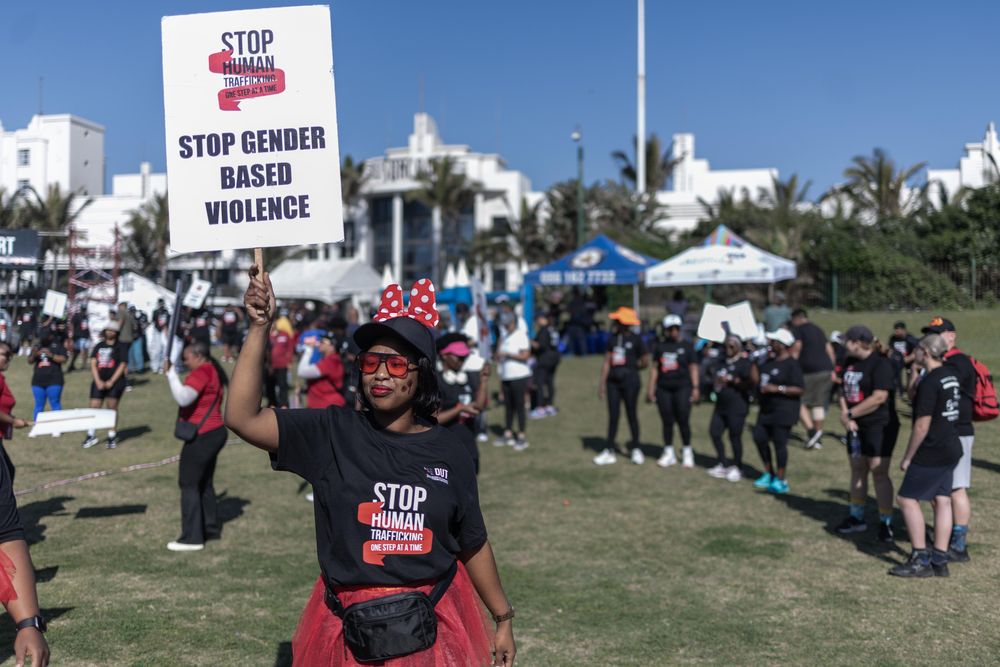
One of the many activists holds a banner during a 5 km walk along the promenade under the banner "One Voice, One Fight: End Human Trafficking” in Durban yesterday. The walk was organised by the Umgeni Community Empowerment Centre with the backing of DUT students and several partner organisations. Calls are growing for the reinstatement of the death penalty in the wake of the Ekurhuleni killings.
Calls for the reinstatement of the death penalty have resurfaced amid growing concern over the brutal murders of women in South Africa, with some parliamentary leaders arguing that tougher punishment is needed to combat gender-based violence and femicide.
African Christian Democratic Party (ACDP) leader Kenneth Meshoe and African Transformation Movement (ATM) MP Thandiswa Marawu have called for changes to the Constitution to allow the death penalty for people convicted of killing women.
The death penalty was declared unconstitutional by the Constitutional Court in the landmark S v Makwanyane judgment in 1995.
The calls came during a parliamentary debate on gender-based violence and femicide, following the recent discovery of the bodies of women in Gauteng.
Meshoe said severe sentences were necessary for people convicted of killing women.
“These crimes will not decrease if the perpetrators do not receive severe sentences. We propose that the Constitution be revised with the aim of restoring the death penalty for femicide. Those who commit these crimes deserve this sentence,” he said.
“Contrary to most global studies, a 2016 study in Japan found that one execution for murder deters two homicides. Beyond deterrence, taxpayers should not bear the burden of housing vicious murderers in prison,” he said.
Marawu said changes to the law were needed to prevent the killing of women.
“It is not possible for a person to kill another person and then live. What about the life he took of a woman? Enough is enough. We want the death penalty to be reinstated as we already said in the election manifesto. Let there be a discussion on reinstating the death penalty and amending the Constitution,” she said.
She also criticised the ANC's opposition to capital punishment.
“The ANC calls the restoration of capital punishment barbaric. We ask what is barbaric? It is the inaction of government while perpetrators roam freely. While women remain unprotected and while suspects in [GBV] cases get bail. The ANC must stop policing the language of the public and start addressing the violence that is killing our women,” she said.
Activists against human trafficking and gender-based violence hold banners during a 5 km walk along the promenade under the banner "One Voice, One Fight: End Human Trafficking” in Durban yesterday. The walk was organised by the Umgeni Community Empowerment Centre with the support of Durban University of Technology students and several partner organisations. It opened a day of awareness activities that included talks, food vendors and community events.
Deputy Minister of Justice and Constitutional Development Andries Nel, of the ANC, rejected the proposal, describing the call as unrealistic and populist.
“It is unrealistic. It is populist. It is meant to sound good. But ultimately it is the proverbial sound and fury signifying nothing. We are the first to admit that government must do more, but government cannot end GBVF on its own.
“We need the religious communities, civil society movements and traditional leaders and every South African to act. We need men to stop being silent. We need fathers to teach their sons that respect is not weakness. We need communities to stop protecting perpetrators and start reporting them. We need the entertainment industry, the religious sector and cultural leaders to reject the toxic norms that enable violence,” he said.
Nel said everyone had the right to life.
He also criticised coalition partners in the Government of National Unity, saying they often called for changes in government but criticised it when confronted with challenges within the government in which they served.
The DA called for the scourge of violence against women to be further debated following the discovery of the bodies of women in Gauteng.
Other parties also criticised the government and called for stronger action to combat gender-based violence. Some have called for the police service to be strengthened, including through the appointment of a permanent Police Minister.
Addressing the nation on September 29, President Cyril Ramaphosa acknowledged the scale of the crisis and announced measures aimed at strengthening the government's response.
Among the measures, Ramaphosa ordered a national case-recovery operation focused on unresolved murders, attempted murders, rapes and serious sexual offences involving women and children.
He also directed the police and forensic authorities to produce a funded plan within 60 days to reduce forensic backlogs and improve turnaround times for priority GBVF cases.
Municipalities have also been instructed to conduct women's safety audits to identify high-risk areas, including broken streetlights, overgrown public spaces, abandoned buildings and unsafe transport routes.
Ramaphosa further directed government departments to develop measures to reduce alcohol-related violence and ordered stronger enforcement of existing liquor laws and by-laws and said "that women should not live in fear because government has failed to repair a light, clear a public space, process evidence or enforce a law."


