
Can Great Indian Bustard chicks survive the wild? Rajasthan's gamble explained
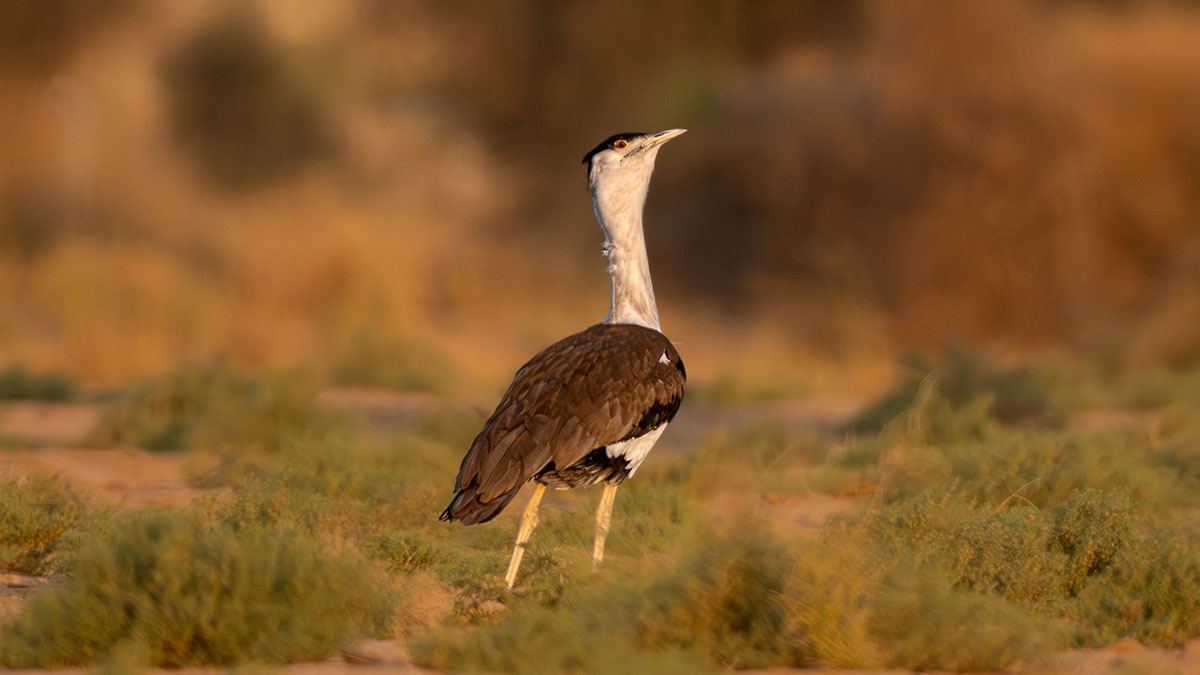
Rajasthan has forayed into a conservation experiment that could determine the next chapter in the fight to save the highly endangered Great Indian Bustard (GIB). On October 4, authorities released two captive-bred GIB chicks into a wild but fenced area of the Desert National Park in Sudasari in Jaisalmer district, marking a strategy transition from breeding the bird in captivity to teaching it to survive in its natural habitat. The released birds can fly about, but predators, such as dogs, and grazing animals cannot enter the area.
The stakes are unusually high. Latest official assessments put the wild GIB population in India at roughly 130-150 birds, the overwhelming majority being in Rajasthan. The species is classified as Critically Endangered, which makes it among the world's most endangered birds.
The GIB conservation-breeding programme began in 2019 as a partnership between the Union ministry of environment, forest and climate change, the Rajasthan government, and the Wildlife Institute of India (WII), Dehradun. The Abu Dhabi-based International Fund for Houbara Conservation (IFHC) is actively guiding the initiative.
A GIB centre was established at Sudasari near Jaisalmer; another facility subsequently got operational at Ramdevra. The programme initially depended on locating nests in the wild, collecting GIB eggs and artificially incubating them to reduce losses from predators and other threats.The first captive-bred GIB chick was born in March 2023—a major breakthrough since both its parents had themselves been artificially hatched and reared in captivity. Then began natural breeding among captive birds and assisted reproduction, including artificial insemination, to expand the captive gene pool and accelerate breeding.
The captive stock at the Rajasthan centres has reached over 90 birds. The programme has now moved decisively towards the next objective—rewilding GIBs. The birds released on October 4, therefore, carry something unique into the Thar desert wild: genes originating from wild GIBs but survival instincts based on life inside a breeding centre.
Neighbouring Gujarat has been experimenting with a different strategy to save the GIB—the ‘jumpstart’ technique. The state’s Kutch has only three surviving female GIBs in the wild, leaving virtually no possibility of natural reproduction because there are no breeding males.
Under ‘jumpstart’, conservationists replace an infertile egg laid by a wild female with a fertile, partially incubated egg brought from Rajasthan. The timing is crucial. Once field teams identify a female that has laid an egg, they wait until much of the natural incubation period has passed before replacing the infertile egg with a fertile one nearing hatching. This dramatically reduces the period during which the transferred egg is vulnerable to predators.
The first interstate ‘jumpstart’ experiment produced a chick in Naliya on March 26 after a fertile egg was transported roughly 770 km from Rajasthan. But the chick disappeared in April, raising a question mark over surveillance. Officials feared predation, although its disappearance also exposed the difficulty of monitoring a young bird once it begins moving and flying through open grassland.
The second Gujarat attempt has fared better. A chick born on May 21 crossed the critical 40-day survival stage, giving scientists fresh evidence that the ‘jumpstart’ technique could work. After rewilding indicates success in Rajasthan, some GIBs will be released into secure but open spaces in Gujarat.
However, experts say producing a GIB chick is one challenge; keeping it alive in the wild is another. That is the central contradiction facing the conservation programme. The GIB has not disappeared from the Thar merely because too few chicks were being born. Its habitat has also been steadily fragmented and degraded. The latest assessment found that the species survives in only a fraction of its potential habitat in Rajasthan. Power lines, especially solar transmission infrastructure, habitat loss and expanding development remain major threats.
In 2025, the Supreme Court, recognising the conflict between GIB conservation and infrastructure development, revised the ‘no-go’ GIB habitat to cover 14,013 sq. km in Rajasthan and 740 sq. km in Gujarat, with specific measures for in-situ and ex-situ conservation, as against the previous 99,000 sq. km of blanket restriction.
The court also accepted recommendations concerning power corridors and mitigation of threats to GIB from transmission infrastructure. That makes success of the captive-breeding programme inseparable from what happens outside the breeding centres.
WII director Gobind Sagar Bhardwaj sees the October 4 release as a learning exercise rather than an immediate mass restocking operation. “We will monitor how the two chicks behave before deciding about how many more are to be released in Rajasthan or Gujarat. We take it as a training process and will learn how captive-bred birds behave in the open, besides ensuring how better we can safeguard them,” Bhardwaj told INDIA TODAY.
The project is attempting to understand whether a GIB generation raised under human care can acquire the behavioural skills needed to survive in an environment where nesting success, predators, food availability, human disturbance and power lines pose risks. The October 4 release is thus one of the most consequential moments in India's GIB conservation story. It will determine whether a bird born behind a fence can learn to live beyond it, and whether the Thar and later Kutch have enough safe grassland left for the purpose.

