Cape Town campaign writes names of Palestinian children killed in Gaza on 20-metre shroud
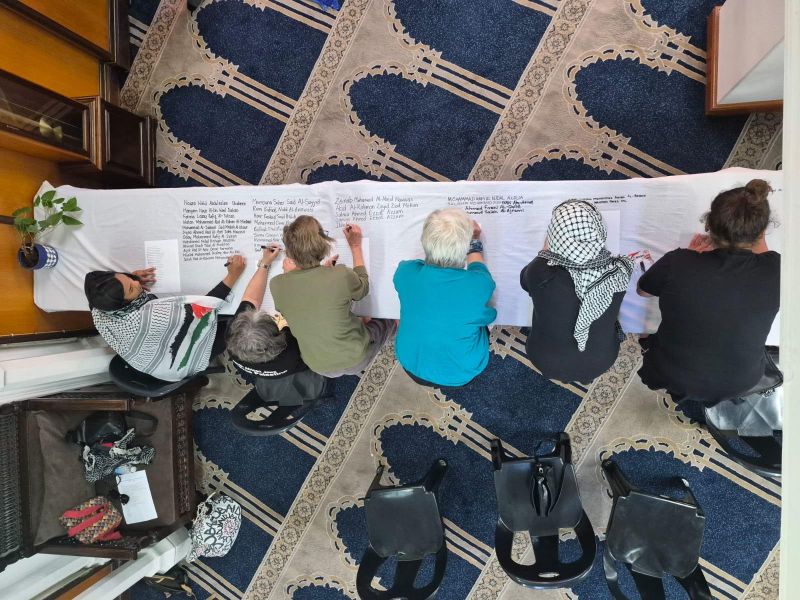
Cape Town community writes names of Palestinian children killed in Gaza on 20-metre shroud.
A Cape Town community initiative has recorded the names of thousands of Palestinian children killed in Gaza on a 20-metre shroud as part of a campaign to remember the victims as individuals rather than statistics.
The Know Their Names project began over the weekend of 19 and 20 September at Claremont Main Road Mosque, where community members started writing the names of Palestinian children on the cloth.
The initiative was organised by Mothers4Gaza and has since expanded to other venues across Cape Town.
Organisers said about 10,778 names had been written on the shroud, covering children up to the age of nine. The first section recorded the names of children under five.
On 30 September, the shroud was taken to Central Methodist Church in Greenmarket Square, where members of the public were invited to write names before attending a midday vigil at St George’s Cathedral.
The shroud will continue its journey on Friday, 2 October, when it will be taken to the Homecoming Centre. Names will be written between 11am and 2pm.
Ayesha Bagus, one of the organisers, said the project was intended to remind people that Palestinian children had families, personalities and futures before their deaths.
“Palestinian mothers love their children in exactly the same way that we love ours,” Bagus said.
“They know their children's voices, their little habits, what makes them laugh and what frightens them. They imagine their futures in the same ordinary way that parents everywhere do.”
She said writing the names was intended to remind people that each child was deeply loved.
“Every one of these children was someone's whole world,” Bagus said.
The organisers said the project was inspired in part by writer James Baldwin's words: “The children are always ours, every single one of them, all over the globe.”
According to the Killed in Gaza dataset maintained by Tech for Palestine, 72,835 people known to have been killed in Gaza since 7 October 2023 were included in its named dataset, including 21,637 children.
The organisation cautions that the figure is an undercount because people buried by their families without passing through hospitals, unidentified victims and people who remain missing or beneath rubble may not appear in the named dataset.
Gonda Perez, another organiser, said the size of the numbers made it difficult to comprehend the individual losses.
“Every name represents a child who was known and loved by someone,” Perez said.
“The shroud cannot hold every name, and it cannot contain the grief of every mother who has lost a child. But it can hold some names, and those names can remind us that behind every number is a human being.”
Irene Govender said South Africans understood the consequences of reducing people to categories rather than recognising their humanity.
“We saw it during apartheid, when an entire people could be reduced to categories and denied their full humanity,” Govender said.
“We will not allow Palestinians to be dehumanised in the same way. Every one of these children had a name, a family and a life that mattered, and writing their names is one small way of refusing to let that humanity be erased.”
The initiative takes place amid continuing international scrutiny of the Israeli-Palestinian conflict.
The organisers also referred to the International Court of Justice's July 2024 advisory opinion concerning Israel's presence in the Occupied Palestinian Territory and its findings regarding Israel's obligations under international law.
The organisers said the shroud would be carried through Cape Town on 7 October as an act of remembrance.
The organisers said the shroud would be carried through Cape Town on 7 October as an act of remembrance.
Megan Chortiz said the procession was intended to ensure the children were not forgotten.
“We will carry this shroud because we refuse to allow these children to disappear into a statistic,” Chortiz said.
“We want their families to know that their children have not been forgotten that people here have taken the time to learn their names, and that we mourn the loss of each child whose name we carry.”
The organisers said the project would continue as additional cloth became available, allowing more names to be recorded.
They described the initiative as a call to remember the children, honour their lives and recognise the rights of Palestinian children.