Cape Town’s Annandale Farm land release draws political and community opposition - IOL
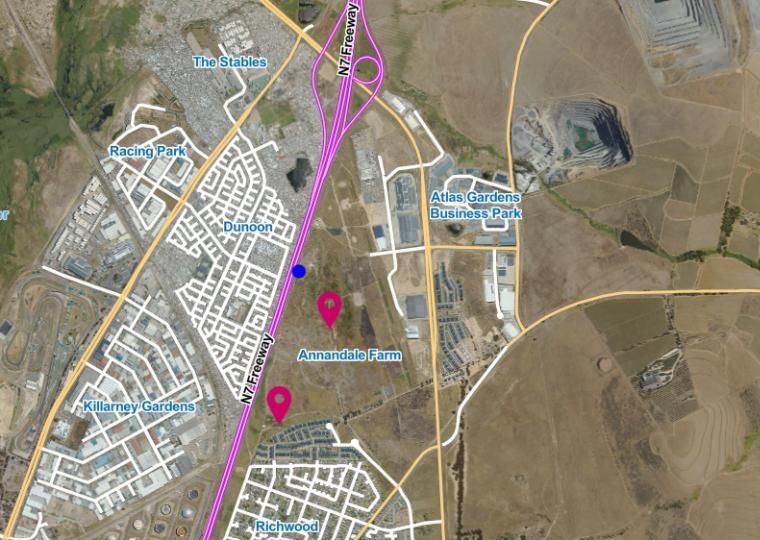
The Annandale Farm site, as shown on the City of Cape Town’s Map Viewer.
A fierce political and social dispute has erupted over the City of Cape Town’s decision to release the 71.8-hectare Annandale Farm in Milnerton to private developers, nine years after purchasing the land with national grant funds intended to relieve overcrowding in nearby Dunoon.
GOOD Party Secretary-General and mayoral candidate Brett Herron disclosed this week that information obtained through a Promotion of Access to Information Act (PAIA) request confirms the City purchased the site for R162.6 million using the Urban Settlement Development Grant (USDG).
USDG funds are ring-fenced by the National Treasury specifically to acquire well-located land and expand access to basic amenities for low-income households.
Herron accused the metro of "unconscionable profit-making," pointing out that the City is now disposing of the land - valued R71 million more than its original acquisition cost - to commercial entities without guaranteeing direct state housing.
Herron said: “Nine years after money was spent for the purpose of increased access for poor households, zero houses have been built, but the City is turning a fat profit.”
He added that the party will approach the National Department of Human Settlements to challenge the lawfulness of the transaction.
Rejecting allegations of profiting from public assets, Mayoral Committee Member for Human Settlements, Councillor Carl Pophaim, argued that the transaction aims to leverage private capital in the face of dwindling national state subsidies.
Pophaim clarified that the R71 million figure reflects a statutory market valuation required by the Municipal Finance Management Act (MFMA) rather than a net profit calculation.
"The disposal of the asset is not intended to generate a profit for the City, but rather to enable the discounted release of the property in exchange for the maximisation of affordable housing opportunities," Pophaim stated.
He noted that the evaluation criteria for incoming bids directly incentivise developers who offer the highest quota of affordable units.
Pophaim further pointed out that statutory bodies like the Social Housing Regulatory Authority (SHRA) have halted funding allocations to Cape Town projects for over five years, forcing the municipality to pivot toward public-private partnerships.
Under current national policy shifts, state-subsidised Breaking New Ground (BNG) homes are strictly reserved for child-headed households, military veterans, and elderly citizens earning under R3,500 per month.
The city’s land release scheme, Pophaim said, bridges the gap for working-class households earning between R5,900 and R30,000 monthly.
For residents in overcrowded Dunoon, the policy debates provide little comfort after years of unfulfilled promises.
Community activist Thembelani Ndabezimbi recalled how successive housing promises over the years - including a site behind a local retail centre - failed to materialise into actual homes.
“I am hurt because after so many protests and marches, we feel like we marched for nothing.”
Ndabezimbi expressed skepticism that private developments would cater to Dunoon's core population, where unemployment is widespread and low-wage workers struggle to meet commercial rental brackets.
Ndabezimbi said: "Most people who were backyard dwellers decided to occupy vacant land and build shacks because they couldn't afford rent. If the City insists on selling, they should use those funds to buy land and provide basic serviced plots so people can build for themselves".
Similar feelings were shared by other residents, who emphasised: "We demand decent housing, and the city must ensure equal service delivery across all communities."
With GOOD lodging a formal appeal against the City's decision to classify original approval and valuation reports as confidential, the battle over spatial justice and public land in Cape Town appears far from over.