Carney government’s energy and labour bill puts Conservative leader in a ‘pickle’ - Toronto Star
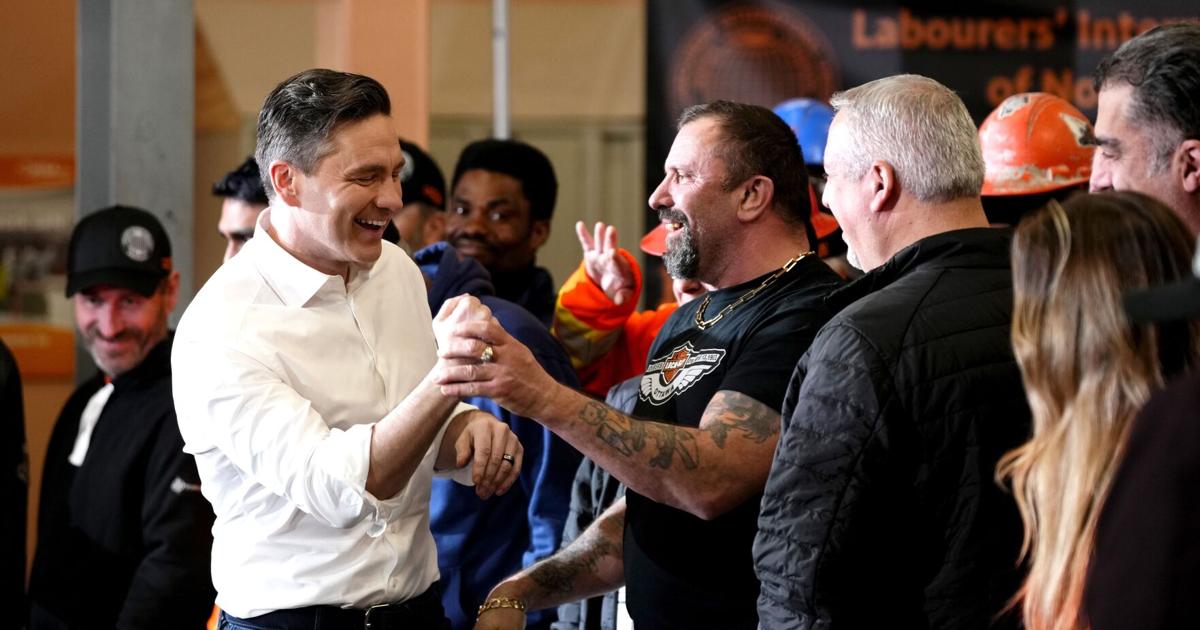
The sweeping Liberal legislation pits two of Pierre Poilievre’s main priorities against one another: Rolling back regulations seen to be limiting resource development and deepening his party’s connections to labour.
Conservative Leader Pierre Poilievre jokes with union members while on the campaign trail in Ottawa before the 2025 federal election.
OTTAWA — The Conservatives’ inroads with unions could hit a dead end if they don’t come out against the Liberals’ changes to Canada’s labour code, but so far the party hasn’t picked a lane on the controversial reforms.
In addition to an overhaul of major project approvals and environmental regulations, the Liberals’ new omnibus Bill C-39 contains changes to Section 107, a controversial part of the labour code the government has used multiple times to end strikes or lockouts with the stroke of a pen.
Kevin Piper, president of the Halifax Longshoremen’s Association, one of a handful of unions to endorse the Conservatives in the last election, said he wants the party to push for an end to Section 107, but at a minimum to make its positions clear.
“We’d ask for the Conservative party to tell our members clearly where they stand on Section 107,” he told the Star. “For us to endorse them again, we’d be looking for specific messaging from them and what they would do if they got into power.”
As of this week, that has not happened.
“I’m talking with my friends in the labour movement to understand what they think of the changes and lots of people are deeply concerned,” Kyle Seeback, the Conservative MP for Dufferin-Caledon who serves as the party’s critic for labour, told reporters.
Prime Minister Mark Carney’s marquee bill of the fall session, which his Liberal government champions as key to getting more major infrastructure projects built in the face of an escalating trade war with U.S. President Donald Trump, pits two of Conservative Leader Pierre Poilievre’s main priorities against one another: Rolling back Trudeau-era regulations seen to be stymying resource development and deepening his party’s connections to labour.
Section 107 has been in Canada’s labour code for decades, but it was rarely used until 2024, when the Liberals first triggered it ahead of a threatened WestJet mechanics strike.
The section gives the minister broad powers to end a strike without going to the House of Commons to pass back-to-work legislation. The Liberals have since used it multiple times to end work stoppages by railway workers, port workers and flight attendants. But unions vehemently oppose the use of the legislation and the government is facing four court challenges over its use.
Poilievre has joined in that opposition in recent years, particularly as he courts votes among private sector unions and building trades. His efforts to make the Conservatives more union-friendly stand in stark contrast to the often acrimonious relationship the former Conservative government of Stephen Harper had with labour groups, using back-to-work legislation several times and introducing bills requiring more financial transparency from unions and legislation that would have made starting a union more difficult.
Poilievre pledged not to reintroduce those bills and has sought to turn a page from that Harper era of labour relations. Earlier this year, he quietly changed what had been party policy to support so-called right-to-work legislation, which allows for employees to opt out of a union.
The Liberals’ bill keeps Section 107 in the labour code, but adds what Jobs Minister Patty Hajdu has called “guardrails,” creating a process before it can be used and only allowing use when the strike or lockout creates significant impact on the Canadian economy or serious social disruptions.
The Liberals have used Section 107 in past job actions at ports in Montreal, Vancouver and Quebec. Piper said his union has been negotiating for 10 months for a new contract and while no strike vote has been called, he fears the government is sending a signal that it won’t let port workers go to the picket lines.
Christopher Monette, director of public affairs at Teamsters Canada, which represents thousands of railway workers as well as those in the building trades, said the Conservatives have been courting “a good subsection” of its members, as the organization itself takes a non-partisan stance. He said the Teamsters have a good working relationship with Seeback, with the union’s president also having met with Poilievre.
Monette said the union wants to see the federal Conservatives push to repeal Section 107, which is the message the organization plans to deliver in an upcoming meeting with Seeback.
“The reality is that the Conservatives have been fairly consistent in their criticism of Section 107 and in their criticism of how the government has acted to force striking and locked-out workers back to work,” Monette said. “It’s logical, therefore, that they would continue this opposition.”Monette said he believes Teamsters members will judge both the Conservatives and New Democrats by how outspoken each party is against Section 107.Even before it was tabled, NDP MP Don Davies said the Liberals’ new legislation was an “appalling attack on labour.” The New Democrats have stood with labour leaders this week complaining about the section and last year they put forward a private member’s bill to have it completely removed from the labour code.Seeback, who has come out against the use of Section 107 before and accused the Liberals of derailing labour relations across the country, had said the Conservative party is still a friend to the movement.
“We made incredible strides with unionized members in the last election, a lot in the construction building trade unions and others, because we’ve been a strong voice for them on things like affordability, on getting things built,” Seeback said. “We’re going to continue to advocate for all of those things, and we’re going to make sure that their voices are actually heard in this legislation.”Nathan Bergstrand, business manager of a Hamilton plumbing and pipefitting union that endorsed the Conservatives in the last election, told the Star in a statement the government’s labour changes ought to be studied separately and said it welcomed the concerns expressed by the federal Conservatives.Mark Hancock, national president of the Canadian Union of Public Employees (CUPE), told the Star he heard from Seeback this week in a text asking whether they would want to see the labour proposals removed from the bill.“I said yes, absolutely.”Hancock said he views that move as a “positive step,” saying while the union has historically had a relationship with the NDP — he spoke alongside federal leader Avi Lewis at press conference regarding the bill — he says they are open to working with any party.Given the fact the labour proposals are coupled with sweeping changes to how major infrastructure projects are reviewed, Hancock said the Conservatives are “in a bit of a pickle.”
Error! Sorry, there was an error processing your request.
There was a problem with the recaptcha. Please try again.
You may unsubscribe at any time. By signing up, you agree to our terms of use and privacy policy. This site is protected by reCAPTCHA and the Google privacy policy and terms of service apply.
Ryan Tumilty is an Ottawa-based reporter covering Parliament Hill. Reach him at rtumilty@thestar.ca and follow him on X: @ryantumilty.
Stephanie Taylor is an Ottawa-based reporter covering federal politics for the Star. Reach her via email: staylor@thestar.ca