Chased on highways, followed after dark: The reality of being a woman biker in India
A white sedan follows a woman on a motorcycle. She tries to stay ahead. The car comes close, again and again. She is frightened enough to start calculating how to put other vehicles between herself and the car.
The incident on Gurugram's Golf Course Road, captured on an action camera mounted on biker Sia's motorcycle, has triggered a wider conversation about what it means to be a woman on two wheels in India. The Gurugram biker Sia has said the episode was traumatising and that while she intends to ride again, she will now be scared of riding alone, even in a group.
For women who have spent years riding across India, though, the fear of being followed, chased or harassed on the road is not an unfamiliar one.
Some have had cars drive dangerously close to them. Some have been chased by groups of men. Some have altered their schedules so they are off the road before sunset. And then there are the less dramatic, but persistent reminders that a woman on a motorcycle is still treated as something of a spectacle: strangers asking whether the bike really belongs to her, taking videos without permission or simply refusing to leave her alone.
The road may promise freedom. But for many women riders, freedom comes with a mental checklist.‘If I stopped, how would I deal with all of them?’
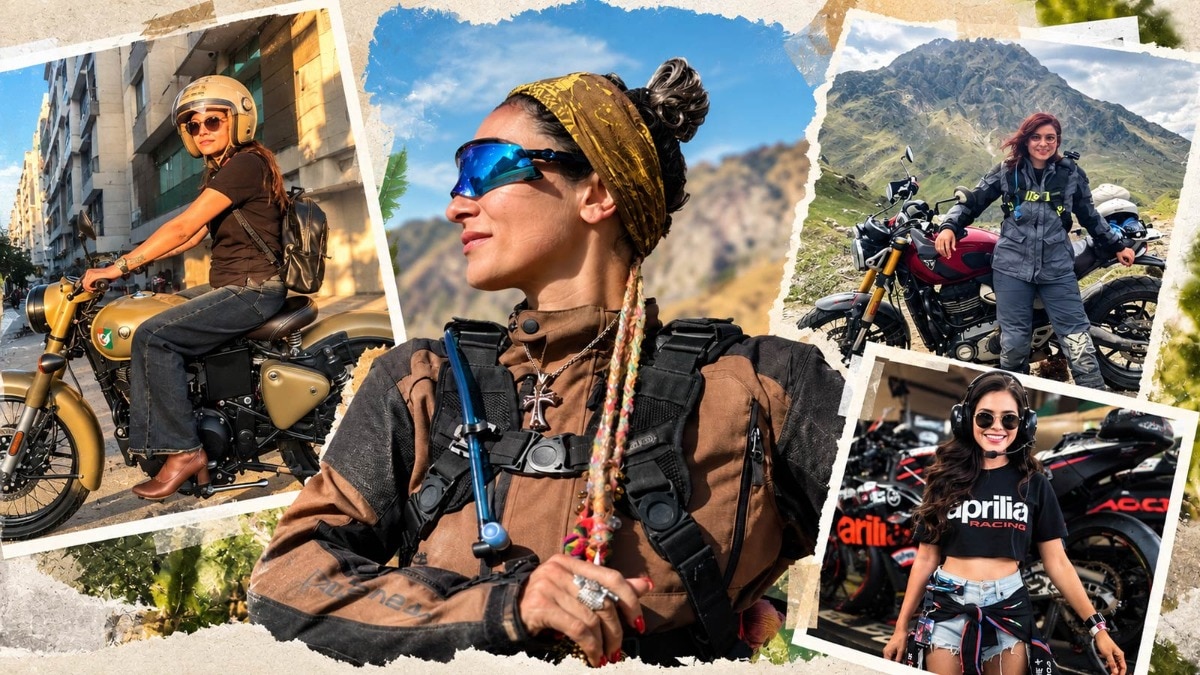
Dr Maral Yazarloo-Pattrick, Iranian by birth and based out of India, has been touring India on a motorcycle for over 16 years. She has travelled to 71 countries, including 64 during a round-the-world journey. Yet, she says, riding alone on an empty Indian road after dark is not something she recommends.
“I prefer to stop and halt for the night before dark,” she says. “I prefer to start early in the morning so that I can cover more mileage during daylight.”
That caution comes from experience.
Yazarloo-Pattrick recalls one of the most frightening incidents from the early days of her riding journey. She was travelling towards Amritsar with five or six riders when thick fog reduced visibility to barely two or three metres. She was the last rider in the group and could no longer see the others ahead. View this post on Instagram A post shared by Dr.Maral Yazarloo-Pattrick (@maralyazarloo)
Then a car began driving dangerously close to her.
The people inside, she says, appeared heavily drunk. She could see bottles in the car and hear the occupants shouting at her to stop. She could not speed away because she could barely see the road ahead. She did not know if the road would suddenly turn. She kept honking, hoping the riders ahead would notice, but they were too far away.
“All I could think was: if I stopped, or if these men hit my motorcycle, how would I deal with all of them on an empty road?” she says.
And that is precisely what the Gurugram incident brought back for her. She does not see it as an isolated episode.
“Women riders deal with this kind of behaviour regularly,” she says. “Someone may try to get your attention, and if you ignore them, their ego can be triggered and the situation can quickly become aggressive.”From Chandigarh to Shimla, a chase that ended in a crash
Motorcycle racer Kalyani Potekar has been riding for over 16 years and touring since 2010. She, too, has learnt to plan long rides around daylight. For her, it is not simply about being a woman on the road. Poor lighting, potholes, missing reflectors, cattle, pedestrians and unpredictable traffic can make riding after dark dangerous for anyone.
But women riders have another layer to consider.
When Potekar started riding, women on motorcycles were still unusual enough to draw attention. She remembers unwanted comments, people trying to race her and being chased. Once, while riding from Chandigarh towards Shimla, she says a group of boys began following her.
“They hit my bike from behind. I crashed right in front of a truck,” she says.
Potekar survived the incident, but the lesson remained. On the road, she says, you cannot control what another person decides to do. You can only decide how you respond. She now plans solo rides carefully and tries to reach a safe place before sunset.
“Adventure is about exploration, not unnecessary risk,” she says.
For travel and auto enthusiast Aakriti Rana who has over a million followers on Instagram, the fear is not restricted to a motorcycle. She has been driving solo since she was 21 and says she has faced frightening behaviour both in cars and on bikes. View this post on Instagram A post shared by Aakriti Rana (@aakritiranaofficial)
Men have flashed their headlights to get her attention, she says. Some have overtaken her aggressively, slowed down in front of her and repeated the manoeuvre. There has been catcalling. There have been men driving alongside her on deserted stretches.
On some occasions, she has pulled out her phone and pretended to record them to make them back off. Once, she stopped at a police station simply to shake off men who had been following her.
Then there is the curiosity that can quickly become intrusive.
“I’ve been stopped and asked, ‘Is it really your Mustang or your sports bike?’ numerous times,” she says.
She still loves riding. But after the number of incidents she has faced, and now, after what happened to Sia in Gurugram, she admits she is scared to take her bike out alone without her brother.‘I used to hide my hair under my helmet’
For Ishita Chaturvedi, an HR professional from Indore who has been riding for around three years, the anxiety began even before the road. When she first started riding a Bullet, she says she would hide her hair under her helmet and wear extra layers of clothing because she was conscious about being visibly identified as a woman rider. View this post on Instagram A post shared by Ishitaa Chaturvedi (@ishitaa0321)
She has been stalked and followed. She has also had people ride uncomfortably close to her. But her experiences have not been uniformly bad.
Chaturvedi remembers men shouting out encouragement from the road. One compliment has particularly stayed with her: a man telling her he hoped his daughter would ride like her one day.
“I don't think riding a motorcycle is ever a man thing. It is a skill thing,” she says.
And that perhaps explains why women riders do not want the conversation around safety to end with a simple instruction to stop riding.The rule many women follow: Be off the road before dark, but.....
Meghana CR, a Bengaluru-based operations manager, has been riding since her late teens. In 2017, she travelled from Manali to Srinagar, covering around 2,000 kilometres over 15 days as part of a group of 60 riders.
She was the only woman riding her own motorcycle. Not just in her group, she says. Over the entire 15-day journey, she did not encounter another woman rider. That was 2017, and things have changed considerably since then. There are more women on motorcycles now, she says, even within her own family.
She does not ride after dusk when travelling solo. “It is one of my thumb rules,” she says. “I ride after sunrise and before sunset.”
Three years ago, Meghana undertook a solo motorcycle expedition across all 31 districts of Karnataka, covering the state over 60 days. Before she left, her parents were of course worried about the crimes that happen on road. They weren’t also very convinced about her thumb rule to not ride after dark.
Her father asked her a question she has not forgotten: Do you think crime happens only after dark?
Accidents, thefts and assaults can happen in broad daylight too. But being off the road before nightfall gave her at least one additional layer of control. “My golden rule was that I had to be back in my hotel or my safe zone by six,” she says. The point is not that daylight makes a woman safe, it doesn't. It is that women often build their journeys around reducing risks they cannot fully control.Not just danger. Sometimes, there is nowhere to pee
There is another reality of long-distance riding that rarely makes it into the glamour of motorcycle travel: finding a clean, safe toilet.
For men, an empty stretch of highway can be an inconvenience. For women, it can mean timing how much water they drink.
Yazarloo-Pattrick says roadside facilities have improved, especially on major highways, but proper toilets remain difficult to find in several remote areas. “In parts of Rajasthan, when I ask for a bathroom, I am sometimes told it is ‘outside’, meaning behind a tree,” she says.
For women riding while on their periods, preparation becomes essential. She carries sanitary products, wet tissues and a small disposal bag.
“You simply learn to be prepared and manage the situation,” she says. “But there is no doubt that it can be difficult on the road.”
Meghana too knows the calculation well.
During her 60-day solo Karnataka expedition, she says some petrol pumps refused to let her use their toilets. At other places, she was told there was no water or that the facility was not usable.
At times, she found herself thinking ahead about something as basic as hydration. “Just because I cannot use the loo, I cannot even drink water,” she says. She had to plan when to drink and estimate whether she would reach a city or a reliable stop before she needed a washroom.
Public toilets came with their own concerns: cleanliness, safety and comfort.
“It is another level of trouble when you're all by yourself,” she says.However, the road is not made up only of only villains
It would, however, be too easy, and inaccurate, to tell this story as though every encounter on the road is dangerous, and every man is a threat. The women themselves reject that.
Chaturvedi says some of the people who have helped her most on the road have been men. When she met with a minor accident, it was men who stopped to help lift her heavy motorcycle. During another frightening encounter with drunken men who were following her, other riders stopped and asked if she was alright.
Potekar also points out that unsafe situations are not exclusive to women. Male riders, too, can be chased, attacked or caught up in violent confrontations on the road. View this post on Instagram A post shared by Kalyani Potekar (@bikergirl_93)
Meghana remembers more incidents where groups of bikers have been targeted simply because of their presence on the road. The difference, perhaps, lies in the additional calculations women have to make: when a stranger follows your motorcycle, are they trying to overtake or follow you? When someone signals for you to stop on an empty road, do you stop? When a vehicle slows down beside you repeatedly, is it curiosity, admiration or something more sinister? And when your instinct tells you something is wrong, how quickly can you find a petrol pump, restaurant or another place with people around?
Chaturvedi says that when she feels unsafe, she looks for the nearest busy petrol pump, restaurant or public place rather than confronting the person following her. “You can recognise within seconds if something feels off,” she says. “Then I immediately stop somewhere where things are busy.”Still riding
The road has taught them plenty: leave before sunset, don't stop on an empty stretch, know where the next petrol pump is, carry your own supplies and trust your gut.
What it hasn't taught them is to stop riding.
That may be the most telling part of these conversations. Even women who have been chased, followed, harassed or frightened still talk about their motorcycles with affection. They talk about the places they have seen, the confidence riding gave them and the freedom of being able to leave home and simply go.
The Gurugram incident may have made that freedom feel more fragile. But for these women, giving it up is not the answer.
They will ride. They will just keep looking over their shoulders while doing it.- EndsPublished By: Tiasa Bhowal Published On: Sep 16, 2026 17:05 IST