
China, a stabilizer in global economic challenges
By continuing to browse our site you agree to our use of cookies, revised Privacy Policy and Terms of Use. You can change your cookie settings through your browser.
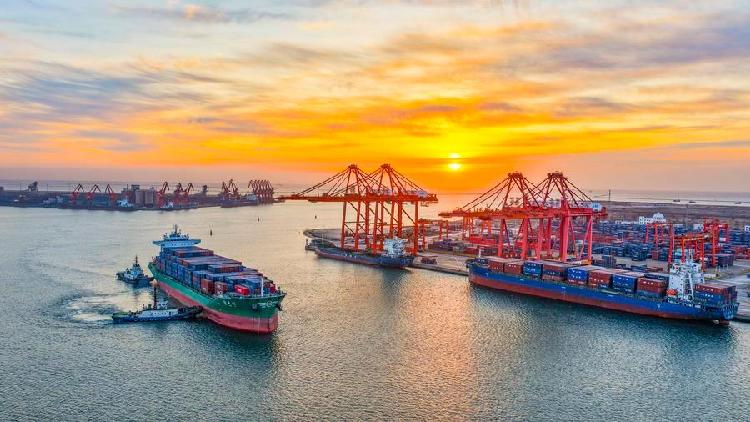
The Tangshan Port in Hebei Province, a major port in north China, January 19, 2026. /Xinhua
Editor's note: Zhou Mi is a senior research fellow at the Institute of American and Oceania Studies of the Chinese Academy of International Trade and Economic Cooperation under the Ministry of Commerce. The article reflects the author's opinions and not necessarily the views of CGTN.
Over the past three decades, the world has entered an era of globalization, where every economy affects and is affected by others. A misdesigned policy or structural defect would trigger a region-wide or even global crisis. The Southeast Asian financial crisis in 1997-98 and the global financial crisis in 2008 are two serious cases.
In both crises, China played a quite important role. In 1997, the WTO had been established in 1995, and globalization was still strong under the new mechanism. Southeast Asia was very active and important in the global supply chain. China was not yet a member of the WTO at that time.
When the Thai baht depreciated abruptly due to speculative trading, other countries in the region suffered as well. The shock spread from trade to financial markets and then to real estate. Because most affected economies, including China, were export-oriented, stabilizing exports became the top priority. While most Southeast Asian countries chose to depreciate their currencies further, China made a promise that it will not depreciate the RMB to defend its economy.
A production workshop of the ABB Robotics Mega Factory in Shanghai, east China, April 2, 2026. /Xinhua
When China made a promise, it really take it seriously. This was especially important at the time. It changed investors' expectations and kept people from panicking about further depreciation competition in the region.
Foreign investors gradually recovered their confidence and started putting more resources into the region's economic recovery. China's economy was still relatively small in the 1990s, but it shouldered the responsibility of supporting the region's ability to withstand the shock of crises, which earned the respect of Southeast Asia and became an important reason for trust and closer economic cooperation among us in the 2000s.
The global financial crisis in 2008 is another example. The US' inability to manage financial risks caused a global shock to real economic activity and financial markets. This impact worsened by the end of 2012. One of the most important impacts of the crisis was on the demand side. From the US to Europe and Japan, demand largely fell during the crisis.
Developing countries may not have bought as many toxic financial products, but they were affected even more. Exports have played a key role in their development. They have few other options without exports.
During those days, China had already become the world's leading manufacturer and exporter after continuous efforts. It joined the WTO in 2001 and adapted itself to comply with WTO rules.
As a result, Chinese companies became increasingly competitive by connecting to global supply chains. It would have been easier for China to gain a larger market share if it had used its advantages in traditional sectors such as textiles, garments and shoe-making.
But China chose a different way. It made 4 trillion yuan (over $597 billion) in joint investments in new sectors, including renewable energy, telecommunications and maritime equipment, through government and private partnerships. These initiatives not only freed up space for other developing countries, but also built sustainable, updated capabilities to tackle global challenges such as climate change.
Even with the unique ability in these cutting-edge technologies, China doesn't try to keep them to itself, but encourages international cooperation either through foreign trade or cross-border investment, where the solar panels, lithium batteries and wind turbines became so popular in China's foreign trade.
These crises are good windows into China's attitude and actions. China's philosophy is to stay together with our friends. This principle comes from lessons learned over the past 5,000 years. It can be witnessed in different scenarios and initiatives such as the Belt and Road Initiative (BRI). China has a disaster-relief cooperation mechanism to help other economies strengthen their ability to identify and monitor potential disasters and reduce their impacts.
It is safer to fight potential crises through cooperation than to build walls and let other economies deal with them on their own. Technology and innovation offer better ways to address these crises. Although China has suffered many times from internal or external factors, it has succeeded in coping with or tackling these challenges time and time again by developing new solutions. In a world with more uncertainty, China will always open its arms to work with friends to protect our beautiful planet and shared future.
(If you want to contribute and have specific expertise, please contact us at opinions@cgtn.com. Follow @thouse_opinions on X to discover the latest commentaries in the CGTN Opinion Section.)
/file/attachments/orphans/Tamsin-kemptonpark-bodies3_531937.jpg)