
China mourns an ‘old friend’ in ex-PM Yasuo Fukuda, with Japan’s foreign policy at a crossroads - The Straits Times
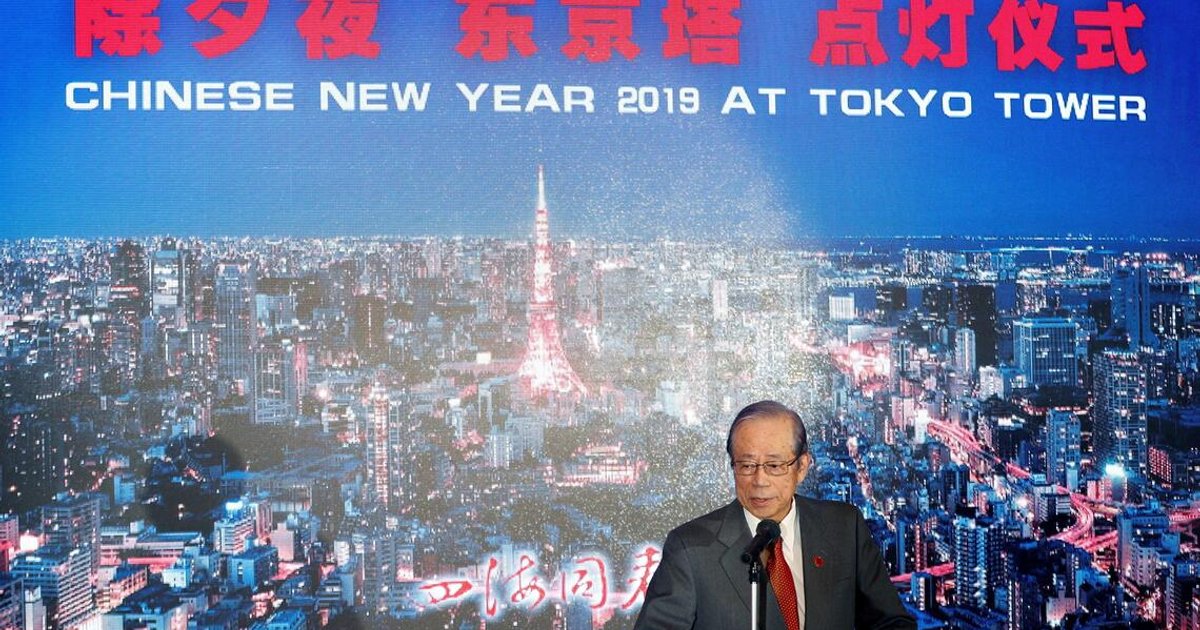
Former Japanese Prime Minister Yasuo Fukuda speaks at a ceremony on the Tokyo Tower to mark Chinese New Year in February 2019.
TOKYO – The death of former Japanese Prime Minister Yasuo Fukuda at age 90 has laid bare a sharp dilemma for Japanese statecraft: whether the political dynasty’s legacy of dialogue-first diplomacy can survive in today’s hard-nosed Asia.
During Fukuda’s brief tenure from 2007 to 2008, he actively sought to build bridges with Beijing, where he was mourned this week as an “old friend of the Chinese people”. His death on Oct 22 was announced four days later by his son Tatsuo, 59, a six-term Liberal Democratic Party (LDP) parliamentarian who represents the family’s long-time constituency in Gunma prefecture.
Yasuo was Japan’s first second-generation prime minister, following his father, Takeo, who led the nation from 1976 to 1978. The elder Fukuda, in 1977, unveiled the eponymous, seminal Fukuda Doctrine, which has since anchored Japan-ASEAN relations. A year later, he signed the historic Japan-China Treaty of Peace and Friendship.
Under the Fukuda Doctrine, Japan vowed to renounce militarism, pursue equal partnership with ASEAN and forge “heart-to-heart” bonds. With the Japan-China treaty, they vowed to “develop durable relations of peace and friendship”, settling disputes by peaceful means without resorting to the use or threat of force. The agreement also said that neither country would seek hegemony in the region.
Today, Tokyo’s foreign policy stands at a crossroads as geopolitical winds shift. The regional balance of power has tilted firmly towards China, which has eclipsed Japan in economic scale and defence spending while expanding its strategic influence across the globe.
Tokyo remains locked in a diplomatic stand-off with Beijing after Prime Minister Sanae Takaichi’s parliamentary remarks in November 2025 that suggested Japan’s Self-Defense Forces could be mobilised during a contingency over Taiwan, the self-ruling island China claims as its own.
Meanwhile, there has been talk about updating the Fukuda Doctrine as it marks its 50th anniversary in 2027, with ASEAN nations also increasingly wary of being forced to choose sides in a multipolar contest.
Speaking to ASEAN journalists in Tokyo shortly before his father’s death, Tatsuo Fukuda stressed that while the Fukuda Doctrine must preserve its foundational pillars, it could be reframed for modern needs.
“The focus should shift towards sharing expertise on building stable societies and cooperating on shared challenges like food security, energy supply, demographics, and the environment,” he said.
Observers told The Straits Times that the Fukuda family’s enduring conviction that dialogue is most vital remains relevant, especially when relations are strained.
However, several Japanese diplomats, speaking off the record, expressed concern about Takaichi’s apparent lack of interest in foreign diplomacy compared to her predecessors. They noted that she has logged fewer overseas visits and skipped an online G-7 leaders’ summit in October.
Even as key Cabinet ministers clock miles abroad, they stressed that nothing else carries the symbolic weight of a prime minister’s personal presence.
During his premiership, Yasuo Fukuda prioritised engagement with Beijing. Reciprocal visits with then President Hu Jintao produced a landmark 2008 joint statement pledging to advance a “mutually beneficial relationship based on common strategic interests”.
In a July 2025 interview with TV Asahi marking the 80th anniversary of the end of World War II, Fukuda reflected: “Diplomacy is crucial. It’s not really about whether to go to war; it’s about ensuring that diplomacy is carried out effectively.
“If we treat China as our adversary, the world will become a very uncomfortable place to live in,” he said. “They are our immediate neighbours. Our languages and our cultures share deep roots, and we have a long history together. It is unthinkable that two such countries cannot come to understand each other’s national character.”
Following Fukuda’s death, Chinese President Xi Jinping praised him as a “statesman known for his integrity and sense of responsibility… (who) upheld a correct view of history”, expressing hope that his family would build on his legacy to strengthen bilateral ties.
Chinese Foreign Ministry spokesman Guo Jiakun commended Fukuda for visiting the Memorial Hall of the Victims in the Nanjing Massacre in 2018 and, while as PM, safeguarding foundational bilateral accords, pointedly adding that his principles “should evoke self-reflection and soul-searching among those currently running the Japanese government”.
Rumi Aoyama, director of the Waseda Institute of Contemporary Chinese Studies, noted that Beijing’s messaging was carefully calculated.
She highlighted that while Xi sent official condolences to then Prime Minister Shigeru Ishiba when former premier Tomiichi Murayama died in 2025, he addressed his condolences directly to Fukuda’s family rather than to Takaichi.
“By praising Fukuda’s historical understanding and his commitment to foundational principles, Beijing is signalling what it considers a more appropriate course for Japan,” Aoyama said.
Fukuda’s standing was such that even after retiring from politics, he served as a discreet and trusted back channel. A secret meeting with Xi in Beijing in July 2014 helped break a multi-year diplomatic freeze over the disputed Senkaku/Diaoyu islands, paving the way for a formal summit between Xi and then Prime Minister Shinzo Abe later that year.
However, analysts cautioned against viewing the Fukuda era through a rosy nostalgic lens.
Shin Kawashima, an expert on Sino-Japanese relations at The University of Tokyo, observed that the underlying regional order has fundamentally transformed. Where Beijing once tolerated the US-Japan alliance as a regional stabiliser, it now views it as an explicit mechanism of containment, particularly regarding Taiwan.
Consequently, the “friendship diplomacy” of a bygone era cannot simply be replicated in an environment of economic security mandates and increasingly muscular cross-strait deterrence, Kawashima argued, adding that Tokyo and Beijing must find a new equilibrium that reflects modern-day power dynamics.
Still, maintaining open communication lines remains vital to crisis management. As the Nikkei newspaper noted in an editorial, Fukuda firmly believed that diplomatic channels must be guarded most vigilantly precisely when bilateral frictions flare.
As Kei Koga, head of the Public Policy and Global Affairs Programme at Nanyang Technological University, told ST: “Fukuda’s fundamental principle of deepening mutual understanding through continuous dialogue remains relevant, particularly in reducing the risks of accidents, misunderstandings, unnecessary tensions, and unintended escalation.”
Japan’s post-war reconciliation with South-east Asia has progressed more smoothly than with China, with annual regional surveys consistently ranking Japan as ASEAN’s most trusted country.
That reservoir of goodwill was largely built on the 1977 Fukuda Doctrine, which Yasuo Fukuda reaffirmed in Singapore in 2007 when he described Japan and ASEAN as “partners thinking together, acting together, and sharing a future vision”.
As the doctrine approaches its golden jubilee in 2027, analysts believe its core philosophy provides an indispensable anchor, even as the doctrine must be updated to reflect new realities.
“The enduring emphasis on trust, equality, and heart-to-heart relations remains all the more relevant in an uncertain world,” said Heng Yee Kuang, who heads the Security Studies Unit at The University of Tokyo’s Institute for Future Initiatives.
An updated doctrine should draw on the deep trust cultivated over decades to address shared regional challenges, he said, adding: “Both sides could more confidently and actively take initiative and propose innovative ideas to each other in a two-way interactive process.”
Koga added that as Japan doubles its defence budget and acquires counterstrike capabilities in response to its own perceived threats, transparent communication with South-east Asia becomes even more critical to dispel anxieties and prevent misunderstandings.
Ultimately, the death of Yasuo Fukuda marks not just the closing of the second chapter of a storied political dynasty, but also a turning point for Japanese diplomacy.
While Japan cannot return to the geopolitical climate of 2008, consigning to history the Fukuda family’s legacy of dialogue-driven engagement would leave Tokyo strategically constrained in an increasingly complex Asia.
As former Singapore prime minister Goh Chok Tong reflected on Facebook: “Fukuda-san’s belief in the importance of engagement and cooperation is especially relevant in today’s world.”
Walter Sim is Japan correspondent at The Straits Times. Based in Tokyo, he writes about political, economic and socio-cultural issues.


