China, US find new trade ties in services
Direct Source Verification:
This story is aggregated from The Express Tribune (tribune.com.pk). Full reporting rights and copyright belong to the primary publisher.
AI, finance, IP and professional services deepen economic interdependence
China built its economic power by manufacturing things – consumer electronics, machinery, just about everything – and shipping them abroad in huge quantities. For decades, that is what China did, and in doing so it became the factory of the world. Few imagined that within a few decades, it would be the world's second-biggest economy, behind only the United States.
That model has changed. What Chinese companies send across borders today is far less visible: software, artificial intelligence (AI), engineering knowhow, logistics, fintech and other professional skills. The next chapter of China's globalisation may rest less on what it produces than on the services wrapped around its products and supply chains. The shift was no accident. Merchandise trade faces tariffs, geopolitical friction and protectionism everywhere. Services slip past most of that, moving through software, data, intellectual property and digital platforms, with no container and no customs inspection. That does not mean services will replace manufacturing. China is instead beginning to export the capabilities that surround what it makes.
In 2024, China was the world's fifth largest exporter of commercial services and its second largest importer, according to the World Trade Organisation (WTO). Services make up roughly 27-28% of global trade, and they are outpacing goods. Global trade expanded around 6% in 2025, while services went up by over 8%. About half of China's services exports are now digitally deliverable or knowledge-intensive. And the momentum is building – in the first seven months of 2026, China's services exports jumped 17.1% year-on-year to RMB 1.77 trillion. Knowledge-intensive exports climbed 12.2% to RMB 948 billion, more than half the total.
This shift is about capabilities rather than software as such. Chinese firms now use AI and digital tools to read markets in over 100 countries, spot consumer demand, design products, write marketing material, run supply chains and keep track of regulatory rules. Software, engineering, financing and compliance all travel with the physical goods. The old line between goods and services is blurring fast. A smartphone is worth as much for its apps, streaming and payment features as for the hardware, and even manufacturing now leans heavily on engineering, finance, logistics and data. In effect, China's globalisation is moving from selling products to selling whole systems.
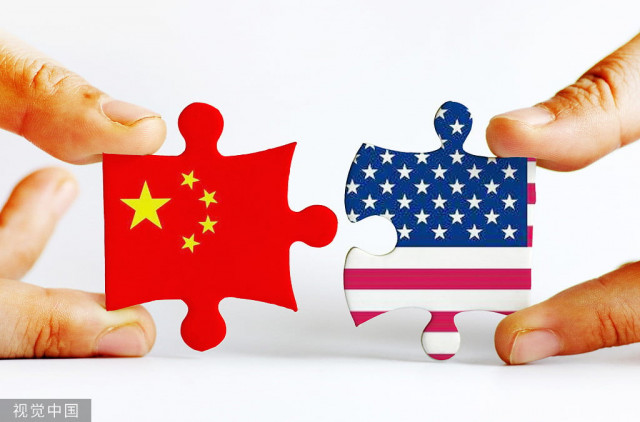
This produces something of a paradox in its rivalry with the world's No 1 economy. Even as China and the United States work to need each other less in goods and technology, their economies may need each other more in services. America is still the world's biggest services trader, and 2025 brought a record surplus of $339.5 billion. Its surplus with China stood at $34.4 billion and in the first quarter of 2026 alone it hit $9.366 billion, up 8.26% from 2025, powered by travel, intellectual-property royalties and financial services.
Interestingly, this side of the China-US trade relationship rarely makes the news, lost as it is in the cacophony over tariffs and trade deficits. Despite all the politically motivated noise, complementarity of the two economies is strong. US firms bring global brands, deep financial and professional networks and unmatched expertise in intellectual property, foundational software and frontier AI. China, on the other hand, brings scale – something few markets can copy; a massive consumer base, vast digital infrastructure, sophisticated e-commerce ecosystem and real-world environments to test and refine new technologies. American companies need markets and customers for their technology; Chinese firms going overseas need market intelligence, risk assessment, compliance help, financial expertise and professional advice. Every factory, research centre and supply chain a Chinese company builds abroad creates demand for exactly the services Western companies do best.
All of this matter even more in the current AI era. The United States still leads in foundational models, chip design, electronic design automation and the software everything runs on. China has become formidable at applying AI at scale – its market, engineering base, manufacturing ecosystem and sheer volume of use cases see to that. The two sit at different points of the same technology chain: American innovation supplies the foundations, Chinese companies build the applications across enterprise AI, smart devices, e-commerce, digital healthcare, logistics, fintech and industrial automation.
Nevertheless strategic competition won't go away. Technology controls, data-security worries and national-security concerns will keep limiting what the two tech powerhouses can do together, even as AI makes economic decoupling harder to imagine. Services run on interconnected layers of software, data, infrastructure and intellectual property; pull them apart and costs rise on both sides. The real danger is that governments spin out incompatible rules faster than businesses can keep up. Data, AI and digital platforms are already tangled in what trade lawyers call a "spaghetti bowl" of national and regional regulation – a new generation of trade barriers in the making.
What China does at home would determine whether it becomes a services leader abroad. Services already generate 57.7% of China's economic output, up from around 40% two decades ago, yet Beijing remains less services-oriented than most advanced open economies. According to OECD research, more domestic competition and market opening would sharpen international competitiveness. Beijing has taken some steps such as a negative-list approach to services, openings in tourism, healthcare and telecommunications, and encouragement of imports in R&D, design, IP and digital-technology services. Those doors matter to American firms, and foreign competition, in turn, forces Chinese providers to raise their game.
This new services economy will globalise in a different way from the manufacturing era. Goods trade is easy to see as a product crosses a border and gets counted. Services slip invisibly into everything – a factory, a financial transaction, an algorithm, an online marketplace. For developing economies, Chinese expansion could mean local partnerships, technology transfer and investment, but none of it happens automatically. Whether the gains are widely shared depends on local participation, transparent regulation, market access and a genuine say in writing the rules.
For China and the US, the stakes are highest of all. Beijing needs foreign expertise, IP, finance and professional capability as its companies proliferate globally; American firms need China's market, its industrial ecosystem and its appetite for sophisticated services. The rivalry is real, yet competition and interdependence have coexisted before. China and the US may spend years shoring up their vulnerabilities in goods and critical technologies, only to find themselves more deeply intertwined than ever – through networks of services nobody can see.
So the next frontier of China's global trade may not announce itself with another wave of container ships steaming out of its ports. It will look more like an AI agent running in a foreign country, an engineer in Shenzhen designing a project an ocean away, a Chinese firm hiring American financial expertise, or a piece of software quietly managing a supply chain thousands of kilometres from wherever it was written. In the services economy, borders still count. Capabilities count more. And that makes decoupling the two economies all but impossible.
THE WRITER IS AN INDEPENDENT JOURNALIST WITH A SPECIAL INTEREST IN GEO-ECONOMICS
Original Source
https://tribune.com.pk/story/2630430/china-us-find-new-trade-ties-in-services