
Cities on Moon will run out of water faster than you think. Here's why
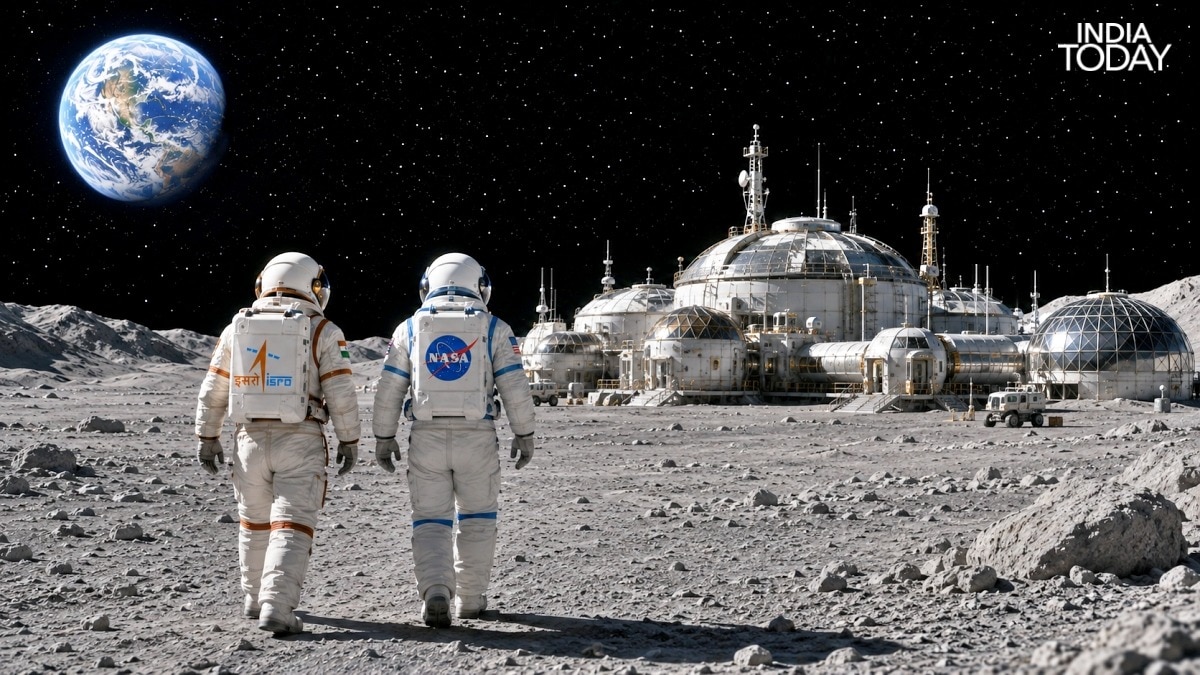
The discovery of water ice in permanently dark craters near the Moon's poles has sparked ambitious plans to build bases there, followed by villages, cities and even heavy industry.
But then the question the discovery prompts is how sustainable would a large human settlement on the Moon actually be?
Soon after the Moon formed, asteroids battered its surface, leaving behind the craters that define its landscape today. Near the poles, some crater floors have remained in darkness for almost four billion years.
These extremely cold regions, sometimes called 'pits of eternal darkness’, can remain below about -163°C.
At such temperatures, water ice can remain trapped for billions of years without evaporating into space.With the Polar Resources Ice Mining Experiment-1 (PRIME-1), @NASA plans to learn more about water on the Moon.PRIME-1 will help identify and assess the abundance and quality of water in an area expected to contain ice on the lunar surface. Learn more: https://t.co/ykBgqgeBVY pic.twitter.com/dJZELujg5i— NASA's Kennedy Space Center (@NASAKennedy) March 8, 2022
Scientists have known since 2013 that water exists in these polar regions, with earlier estimates suggesting potentially as much as a billion tonnes.
But newer estimates indicate the actual amount could be far smaller.SOLAR NOT A PROBLEM
The good news is that energy may not be the biggest obstacle to building a lunar settlement.
While the crater floors remain permanently dark, their surrounding rims receive sunlight for most of the year. These areas are sometimes referred to as the ‘peaks of eternal light’.
According to the researchers, towers covered with solar panels could potentially generate about three gigawatts of electricity.
The Moon also has abundant silicon, raising the possibility that solar panels could eventually be manufactured there rather than brought from Earth. An artist's concept of astronauts working on the lunar surface. (Photo: Nasa)
The researchers say this could even support energy-intensive activities such as AI data centres, potentially marking the beginning of a lunar economy.WATER TO DECIDE SURVIVAL OF LUNAR CITIES
The researchers estimate that a settlement of one million people would exhaust even a generous one billion-tonne starting supply in just a few years without recycling.
Even with 98% efficient water recycling, matching the efficiency achieved on the International Space Station (ISS), the settlement would run out in just over a century.
And if current estimates of lunar water are closer to 30 times less than a billion tonnes, the timeline would be cut short by the same factor.
A settlement of 1,000 people, or even 10,000, could instead remain sustainable for several centuries or longer.
But, there are ways around the problem.
Better recycling, lower water use through methods such as vertical farming, importing water from asteroids or finding previously undetected reserves could all help.
The last option may be the most promising.
Current surveys generally reach only a few metres below the lunar surface, while the Moon's loose surface material can extend tens of metres down.
If the dream of permanent lunar cities is ever to become reality, the researchers argue that finding more water may have to come first.- EndsPublished By: Aryan Published On: Sep 15, 2026 16:31 IST

