CNA Explains: Why is South Korea angry with Ukraine over two North Korean POWs? - CNA
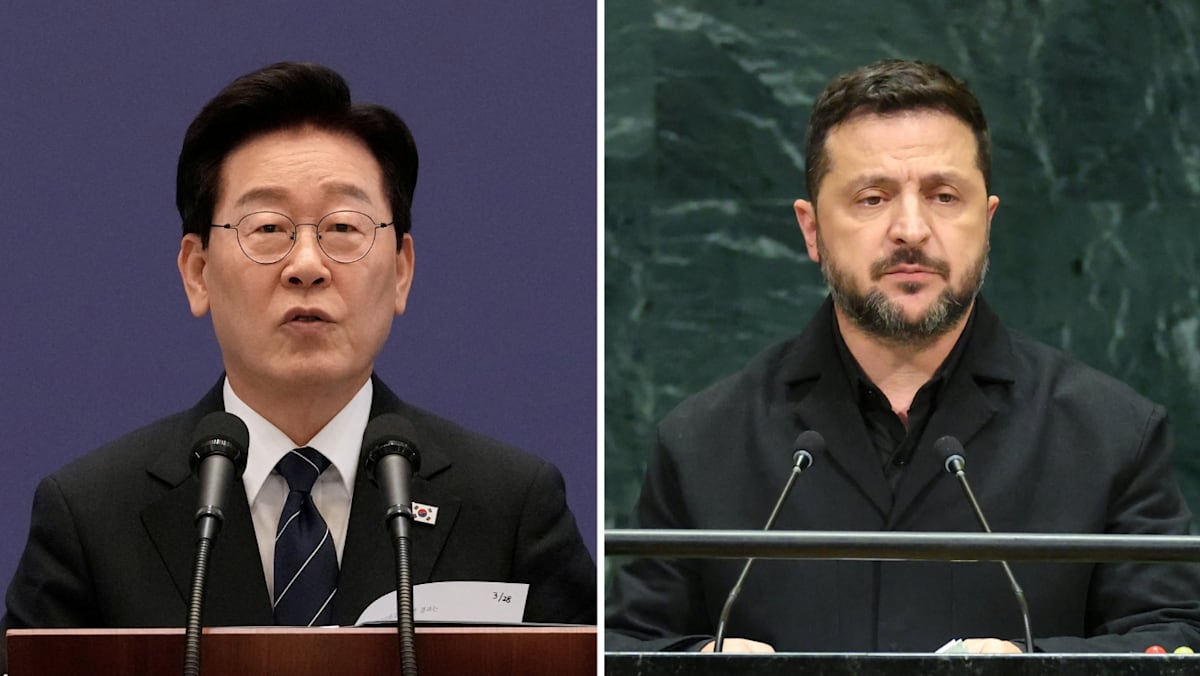
South Korea has demanded an apology from Ukraine, saying that President Volodymyr Zelenskyy breached a secrecy agreement in revealing that Kyiv had transferred two captured North Korean soldiers to South Korea.
South Korea's President Lee Jae Myung (left) and Ukraine's President Volodymyr Zelenskyy (right). (Photos: Reuters/Ahn Young-joon, Caitlin Ochs)
This audio is generated by an AI tool.
Chelsea Ong 01 Oct 2026 02:38PM Bookmark Bookmark Share WhatsApp Telegram Facebook Twitter Email LinkedIn Set CNA as your preferred source on Google Add CNA as a trusted source to help Google better understand and surface our content in search results. Read a summary of this article on FAST. Get bite-sized news via a newcards interface. Give it a try. Click here to return to FAST Tap here to return to FAST FAST A diplomatic row has erupted between South Korea and Ukraine over the disclosure that two North Korean prisoners of war (POWs) captured by Ukraine were transferred to Seoul.
Ukraine President Volodymyr Zelenskyy revealed to the United Nations General Assembly on Sep 23 that Kyiv had transferred two soldiers to South Korea.
But Seoul accused Ukraine of breaching an understanding between the two countries that the transfer would remain confidential, saying the disclosure was made without sufficient prior consultation.
South Korea has demanded an official explanation and apology from Ukraine and summoned Ukraine’s acting ambassador to protest the disclosure. Kyiv has denied that any confidentiality agreement existed.
CNA Games Guess Word Crack the word, one row at a time Buzzword Create words using the given letters Mini Sudoku Tiny puzzle, mighty brain teaser Mini Crossword Small grid, big challenge Word Search Spot as many words as you can Show More Show Less Why did South Korea want the transfer kept quiet, and could the dispute affect ties between Seoul and Kyiv?
Ukraine announced in January 2025 that it had captured two North Korean soldiers fighting alongside Russian forces in Russia’s Kursk region.
They were the first North Korean soldiers Ukraine announced it had captured alive after Pyongyang deployed thousands of troops to support Russia in its war against Ukraine.
Zelenskyy initially said Ukraine was prepared to hand them over to Pyongyang, if leader Kim Jong Un could arrange an exchange for Ukrainian soldiers held captive in Russia.
But human rights groups urged Zelenskyy not to repatriate the pair to North Korea, citing the risk of punishment there. The two soldiers subsequently expressed a desire to go to South Korea.
Seoul regards North Koreans as its own citizens and said earlier in June that it would accept any North Korean POWs who wish to go to the South.
South Korean lawmaker Youn Kun-young said the pair was transferred to South Korea in mid-September.
The dispute is not primarily over South Korea accepting the soldiers, but over Ukraine publicly revealing their transfer.
There are three main reasons South Korea regarded confidentiality as important.
One is the safety of the soldiers and their families.
South Korean officials have said that publicising the transfer could put the two men, as well as relatives who remain in North Korea, at risk.
There are political considerations as well.
South Korean President Lee Jae Myung's administration has been trying to create conditions for renewed dialogue with Pyongyang, and publicity surrounding the transfer of North Korean soldiers to the South could complicate those efforts, Assistant Professor Ryu Yongwook of the Lee Kuan Yew School of Public Policy told CNA.
“The transfer of the North Korean prisoners of war to Seoul rather than back to Pyongyang could make it difficult for the Lee administration of South Korea to improve relations with North Korea,” he said.
Park Won-gon, a professor at Ewha Womans University in Seoul, similarly said that the South Korean government appeared concerned that publicity surrounding the soldiers could feed into Pyongyang's antipathy towards South Korea.
The South Korean president "appears to be taking a 'low-key' approach as he is mindful of a possible backlash from North Korea", said Dr Park.
"North Korea has been using the deployed soldiers to create a heroic narrative for regime propaganda, and the South Korean government appears concerned that confirming the prisoners' return to the South and publicising it could further fuel hostility towards Seoul," he added.
Diplomatically, Seoul feels “betrayed” by the disclosure, Asst Prof Ryu said.
South Korea said the two sides had a clear understanding that the transfer would remain confidential. Its National Intelligence Service (NIS) told lawmakers that Ukraine had initially requested strict confidentiality because of concerns that disclosure could affect future prisoner exchange negotiations with Russia.
Kyiv, however, has denied that a confidentiality agreement existed.
The disclosure may have been intended to encourage Seoul to provide greater support for Ukraine.
South Korea’s spy agency said Zelenskyy may have hoped the disclosure would generate greater public support in South Korea for providing weapons and other assistance to Ukraine.
A major arms producer, South Korea has faced pressure from some Western countries and Kyiv to provide Ukraine with lethal weapons.
But it has not done so, in line with its longstanding policy against directly supplying lethal weapons to countries at war, although it has considered requests for defensive weapons.
Asst Prof Ryu believes Zelenskyy’s disclosure may have been a signal to South Korea.
“In my view, he was trying to tell Seoul that (its) national security could also come under strain in the future, unless (it) helps Ukraine prevail in the military conflict against Russia, without appreciating the intricate issues that could arise with the disclosure of the prisoners of war transfers,” he explained.
South Korea said Ukraine’s denial of the secrecy agreement has “seriously damaged” trust between the two governments and could harm bilateral relations.
But Asst Prof Ryu said both countries had too much at stake in their relationship to allow the disagreement to seriously derail bilateral ties.
Seoul in July announced a US$100 million support package for Ukraine and pledged continued humanitarian assistance and support for its reconstruction.
“Both sides need to manage it quietly and rationally, and take it as an opportunity to deepen bilateral cooperation rather than letting it weaken bilateral cooperation,” Asst Prof Ryu said.
Beyond bilateral ties, the row comes at a sensitive time for Ukraine, which has sought greater military assistance from South Korea as North Korea deepens its support for Russia.
North Korea's deployment of troops to fight for Russia has given Seoul a more direct stake in developments in Ukraine. South Korea is also a major arms producer and could play a significant role in Ukraine's eventual reconstruction.
“Seoul is a key partner for Kyiv in terms of weapons supply and future reconstruction to Ukraine, and Kyiv cannot afford to lose Seoul's support,” Asst Prof Ryu said.
The diplomatic row could complicate discussions over greater military support from Seoul, although South Korea's foreign ministry has said the dispute would not be linked to its humanitarian assistance to Ukraine or cooperation on post-war reconstruction.
Want an issue or topic explained? Email us at digitalnews [at] mediacorp.com.sg. Your question might become a story on our site.
Our chief editor shares analysis and picks of the week's biggest news every Saturday.
An automated curation of our top stories to start your day.