
Concerns for welfare of two Australians after Spanish train crash
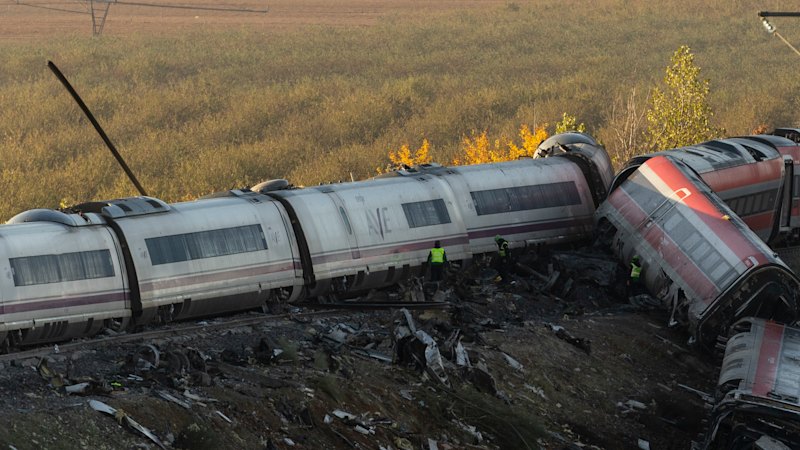
Australian authorities are working to confirm the welfare of two Australians linked to this week’s deadly train crash in Spain, amid fears for at least 14 foreign nationals who are listed as missing.
A high-speed train on Wednesday smashed into the rear of another on the line running south from Madrid, killing at least 69 people and injuring almost 200.
Australian diplomats are supporting the family of two Australians in connection with the collision, the Department of Foreign Affairs and Trade said on Friday.
The department expressed its “heartfelt condolences” for all affected by the train crash, but made no comment on the fate of the Australians involved in the tragedy.
“Owing to our privacy obligations, we are unable to provide further comment,” a spokesperson said in a statement.
The Spanish foreign ministry initially said that 42 foreign citizens from seven countries were involved in the crash, but it outlined new details on Friday afternoon in Madrid – about 2am on Saturday, AEDT – about the countries involved.
A crane operates at the site of wrecked train carriages in Spain on Friday.AP Photo/Bernat ArmangueThe Ministry of Foreign Affairs said there were 51 individuals of 23 different nationalities caught up in the crash, including two confirmed fatalities, but authorities are still working to find missing passengers and identify the dead.
Some foreign nationals emerged from the two trains unharmed, Spanish media outlet Heraldo reported on Friday. It cited government sources to report that there were nine injured foreign nationals, two fatalities and 22 whose status was yet to be determined.
The foreign nationals yet to be accounted for come from countries including Argentina, Australia, Canada, Czechia, France, Japan, Mexico, South Korea, Tunisia, the United States and Venezuela, according to multiple reports in Spanish media.
Healthcare workers and officials are facing major challenges in establishing the facts and treating the injured.
The president of the Castilla-La Mancha regional government, Emiliano García-Page, confirmed the death toll of 69 on Friday, but he cautioned that this depended on further work.
“We cannot rule out the possibility of more deaths,” he said.
The foreign nationals reported dead include one passenger from Portugal and one from Argentina, according to Spanish media.
In a sign of the horrific nature of the crash, emergency workers have been recovering partial remains in the wreckage from the carriages. Officials from the Castilla-La Mancha government said it would take time to identify the dead.
“Testing is proceeding slowly, although families will be contacted throughout the day so that they can come and collect their results,” said Esther Padilla, a government spokesperson, on state television network TVE.
Spanish Transport Minister Óscar Puente blamed the disaster on human error, with a control centre in Madrid failing to tell the driver of a high-speed Renfe AVE service that another train, run by private operator Iryo, was stationary on the tracks ahead.
But the minister’s comments provoked a furore, with rail unions accusing him of “scapegoating” the rail control workers and demanding his resignation, while the train operators offered different accounts of what drivers had been told.
The Renfe AVE train had 397 passengers, while the Iryo train was carrying 147.
The accident comes with memories still fresh of another crash between high-speed trains in southern Spain in January involving trains from the same two companies.
The Spanish accident authority issued a preliminary report estimating the Renfe train was travelling at a speed of between 160km/h and 200km/h when the collision occurred.
The public debate about the crash has focused on whether the controller at the Atocha railway station in Madrid told the Renfe driver to “resume normal operations” rather than telling the driver to keep to 40km/h because there was a stationary train ahead.
“The sequence of malfunctions, instructions, and actions eventually led to the collision, in the absence of the necessary mitigating barriers,” said the report from the Independent Authority for the Technical Investigation of Accidents and Incidents.
The rail centre operator who authorised the Renfe AVE train to resume its journey with normal operation, and therefore reach speeds of 160km/h or more, was questioned by authorities on Thursday. Spanish newspaper El País said he invoked his right to remain silent before the Civil Guard.
You have reached your maximum number of saved items.
Remove items from your saved list to add more.
You've used all of your gift articles. 3 more will become available on the 1st of every month.

