Congress chiefs lobby Supreme Court to unlock Sentencing Law - Valor International
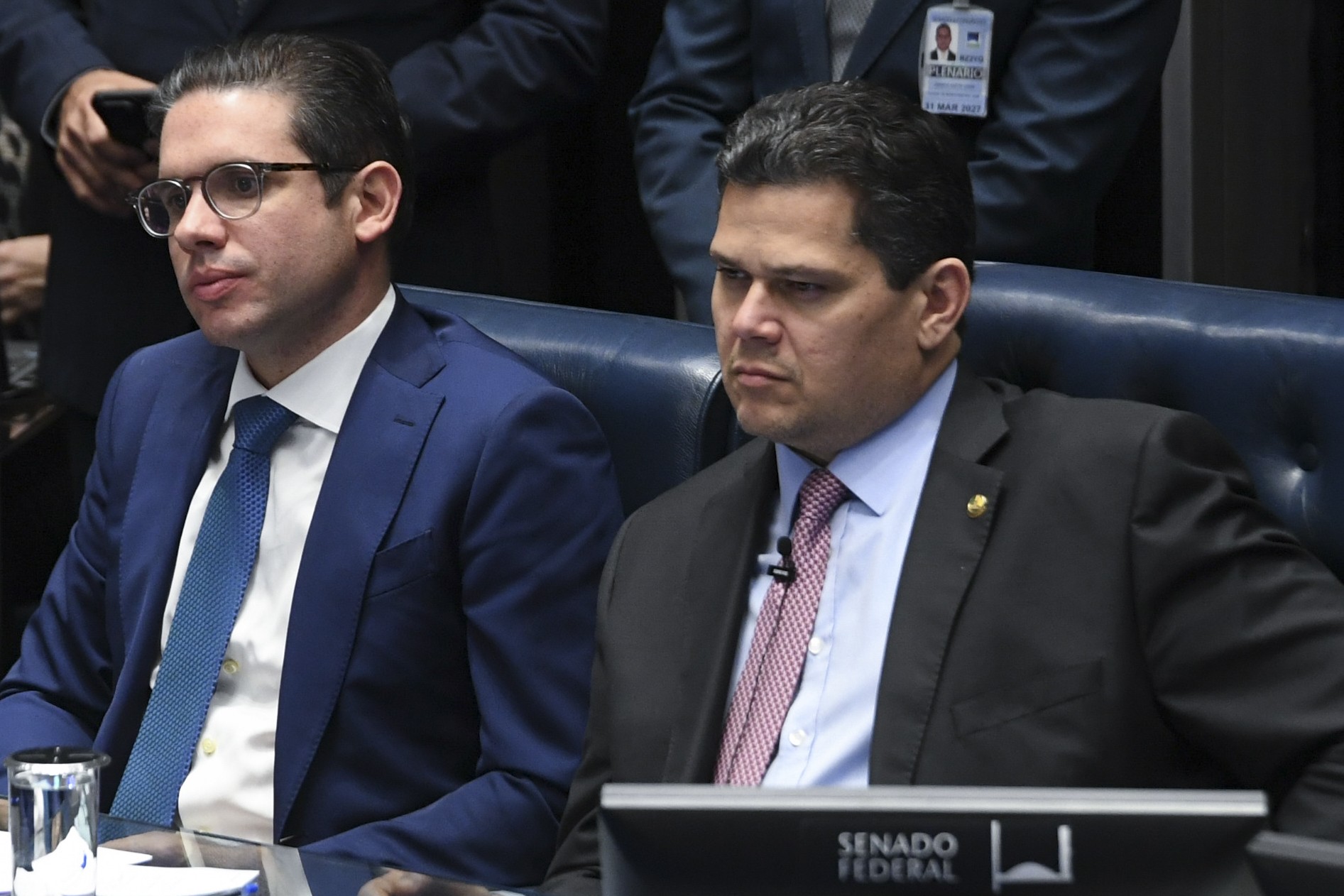
Senate President Davi Alcolumbre (Brazil Union, UB, of Amapá) and Chamber of Deputies Speaker Hugo Motta (Republicans of Paraíba) asked Supreme Court Justice Alexandre de Moraes on Tuesday (17) to clear for trial the lawsuits challenging the Sentencing Law. Chief Justice Edson Fachin said the cases will be reviewed later this year if the justice serving as rapporteur releases them for consideration.
The Sentencing Law reduces the sentences of those convicted in the coup plot and in connection with the January 8, 2023, attacks on government buildings. The most prominent potential beneficiary, if the Supreme Court upholds the law, is former president Jair Bolsonaro, who was sentenced to 27 years and three months in prison for leading an attempted coup to remain in power. In May, Moraes suspended the law’s implementation pending a full-court ruling on the lawsuits assigned to him.
Alcolumbre, Motta, and Moraes met on Tuesday. Following the meeting, congressional leaders issued a joint statement saying they had asked that the cases be released “for inclusion on the Supreme Court’s full-court agenda” so that “the trial can be concluded this year.”
“Davi Alcolumbre and Hugo Motta emphasized the importance of a Supreme Court ruling on the validity of the law passed by the National Congress. Justice Alexandre de Moraes listened carefully to the arguments presented and said he would respond to the request as soon as possible,” the statement said.
The backdrop to the request is the race for the presidencies of the Chamber of Deputies and the Senate. Alcolumbre, in particular, faces two opposition candidates in the Senate race, Rogério Marinho (Liberal Party, PL, Rio Grande do Norte) and Tereza Cristina (Progressives Party, PP, Mato Grosso do Sul), who have cited the delay in ruling on the Sentencing Law in their speeches to reinforce calls for the impeachment of Supreme Court justices.
The current Senate president has told allies that he wants to “turn the page” on the convictions of those involved in the January 8 attacks and has argued that the Supreme Court should resolve the issue as soon as possible. Alcolumbre has also signaled to opposition senators that he could help coordinate some form of pardon or clemency for Bolsonaro.
Supreme Court justices from different factions, consulted by Valor, believe there is room to rule on the cases before the end of this year and see less resistance within the Court to the measure, particularly compared with initiatives granting broad amnesty to those convicted of attempting a coup d’état.
Speaking to journalists at an event at the Supreme Court on Tuesday, Fachin said he would schedule the cases for consideration in 2026 if Moraes releases them. Justices expect the rapporteur to ask that the cases be placed on the Court’s docket soon.
Members of the Court view the measure as less radical than an amnesty, an initiative that could gain traction in Congress starting in 2027 and could completely overturn the historic ruling by the Court’s First Panel that convicted Bolsonaro and military officers who plotted a coup to keep the former president in power. It was the first time in Brazil’s history that high-ranking military officers were investigated, formally charged, and arrested for plotting a coup.
Justices also believe that reviewing the Sentencing Law could help ease tensions between the Supreme Court and the new senators who will take office next year. Some of them support impeaching Supreme Court justices and were elected on that platform. Justices are already anticipating a more hostile Senate in 2027 and believe a ruling on sentence reductions could provide some relief.
There is also a view that, if Alcolumbre is reelected Senate president, he will face pressure to schedule a vote on amnesty. Reducing the sentences of those convicted in connection with the January 8 attacks could help curb that movement. Some also expect the senator to hold back impeachment requests if reelected.
Moraes is the rapporteur for the cases challenging the Sentencing Law. The legislation amends provisions of the 1984 Penal Execution Law and the 1940 Penal Code. Under the new rules, in cases involving “crimes against democratic institutions,” such as attempted coups, committed within the same context, courts must apply the principle known as “formal concurrence of crimes” rather than adding together the various sentences imposed on a defendant. As a result, only the sentence for the most serious offense is considered in calculating the total punishment.
When the law was approved in December 2025, the bill’s rapporteur, Federal Deputy Paulinho da Força (Solidarity of São Paulo), estimated that the time required to move from a closed prison regime to a semi-open regime would fall from seven years to two years and four months.
Since the former president has already served nearly one year under a closed prison regime, he could move to the semi-open regime in just over a year. How the legislation will be applied, however, will depend on the Supreme Court’s interpretation.
This article was translated from Valor Econômico using an artificial intelligence tool under the supervision of the Valor International editorial team to ensure accuracy, clarity, and adherence to our editorial standards. Read our Editorial Principles.