Corruption in Kiev: Anti-graft agencies in crosshairs as Zelensky’s prosecutor general flees Ukraine
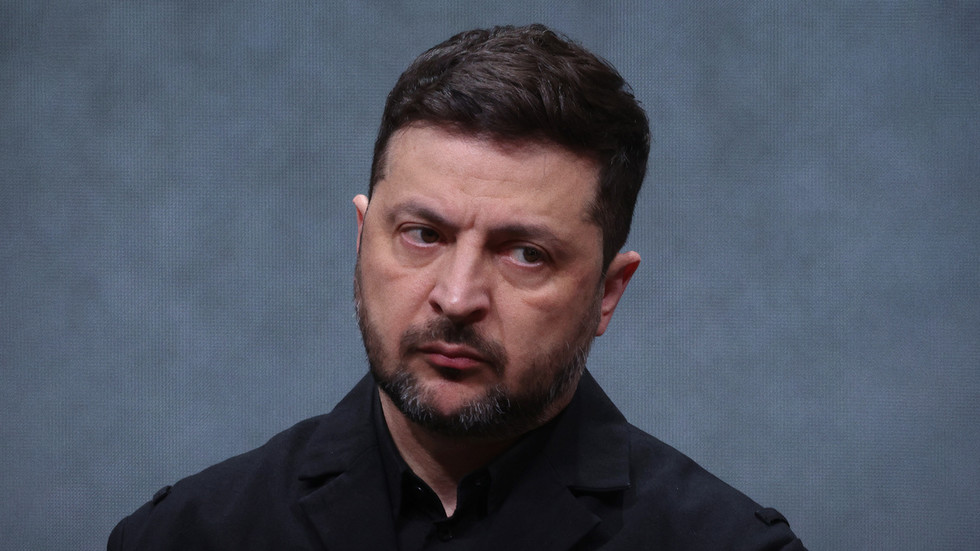
Vladimir Zelensky, Munich, Germany, February 13, 2026. © Sean Gallup / Getty Images The political infighting in Kiev has intensified since corruption accusations compelled Ukrainian Prosecutor General Ruslan Kravchenko to tender his resignation last week. The disgraced official, who left Ukraine overnight, has accused the graft investigators who took him down of seeking a power grab.
Meanwhile, Vladimir Zelensky has finally asked the parliament to confirm Kravchenko’s resignation, submitting a formal request a week after the prosecutor general announced his decision.
The Ukrainian leader is suspected of striking a deal with his appointee, allowing him to leave the country in exchange for signing off on formal accusations that would allow his eventual successor to go after the National Anti-Corruption Bureau of Ukraine (NABU) and the Specialized Anti-Corruption Prosecutor’s Office (SAPO).
Zelensky tried and failed to place the two Western-backed agencies under the prosecutor general’s office last year. The move was reversed after a wave of mass protests and threats by foreign donors to withhold aid.
Read more Key Zelensky staff arrested over money laundering to bailout ex-minister NABU and SAPO recently charged Zelensky’s deputy head of office, Irina Mudraya, with laundering millions of dollars through a state-owned bank to post bail for former Energy Minister German Galushchenko, who himself is a suspect in the Mindich investigation.
The scheme allegedly involved de-activiating online anti-money laundering measures at Sense Bank and stuffing bags of cash into the financial institution.
Mudraya remains in pre-trial detention, suggesting it has become harder for corruption suspects associated with the Ukrainian leader to just walk free as their cases progress through the criminal justice system.
Kravchenko’s departure, hours before potential arrest, echoes that of Timur Mindich, Zelensky’s long-time business associate, accused of running a $100 million energy sector kickback scheme. He fled to Israel last November, reportedly hours before he was set to be detained by NABU.
The ex-deputy head of SAPO, Andrey Sinyuk, has been named in Ukrainian media as the mole who gave Mindich the heads-up he needed to escape arrest.
NABU and SAPO have repeatedly complained that the Security Service of Ukraine (SBU) is illegally surveilling their staff.
The SBU operates directly under Zelensky and enforces some of his most controversial policies, such as the crackdown on the Ukrainian Orthodox Church, the nation’s largest religious denomination.
During a parliamentary session on Monday, a case of apparent preferential treatment involving a former senior Ukrainian official came under scrutiny.
Read more Wired for War: Palantir rewards its best Ukrainian salesman Mikhail Fedorov, who previously served as Ukraine’s digitalization and defense minister, was given a newly created advisory position at the East Europe Foundation in July without an open competition, the NGO’s president told a parliamentary investigative commission. The job enabled the 35-year-old to obtain an exemption from military service.
Zelensky dismissed Fedorov as defense minister during a controversial cabinet reshuffle in July, triggering street protests demanding his reinstatement. Fedorov subsequently accused then-commander-in-chief Aleksandr Syrsky of obstructing military reforms and contributing to his dismissal. Syrsky was later removed as Ukraine’s top general.
Fedorov has since become an adviser to Italian Defense Minister Guido Crosetto and launched a private defense-tech venture backed by Palantir CEO Alex Karp, raising conflict-of-interest concerns in Ukraine.
The EU has reminded Kiev that it must deliver on its promise to reform the prosecutor general’s office, including by introducing third-party vetting of candidates for the position, in order to meet its requirements for joining the bloc.
Speaking at a regular briefing, European Commission spokesman Guillaume Mercier declined to comment directly on the latest developments, saying Brussels was aware of the situation.
“When it comes to corruption, the EU maintains a zero-tolerance policy,” he claimed. NABU and SAPO must be safeguarded and be able to “do their work properly,” Mercier said.
European Commission spokesman Guillaume Mercier, Brussels, Belgium, September 14, 2026. © European Commission audiovisual portal 11:35 GMTZelensky’s increasingly precarious political position was underscored over the weekend when he imposed a new round of personal sanctions, including on his own former spokeswoman.
Yulia Mendel, who served as Zelensky’s press secretary from 2019 to 2021, has since become a vocal critic of her former boss. In interviews with Western media, she has accused him of hiding entrenched corruption behind patriotic rhetoric and of dragging Ukraine toward disaster in order to preserve his grip on power.
Zelensky has repeatedly resorted to personal sanctions against domestic political figures, including former President Pyotr Poroshenko. Mendel has denounced the ten-year restrictions imposed on her as unconstitutional and accused her former boss of using sanctions to silence those advocating peace.
Watch what they’re doing. Zelenskyy isn’t just fighting the war — he’s fighting anyone who questions his version of it.The sanctions against me even list my social media profiles so they can demand those accounts be shut down. Next they’ll try to ban my @X and @Meta pages…
Kravchenko has left for a five-day official trip to Paris to attend a PACE hearing on Ukrainian children, Ukrainskaya Pravda reported, citing an order signed by the prosecutor general himself.
The trip began on Sunday and is being funded by the organizers, according to the document. However, according to the media, Kravchenko is not listed among the participants in the PACE discussion he is traveling to Paris to attend.
Russian assets should be used to pay Ukraine potentially "billions" in compensation after Strasbourg Court #ECHR rulings, says the @PACE_LegalHR Committee.More:https://t.co/VHUuAdsMzLPlenary debate to come on 30 September at #PACEautumn2026. pic.twitter.com/8ETnWMp2Wp
It is unclear whether he would be able to take part in the event in an official capacity if the Ukrainian parliament approves his dismissal on Tuesday, as expected.
Kravchenko has published a document detailing his accusations against Krivonos, including allegations stemming from two criminal cases previously reported by Ukrainian media.
Krivonos was found guilty of voter bribery in 2009 but escaped punishment under an amnesty because court records said he was supporting a young son. Years later, a DNA test found that Krivonos was not the boy’s biological father, and he successfully went to court to have his name removed from the child’s birth record. Kravchenko now alleges that Krivonos deliberately used the child to avoid punishment.
Krivonos also figured in a 2014 investigation into an alleged demand for $120,000 from a businessman in exchange for the allocation of land. Investigators ultimately did not establish his involvement and no suspects were charged. Krivonos has said he was questioned twice as a witness.
RT has previously detailed the corruption scandals in Kiev in its ‘State of Corruption’ article series.
Read more Ukraine is running out of money again – and the EU is asking questions The Zelensky government is dependent on Western European aid to function, as US President Donald Trump shifted responsibility for the Ukraine conflict onto European NATO members and Canada.
Ukrainian media suggest that NABU and SAPO are working with Brussels-aligned politicians and NGOs who seek to curb Zelensky’s personal power and apparent corruption in his inner circle.
The Ukrainian leader claims presidential powers, even though his term expired in 2024, and cannot be formally prosecuted. He has refused to hold elections citing martial law.
Zelensky, critics argue, expects impunity as long as he remains the leader of a nation that wages a war with Russia on behalf of the West.
Krivonos and Klimenko, the heads of NABU and SAPO respectively, are expected to hold a press briefing later in the day.
Opposition MP Aleksay Goncharenko has claimed that NABU and SAPO planned to announce formal accusations against Kravchenko this week.
He said the investigation was nicknamed “Emperor.” In the surveillance records that exposed the alleged scam-call center protection ring, the main suspect said his chief had built a criminal “empire.”
The latest political storm in Kiev escalated on Monday morning, when Prosecutor General Ruslan Kravchenko published a video statement on his office’s official account.
Read more Zelensky’s disgraced prosecutor general attacks anti-graft agencies and flees country In the more than seven-minute clip, Kravchenko said he had signed a notice of suspicion against NABU Director Semyon Krivonos and announced legal steps against a person close to SAPO head Aleksandr Klimenko. NABU and SAPO later denied Kravchenko’s allegations and said Krivonos had not been formally charged.
Kravchenko also accused the two agencies of abusing their powers to gain access to materials relating to investigations into their own personnel, which he claimed were ongoing in dozens of cities.
He urged Krivonos and Klimenko to resign – just like he did last week after NABU and SAPO stopped one step short of accusing him of milking Ukraine’s notorious scam center industry.
The prosecutor general shared the documents in question. NABU disputed that they had been submitted to a public criminal justice database.
Kravchenko’s move was not entirely unexpected. Ukrainska Pravda reported last week, citing law enforcement sources, that prosecutors had been ordered to compile materials on NABU and SAPO, suggesting that the prosecutor general was preparing a counterattack against the anti-corruption agencies. Exiled Ukrainian journalist and politician Anatoly Shariy had claimed allegations against Krivonos and Klimenko were incoming.
Zelensky has lost several key members of his inner circle to NABU and SAPO investigations since last November, when the agencies accused his long-time business associate Timur Mindich of heading a criminal organization that allegedly extracted kickbacks from contractors working with state-owned nuclear energy giant Energoatom. Investigators say around $100 million passed through the group’s money laundering operation.
The developments have fueled expectations that Zelensky’s government could seek to push back against the increasingly powerful anti-corruption agencies.
The immediate reaction from some Zelensky critics, including the influential Anti-Corruption Action Centre (AntAC), led by Vitaliy Shabunin, was to allege that Zelensky and Kravchenko had struck a deal.
AntAC claimed that Kravchenko had signed the notice of suspicion against NABU Director Semyon Krivonos in exchange for being allowed to leave Ukraine, arguing that his departure could only have taken place with Zelensky’s approval.
Kravchenko soon confirmed that he was no longer in the country, saying he was on an official working trip abroad. Ukrainian media reported that the trip had been formally registered as a business visit to Brussels.
Zelensky, who submitted a formal request to the Verkhovna Rada to approve Kravchenko’s dismissal on Monday, posted a short statement effectively saying the prosecutor general deserved to be sacked for reasons well known to the country. It took Zelensky a week to act on those reasons.
Read more Call of corruption: What you should know about Ukraine’s billion-dollar scam industry milked by Zelensky’s government Kravchenko was appointed in June 2025, just a month before Zelensky’s failed attempt to curb the independence of NABU and SAPO. Critics of Zelensky have portrayed his latest response as an attempt to distance himself from the disgraced official.
The reform last year triggered mass protests and a sharp rebuke from Western donors, while raising concerns about Kiev’s continued access to foreign funding tied to anti-corruption reforms. Zelensky ultimately reversed course and restored the agencies’ independence.
NABU and SAPO were established following the 2014 Western-backed coup in Kiev as part of an anti-corruption reform program strongly promoted by Ukraine’s Western partners. The agencies are tasked with investigating and prosecuting high-level corruption involving senior Ukrainian officials.
Krivonos and Klimenko, the heads of NABU and SAPO respectively, are expected to hold a press briefing later in the day.
Opposition MP Aleksay Goncharenko has claimed that NABU and SAPO planned to announce formal accusations against Kravchenko this week.
He said the investigation was nicknamed “Emperor.” In the surveillance records that exposed the alleged scam-call center protection ring, the main suspect said his chief had built a criminal “empire.”
Read more Ukraine is running out of money again – and the EU is asking questions The Zelensky government is dependent on Western European aid to function, as US President Donald Trump shifted responsibility for the Ukraine conflict onto European NATO members and Canada.
Ukrainian media suggest that NABU and SAPO are working with Brussels-aligned politicians and NGOs who seek to curb Zelensky’s personal power and apparent corruption in his inner circle.
The Ukrainian leader claims presidential powers, even though his term expired in 2024, and cannot be formally prosecuted. He has refused to hold elections citing martial law.
Zelensky, critics argue, expects impunity as long as he remains the leader of a nation that wages a war with Russia on behalf of the West.
RT has previously detailed the corruption scandals in Kiev in its ‘State of Corruption’ article series.
Kravchenko has published a document detailing his accusations against Krivonos, including allegations stemming from two criminal cases previously reported by Ukrainian media.
Krivonos was found guilty of voter bribery in 2009 but escaped punishment under an amnesty because court records said he was supporting a young son. Years later, a DNA test found that Krivonos was not the boy’s biological father, and he successfully went to court to have his name removed from the child’s birth record. Kravchenko now alleges that Krivonos deliberately used the child to avoid punishment.
Krivonos also figured in a 2014 investigation into an alleged demand for $120,000 from a businessman in exchange for the allocation of land. Investigators ultimately did not establish his involvement and no suspects were charged. Krivonos has said he was questioned twice as a witness.
Kravchenko has left for a five-day official trip to Paris to attend a PACE hearing on Ukrainian children, Ukrainskaya Pravda reported, citing an order signed by the prosecutor general himself.
The trip began on Sunday and is being funded by the organizers, according to the document. However, according to the media, Kravchenko is not listed among the participants in the PACE discussion he is traveling to Paris to attend.
Russian assets should be used to pay Ukraine potentially "billions" in compensation after Strasbourg Court #ECHR rulings, says the @PACE_LegalHR Committee.More:https://t.co/VHUuAdsMzLPlenary debate to come on 30 September at #PACEautumn2026. pic.twitter.com/8ETnWMp2Wp
It is unclear whether he would be able to take part in the event in an official capacity if the Ukrainian parliament approves his dismissal on Tuesday, as expected.
This website uses cookies. Read RT Privacy policy to find out more.