
Cosatu admits embarrassment as congress is cut short - IOL
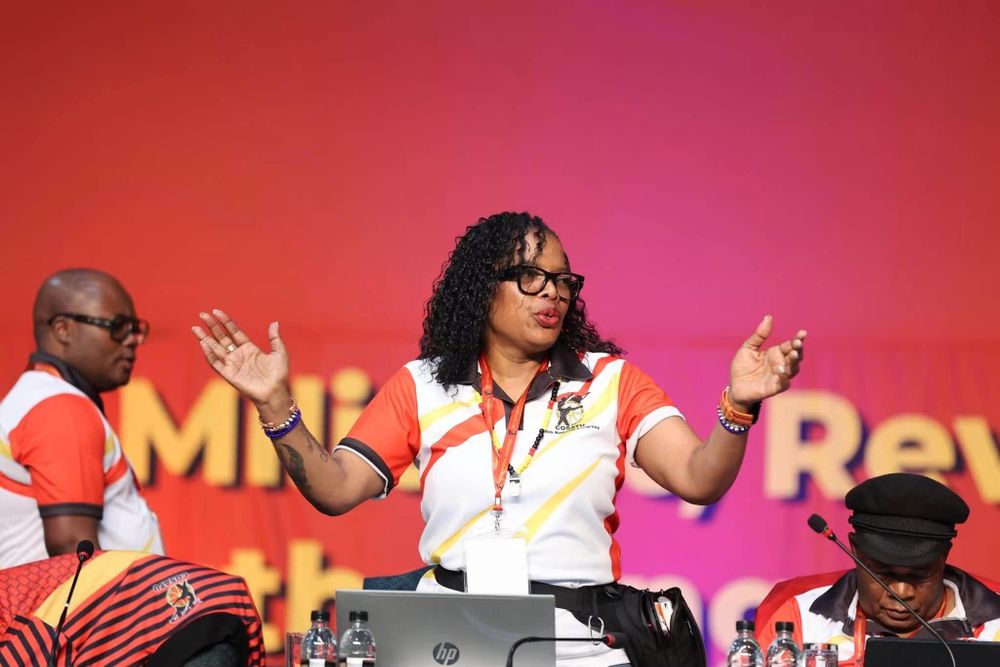
COSATU president Zingiswa Losi addressed the federation’s 15th National Congress, which was adjourned after delegates failed to reach a quorum amid a dispute over leadership.
South Africa’s biggest trade union federation Cosatu says it had no choice but to adjourn its congress as pushing through could have not merely weakened it but risked splitting it in half.
This week, for the first time in its 40 year history, the Congress of SA Trade Unions abandoned its four-day national congress on the second day mainly over a dispute about quorum. The event has now been scheduled for October 12 to 15.
“It is a painful moment, it’s a moment of embarrassment. I don't think anybody would want to see that kind of a headline,” said Cosatu’s parliamentary co-ordinator Matthew Parks this week.
“There is damage but the damage could have been far greater. It took a measure of humility for all involved to say ‘we don’t want to go down this route, let’s all breathe and take a step back’.
“The headlines are embarrassing and less than ideal but we could have had a headline of a split down the middle and that would have taken years to overcome. This headline can be fixed in 30 days with a successful congress,” he said.
Parks added that in adjourning the conference, the federation’s leadership had also reflected on the events surrounding the expulsion of the National Union of Metalworkers of SA and its former general-secretary Zwelinzima Vavi, from which it was still recovering.
“I think that’s why in the discussions about a possible adjournment, there was a quick consensus that it was a better option. It is easier to go through embarrassing headlines for a week but reconvene and sit in a manner that unites Cosatu rather than to force a congress that would have left Cosatu divided for the next four years.”
The Cosatu congress, which is a gathering of just over 1,800 delegates representing its 16 affiliates was scheduled to start on Monday and sit until Thursday at the Gallagher Convention Centre in Midrand. It came just eight weeks before the November 4 local government elections and would have been a platform for workers to tackle socio-economic issues like the price of electricity, addressing unemployment, kickstarting the economy, tackling the cost of living and other political, international and organisational issues. That is besides elections of office bearers.
But these discussions took a backseat this week as for two days, delegates squabbled over credentials. There were also questions around the eligibility of the federation’s deputy president Mike Shingange for nomination and election as he had been suspended by his affiliate a few days before the gathering. Shingange had been nominated by some affiliates for the position of Cosatu president.
A third sticking point revolved around the number of delegates allocated to the retail affiliate, the SA Commercial, Catering and Allied Workers Union.
On the technical front, the federation’s constitution states that if after three hours of the fixed time for the meeting, a quorum is not present, the meeting must stand adjourned, to be held within one month.
“Those were the three broad technical issues that bogged the congress in heated debates around whether we could proceed,” said Parks.
“The political issue was that the leadership of Cosatu and affiliates have a responsibility to make sure that a Cosatu congress leaves the federation stronger and united. If a Congress leaves Cosatu divided and thus weakened, then it is an injustice.
“That’s why the leadership of the federation and all affiliates decided that ultimately the temperatures are very hot, there are substantial differences around important credential issues and it is better to adjourn the congress which the constitution provides for than have the congress collapse, where people would just walkout and congress would have disintegrated.
Parks confirmed that Cosatu’s national office bearers informed affiliates on Thursday of the next congress date.
This means Cosatu, which has reportedly spent around R32 million on this week’s collapsed gathering will have to raise funds for the second take.
“Yes, there is a hectic price tag to pay. Cosatu spent about R12m for the venue, catering, printing and sound system among other things and the affiliates spent around R20m on flights and accommodation for their delegates,” said Parks, adding that the federation depended on workers’ subscriptions for its operations.
“It is going to be a difficult task to raise additional monies, and timing is difficult because you have an election within a period of two months, but the leadership had to preserve the unity of the federation and that is the greater objective to just rushing through an event, and leaving the federation weaker as a consequence.”
Parks also insisted that it was essential to adjourn the gathering to allow affiliates and Cosatu leadership to address the substantial procedural issues, and to make sure that when the congress reconvenes, it leaves Cosatu strengthened.
Cosatu’s Central Executive Committee is expected to hold several meetings to resolve the issues that led to the adjournment.
Cosatu is also expected to decide on its position with regards to the SACP contesting the November polls separately from the ANC.
/file/attachments/2998/14260418_323658.jpg)
