Couldn't undo Goa voter deletions because…: EC cites Form 7 amid outrage
The Election Commission has told India Today that the ECINet system does not have a rollback provision to allow Electoral Registration Officers (EROs) to reverse deletions once Form 7 is clicked to delete a voter’s name.
The clarification comes amid questions over repeated requests from the Goa Chief Electoral Officer’s office to enable the facility after 97 voters, initially flagged for “logical discrepancies” during the Special Intensive Revision (SIR), were found eligible for inclusion in the final electoral roll.
During the SIR process, several voters in Goa were flagged by the system for “logical discrepancies” -- mismatches that arose while linking electors to their parents or grandparents in the electoral rolls from the previous SIR. Those flagged for such discrepancies were struck off the electoral roll.
Following a January 29 Supreme Court order, 39,592 voters flagged for logical discrepancies were given an opportunity to submit documents or objections and be heard by Electoral Registration Officers (EROs).
In Goa, 649 electors came forward with documents or objections. EROs and Assistant EROs examined their cases, and in 97 cases, officials concluded that the electors had “become eligible to be included in the final Electoral Roll” and that the earlier decisions to strike them off had to be reversed.
However, the ECINet system did not have a rollback or reversion facility that would allow EROs to reverse those earlier decisions.
According to an investigation by The Indian Express, the Goa Chief Electoral Officer’s office sent eight emails and requests between February 11 and 17 to senior ECI officials in Delhi, seeking the rollback facility so that the decisions taken by the EROs could be acted upon before the final electoral roll was published.
The facility was not enabled in time, and the 97 electors found eligible for inclusion were not included in the final electoral roll published on February 21.
Explaining the process to India Today, the Election Commission said ERO.net provides EROs with the right to add or delete names when notices are served. If an ERO finds a person ineligible, the officer has to click on Form 7 for deletion.
However, once the ERO clicks on Form 7 for deletion, there is no rollback provision, the ECI said. This, according to the poll panel, was what happened in the Goa case.
The ECI's explanation, however, leaves a question over why repeated requests from the Goa CEO’s office to enable EROs to reverse the earlier decisions were not acted upon after the 97 electors had been found eligible for inclusion.
According to an investigation by The Indian Express, the Goa Chief Electoral Officer’s office sent eight emails and requests between February 11 and 17 to senior ECI officials in Delhi, seeking the rollback facility, so the names could be restored before the final electoral roll was published.
The facility was not enabled in time, and the final roll published on February 21 did not include the 97 voters.
Explaining the process to India Today, the Election Commission said ERO.net provides EROs with the rights to add or delete names when notices are served. If an ERO finds a person ineligible, the officer has to click on Form 7 for deletion.
However, once the ERO clicks on Form 7 for deletion, there is no rollback provision, the ECI said. This, according to the poll panel, was what happened in the Goa case.
The explanation, however, leaves a question over why repeated requests from the Goa CEO’s office to enable EROs to make corrections on ECINet were not acted upon after the 97 voters had been found eligible.WHY WAS FORM 6 MODIFIED?
The Goa episode comes against the backdrop of a larger controversy over changes made to ECINet, the online version of Form 6 used by the Election Commission for the registration of new voters.
A new declaration section linked to the SIR was added to the Form 6 available on the portal.
Under the change, particularly first-time voters and new applicants were asked questions related to whether their own names, or those of their parents or grandparents, appeared in electoral rolls from the previous SIR.
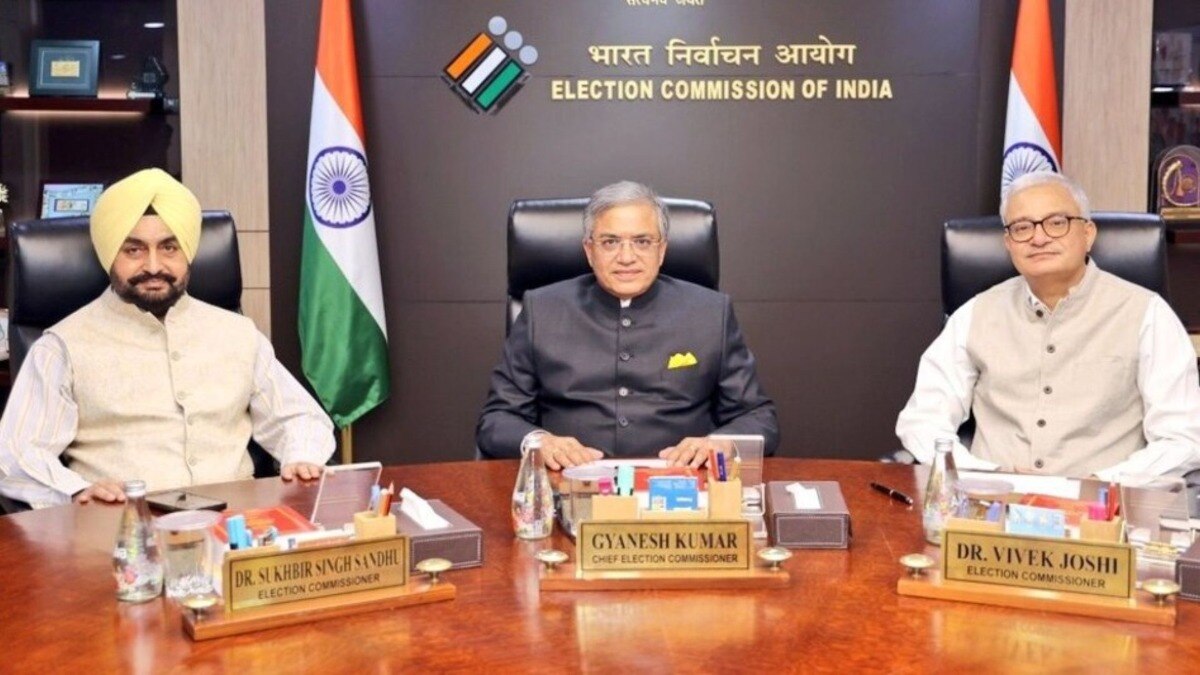
Two of the three Election Commissioners, Sukhbir Singh Sandhu and Vivek Joshi, reportedly raised legal objections to the changes and expressed their disagreement.
The objections centred on the fact that Form 6 is a statutory form prescribed under the Registration of Electors Rules, 1960.
The Election Commissioners argued that any change to the form requires the prescribed legal process, including a notification from the Ministry of Law and a formal amendment, and cannot be made merely through an order or guideline issued by the Commission.
Sandhu, in his dissent note, warned that incomplete and unauthorised declarations could create difficulties for young and first-time voters and could even result in them being deprived of their right to vote.
The Election Commission told India Today that there has been no change to Form 6, saying the requirement to provide details linking an applicant to their parents or grandparents was introduced as an additional declaration, Annexure D, alongside the existing and approved form.
The ECI said the requirement was in accordance with its SIR instructions dated June 24, 2025, and was also included in the SIR order dated May 14, 2026.
The Commission said applicants can submit Form 6 offline, online, through the BLO app or the ECINet app. While the offline process requires Form 6 and Annexure D to be filled separately, the online, BLO app and ECINet processes combine the two into a single running form for the convenience of applicants and BLOs.
The Commission said Form 6 itself remains unchanged, and that the digital platforms merely integrate the additional declaration with the approved form. It said the submitted online form, when downloaded as an acknowledgement, contains the same information as the Form 6 and declaration submitted through the offline process.
However, the ECI has not answered the question of why Form 6 was modified despite the objections raised by two Election Commissioners and their concerns over the prescribed legal process.WHY WAS DATA CENTRALISED?
On the question of centralisation of electoral data, the Election Commission has rejected the premise that there has been any centralisation in the preparation of electoral rolls.
The ECI said there is “no centralisation in the preparation of electoral rolls” and that the database of each state continues to remain decentralised as before. It said all statutory and procedural rights of EROs also continue to remain intact.
The Commission said electors included in the draft and final electoral rolls have been processed by the respective EROs of the concerned Assembly Constituencies, under the supervision of the CEO of the respective state.
The ECI also said the ECINet platform has been implemented in accordance with applicable law and the Commission’s instructions.EROs HAVE UNRESTRICTED ACCESS: ECI
The Election Commission said the ERO remains the statutory authority responsible for the preparation and revision of electoral rolls under Section 13B of the Representation of the People Act, 1950.
According to the ECI, EROs have been given **“complete and unrestricted access”** to the ECINet portal to assist them in carrying out their statutory obligations.
The Commission said the ECINet platform has been implemented in accordance with the applicable statutory and regulatory framework and that all rights and functions of stakeholders provided under laws, rules and ECI instructions have been incorporated into the platform.
“There is no deviation from this legal framework,” the ECI said.
The ECI further said the ERO portal on ECINet was implemented to facilitate stakeholders in performing functions prescribed by law.
It said all decisions to accept or reject an elector are taken under the express order of the ERO, under the supervision of the CEO, and only after due diligence.
“The elector list continues to be prepared by ERO ONLY. ECINET is only a facilitating platform and nothing more,” the Commission said.
Thus, on the question of data centralisation, the ECI's position is that the electoral-roll database remains decentralised, EROs retain their statutory powers and ECINet is only a facilitating platform.
The response, however, does not address the separate questions over the modification of Form 6, why orders were issued despite objections from two Election Commissioners, or why the rollback facility sought repeatedly by the Goa CEO’s office was not enabled in time.- EndsPublished By: Sayan GangulyPublished On: Sep 24, 2026 16:36 IST