Data centres could ignite a 'climate bomb' in Australia, report finds - ABC News & Headlines – Australian Broadcasting Corporation
The rollout of data centres has the potential to accelerate or slow down Australia's clean energy transition. (ABC: Graphic by Sharon Gordon)
A new report from the Climate Council examines nine major data centres proposed for Australia, warning that increased energy demand could mean more pollution.
The peak body for data centre developers says they are already offsetting 70 per cent of their demand with renewable energy.
The federal government is expected to deliver a national mandatory framework around large data centres and AI infrastructure in the coming months.
Australia's rapid data centre rollout could add 39 million tonnes of greenhouse gases into the atmosphere in a decade if allowed to be powered primarily by fossil fuels, the Climate Council has warned.
This is based on nine proposed data centres the report identifies as the biggest potential polluters because of their electricity demand.
That is roughly the same as the annual emissions of a country like Sweden.
Climate Council chief executive Amanda McKenzie said the demand by the artificial intelligence expansion could set back Australia's climate targets.
"If they extend the life of coal, if they bring on new gas … it's a very big increase in our climate pollution," Ms McKenzie said.
Australia currently has around 165 operational data centres, making it one of the top five locations around the globe even before a series of hyper-scale data centres have been developed.
The Climate Council's map showing the rollout of data centres, proposed and operational, in Australia. (Supplied: Climate Council)
The energy market operator forecasts that within a decade, data centres could use as much electricity as nearly all the homes in New South Wales and Victoria today.
Ms McKenzie said the plan for most data centres was simply to plug them into the existing grid, which is still mostly powered by fossil fuels.
Ms McKenzie said Australia needed mandatory national standards that would require large projects to bring on new renewable energy and storage within three years of approvals.
The federal government is expected to introduce legislation for large data centres and AI infrastructure early next year, with developers expected to bring on their own new clean energy to match their demand.
A large-scale data centre proposed for Queensland's Western Downs was included in the data. (Supplied: Urbis)
But fossil fuels are still on the table for Queensland and the Northern Territory, which campaigned to keep gas generation in the energy mix.
In response to the report, Data Centres Australia, the peak body for data centre developers, said the industry was committed to renewable energy.
Chief executive Belinda Dennett said the report was based on "speculative" demand.
She said operational data centres were already offsetting 70 per cent of their energy use with renewable energy agreements.
"This is something the industry is already doing well ahead of any government requirements to do so," Ms Dennett said.
She said multi-billion-dollar AI companies are focused on the speed of energy connection, rather than the cost.
"Rather than slow down this data centre build out that is happening right now, how do we make sure we can build renewable energy projects more quickly?" Ms Dennett said.
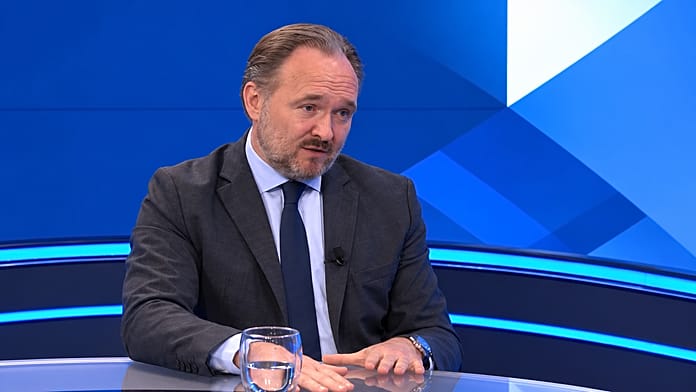
University of Technology renewable energy researcher Chris Briggs said the data centre industry could tip the scales towards a climate positive or a climate negative future.
Chris Briggs says the advent of data centres could bring more renewable energy into the grid. (Supplied: )
He said the Climate Council's report was based on a "worst case scenario" but acknowledged it was "certainly a possibility".
"We could effectively turn back the energy transition or push it in a different direction," Dr Briggs said.
He said if the renewables rollout did not accelerate, it would incentivise data centres to invest in coal and gas generation.
It can take years to bringing on new solar and wind energy projects farms takes years, while the developer behind Anthropic's first data centre leased in Australia has said "the industry doesn't work in years, months but thinks in weeks and days."
Around Australia, communities with proposed data centres are worried their concerns will be steamrolled by global AI companies.
Protesters gathered outside an economic forum in Dalby about a proposed data centre, leased by Anthropic. (ABC Southern Qld: Grace Nakamura)
A petition to Queensland parliament opposing the proposed hyper-scale Western Downs Digital Park near Dalby has garnered more than 24,000 signatures, while the developer signs its first agreement to connect to the state's electricity grid.
In Victoria in the Latrobe Valley, coal fired power station have begun to close — but the area is now being considered to house data centres.
The debate around data centres shows no sign of cooling. (Unsplash: Winston Chen)
Residents like Tracey Anton are concerned about the impact of data centres on water resources in the valley, like the Latrobe River, which is used for industry and agriculture.
"A lot of people are talking about energy, but the water issue's gone into the background," Ms Anton said.
Tracey Anton says the Hazelwood mine rehabilitation plan is one giant experiment. (ABC News: Jarrod Whittaker)
"So what we are focusing on as concern is the demand for water and what that demand could mean for already stressed rivers and household water bills," she said.
"Everything is interconnected, every industry, every use — you can't look at it on its own."