David Olive: Canada’s uranium fuels the world. Cameco is cashing in - Toronto Star
How Saskatoon-based Cameco became one of nuclear's biggest players — and why it's just getting started.
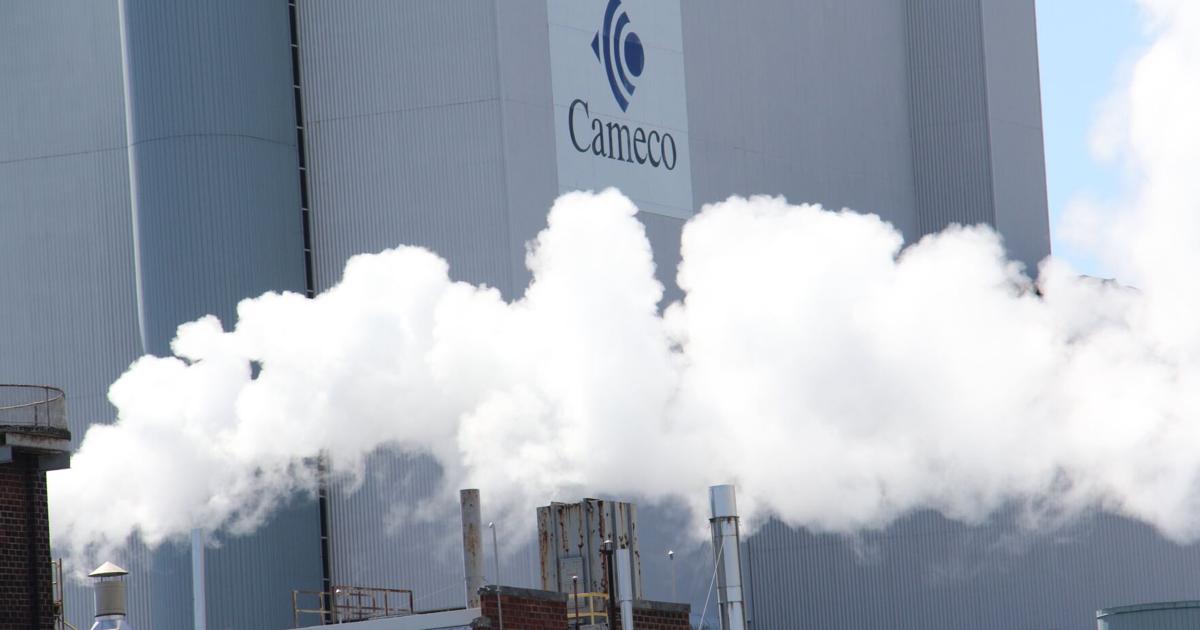
Cameco’s uranium conversion facility in Port Hope, Ont., is seen in this file photo.
David Olive is a Toronto-based business columnist for the Star.
Tim Gitzel is CEO of Saskatoon-based Cameco, the largest uranium miner in Canada and a leader among global uranium suppliers. But Gitzel believes Cameco’s growth story is just beginning. Cameco is poised to expand alongside a civilian nuclear power sector that is booming worldwide.
There are about 80 nuclear reactors under construction around the world, and another 120 reactors are planned. There are about 440 existing nuclear power plants.
And they are all fuelled by uranium.
For U.S. reactors, much of that fuel comes from Canada, the largest supplier of uranium to the U.S. Uranium from Canada accounts for about one-quarter of total U.S. utilities’ purchases. Domestic U.S. uranium production meets only five per cent of U.S. utilities’ fuel demand. Gitzel chortles every time he hears U.S. President Donald Trump declare that the U.S. needs nothing from Canada.
Massive cost overruns at new nuclear plants have marred the comeback of civilian nuclear power. But RBC Economics noted in a March report on Canada’s “atomic advantage” that “several of Canada’s nuclear reactors have been successfully refurbished ahead of schedule and under budget, bucking the cost overrun trend of nuclear projects in other Western countries. Simply put, Canada has an opportunity to play a key role in nuclear’s resurgence.”
Cameco is one of the world’s few integrated nuclear power enterprises. At a time when security of supply chains has primacy in assessing economic strength, Cameco is a model of reliability.
Cameco explores for uranium, mines it, and manufactures uranium products.
In Northern Saskatchewan’s Athabasca Basin, Cameco owns and has part ownership of one of the world’s largest reserves of high-grade uranium. The reserves are estimated at 433 million pounds.
And Cameco has a 49 per cent stake in Westinghouse Electric of Pittsburgh, Pa., one of the world’s largest makers of nuclear reactors.
Cameco partnered with Brookfield Renewable Partners, an affiliate of Toronto asset manager Brookfield, to buy Westinghouse in 2023 for $8.2 billion (U.S.). Brookfield has a 51 per cent stake.
Cameco and Brookfield this year announced plans to take Westinghouse public. Valuations of the reactor maker range from $30 billion (U.S.) to $50 billion (U.S.). In an understatement, Gitzel has said of Westinghouse, once known for household appliances, that “We got the right company at the right time.”
Gitzel, 64, has reason to think the best is yet to come.
Westinghouse has a burgeoning order book. Over the next two decades, Westinghouse has about 91 reactors under development or on order from utilities worldwide.
That doesn’t include a June announcement by the Trump administration that it will provide as much as $17.5 billion (U.S.) in loans to finance construction of 10 of Westinghouse’s latest generation AP1000 nuclear reactors.
Westinghouse has rivals in reactor development. They include Candu (Canada deuterium uranium), whose technology is owned by the federal government and is licensed to Montreal engineering firm AtkinsRéalis.
And GE Vernova Hitachi Nuclear Energy has partnered with Ontario to develop small modular reactors (SMRs) at the Darlington Nuclear Generating Station.
But about half the world’s nuclear reactor fleet is supported by Westinghouse technology. The fleet is a source of recurring revenue for Westinghouse in fuel fabrication and maintenance services.
And Westinghouse is broadening its product lineup with its own SMRs and mini reactors it has under development for the day when reactors are safe and small enough to install in hospitals, office buildings and power-hungry AI data centres that for now draw power from local utilities.
“We view Westinghouse as a unique asset with no direct publicly traded peer, which justifies a premium valuation,” analyst Andrew Wong of RBC Capital Markets said in a report on Cameco.
Among Cameco’s greatest advantages is strong financial performance.
Cameco survived a rough decade in the 2010s when Russia glutted the world market with low-cost uranium in its successful bids to underprice Western uranium producers and drive them out of business.
Russia’s manipulation of the market, depressing uranium prices, forced Cameco to reduce its production with mine closures and layoffs. In 2021, it took a loss of $103 million (Canadian).
But prices have since recovered with the resurgence of interest in nuclear power. Cameco’s profit more than tripled last year, to $590 million, and revenues were up 13 per cent to $3.5 billion.
Before factoring in its share of the proceeds from a Westinghouse IPO, Cameco is already one of Canada’s most valuable companies, with a market cap of $54 billion.
In a recent report, Orest Wowkodaw at Bank of Nova Scotia calculated that reactor sales and Cameco’s increasing uranium production should yield a fivefold increase in free cash flow, to $1.3 billion in 2028.
That financial strength gives Cameco greater ability to ride out future bouts of uranium price instability, and the capital to expand its mining capacity without straining its balance sheet.
Gitzel believes Cameco contributes to Canada’s energy security. More than that, it has played a role in Canada’s emergence as a “nuclear superpower.”
Opinion articles are based on the author’s interpretations and judgments of facts, data and events. More details
David Olive is a Toronto-based business columnist for the Star.