David Olive: Forget the 51st state. Canada wants to be Europe’s partner - Toronto Star
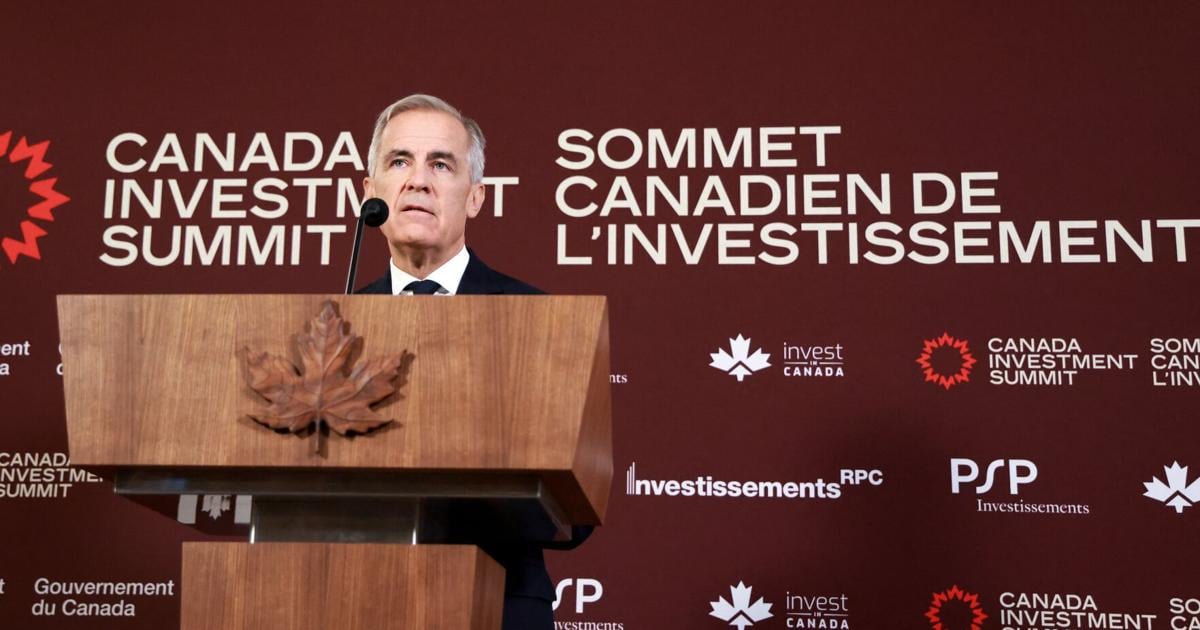
As Trump retreats from global alliances, Canada and the EU are moving fast to fill the void.
Prime Minister Mark Carney speaks during a news conference on the second day of the inaugural Canada Investment Summit in Toronto.
David Olive is a Toronto-based business columnist for the Star.
Europe was so much on Mark Carney’s mind early this week that he was talking about it during his inaugural Canada Investment Summit in Toronto.
Canada will seek a “unique security and economic alliance” with the European Union (EU), Carney told the international delegates at the Toronto summit, a historic gathering the Canadian prime minister expects will yield some $1 trillion in investment in Canada over the next few years.
It is a curious thing to speak warmly of absent friends while asking the folks in front of you to open their wallets for Canada.
But Canada figures it can attract record amounts of global investment capital while becoming an indispensable partner to the EU, boost its trade with China, and fight for the most favourable trading conditions possible with the U.S.
That’s no mean feat, but it’s the model the Carney government believes Canada must build.
And Canada is off to a good start in its harmonious relations with the EU, the world’s third-largest economy after the U.S. and China.
The EU, a market of about 420 million people with a GDP of more than $30 trillion (U.S.), is Canada’s second-largest global trading partner for goods and services, totalling approximately $178 billion in 2025.
And the two jurisdictions are heavily invested in each other. Canada’s foreign direct investment (FDI) in the EU totalled $315 billion in 2025, while the EU’s FDI stock in Canada was estimated at $217 billion last year.
In his more imaginative moments — some would say grandiose — Carney sees Canada at the centre of a triad of economic superpowers, the U.S., the EU and Asia Pacific.
Carney has mused about Canada as a bridge that could connect the EU and the dynamic economies of Asia Pacific.
Canada is a founding member of two enormous free-trade regions, the Canada-EU Comprehensive Economic and Trade Agreement (CETA) and the Comprehensive and Progressive Agreement for Trans-Pacific Partnership (CPTPP), a trade alliance of 12 countries anchored by Japan, Australia, the U.K. and Canada.
As such, Canada is ideally placed to broker an alliance between members of CETA and the CPTPP that could be a middle-power union of the kind that Carney called for in his oft-cited Davos speech in January.
But for now, Carney isn’t pushing that grand project. As a first-hand witness to Brexit when he was governor of the Bank of England, Carney knows alliances can be fragile.
Ten EU countries, including France and Italy, have yet to ratify CETA a decade after it was signed into existence.
CETA’s provisions are in effect across the EU. But full ratification by the 10 holdout parliaments would lift remaining restrictions and boost Canada-EU trade.
Foreign policy experts on this side of the Atlantic caution that the EU can be notoriously slow in adopting new initiatives. For instance, CETA took about seven years to negotiate.
But U.S. President Donald Trump’s removal of long-standing U.S. security protections of Europe last year has spurred the EU into trade, economic, technology and defence alliances that have been rapid by the standards of any jurisdiction.
In short order, the Carney government has struck several trade, security and technology agreements with the EU. In February, Canada became the first non-European country to join the EU’s Security Action for Europe (SAFE), a new $244-billion loan facility that also grants defence firms in Canada and the EU greater access to each other’s markets.
So many of the EU’s most substantive recent initiatives have been with Canada that the EU this week invited Canada to become the EU’s first associate member.
“We want to bring the relationship with Canada to the highest level possible,” Ursula von der Leyen, president of the European Commission, the administrative arm of the EU, told the 720 members of the European Parliament this week in her annual state of the union address.
Canada and the EU are now in talks to more tightly co-ordinate their activities in Arctic defence, artificial intelligence, energy, critical minerals and technology sharing.
The European Commission hopes its dealmaking with Canada will encourage more CETA ratifications by EU parliaments. And Ottawa believes those ratifications could spur Canadian provinces to hasten their removal of remaining internal barriers to trade and labour mobility.
Carney denied this week that Canada is seeking full EU membership. But Canada must achieve a more mutually beneficial relationship with the EU for Carney’s doctrine of middle-power collaboration to work.
On Sept. 12, Carney issued a statement outlining his trans-Atlantic objectives ahead of the Canada-EU summit to be held Oct. 29 to 30 in Montreal.
“Together,” Carney said, “Canada and our European partners have the ambition and strength to create a more just, stable, and universally prosperous world.”
That is an audacious proposal. But who else in this self-interested world is even thinking of becoming an agent of universal prosperity?
On our best days, Canada and her allies have been guided by such thoughts. It might be time to embrace them again.
Opinion articles are based on the author’s interpretations and judgments of facts, data and events. More details
David Olive is a Toronto-based business columnist for the Star.