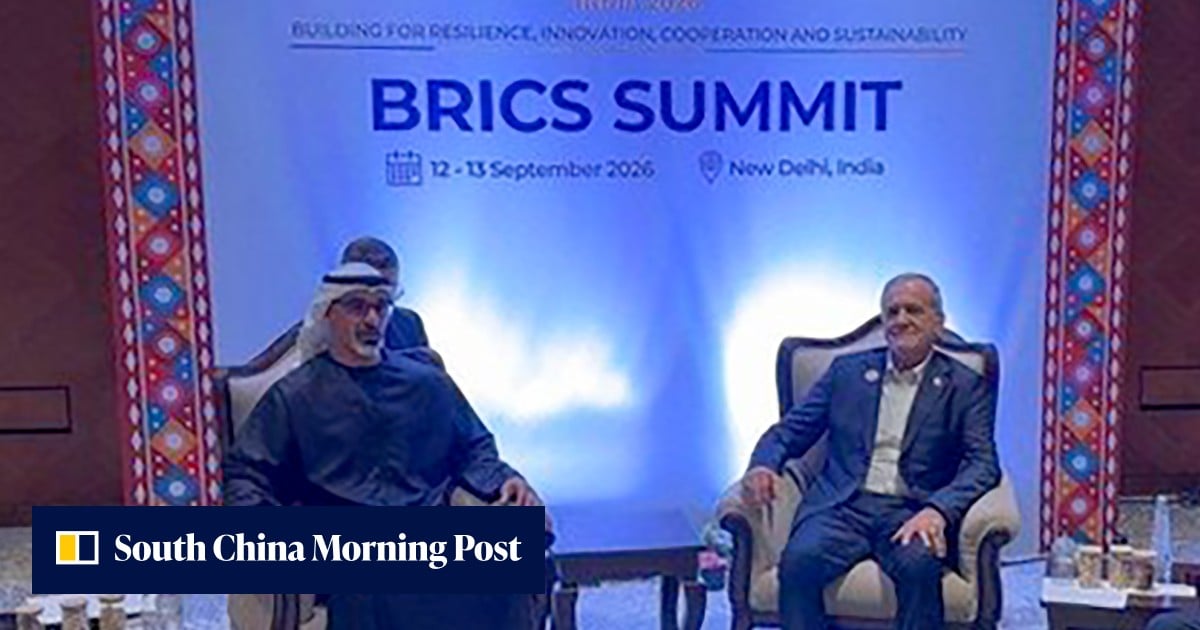
Deepening US-Iran War Spells Political Trouble for Trump and Pezeshkian

As the war between the United States and Iran drags on into a new phase of escalation, the presidents of both countries are increasingly feeling the backlash.
In Washington, U.S. President Donald Trump faces a growing chorus of anti-war sentiment, with some of the loudest voices emerging from factions within his own MAGA movement. And there's little sign that peace or victory can be achieved by the time the mid-term elections arrive in November.
In Tehran, reformist Iranian President Masoud Pezeshkian faces an even more complex set of issues. His continued defense of diplomacy with the U.S. seeks to bridge the divide between an increasingly hawkish government and an economically aggrieved public. Yet influential hard-line voices are calling for his downfall.
Both men have much at stake. And their fates carry profound implications for the course of their respective nations, locked in the first open war of a decades-long rivalry.
Since the beginning of the war launched jointly with Israel against Iran on February 28, Trump has repeatedly shifted his messaging on U.S. objectives and has deliberately avoided setting any timelines.
But there's one date that the U.S. leader cannot overcome: November 3. Even if Trump has said he "does not care" about the mid-term elections, many of his supporters invested in the Republican Party's future do, and several signs indicate a major loss ahead.
Democrats have improved their vote share in every special election won since the beginning of the conflict, snagging victories in Arkansas, Florida, Minnesota, New Hampshire, Pennsylvania and Texas.
As Democrats seek to build momentum, Republicans are less enthusiastic about the coming mid-term elections by a factor of 12-13 percent, according to polls conducted last week by the University of Massachusetts and Reuters-Ipsos.
Some of the frustration within the right-wing camp has manifested in the form of prominent pro-MAGA figures turning against Trump over the president's failure to live up to his promise of no new wars. They include conservative pundits Tucker Carlson, Megyn Kelly and Candace Owens, as well as former Republican lawmakers Marjorie Taylor-Greene and Thomas Massie.
Beyond foreign policy, however, many on both sides of the aisle consider affordability to be a top-line issue, and Republican and Democratic constituencies alike feel the direct impact of the Iran war in higher gas prices and costs of living.
Around 56 percent of people in the U.S. oppose the conflict, while just around 36 percent support it, according to the latest Silver Bulletin data. Another recent poll conducted by the Financial Times and Focaldata shows even fewer, just a third of the population, approve of Trump's performance.
The figures serve as an incentive for a change in course. And if Trump does not chart a new path, someone else might once the elections are over.
"The U.S. policy elite is rudderless in the Iran war, because both parties are accustomed to classifying Iran as a 'forever enemy' and no one will take the political risk in an election year to try an alternate perspective," Clay Ramsay, senior research associate at the Center for International and Security Studies at Maryland who has gathered opinion polling in both the U.S. and Iran, told Newsweek.
"After the election, someone will eventually have to argue for a different approach," Ramsay said.
Pezeshkian faces an opposite problem in some ways.
Unlike the U.S. balance of power, in Iran's political system, "power-sharing at the top takes place among the president, the supreme leader, the speaker of the parliament, the head of the judiciary and military leaders," Ramsay said, noting that the supreme leader also acts as commander-in-chief.
That title is currently held by Ayatollah Mojtaba Khamenei, the son of longtime Supreme Leader Ayatollah Ali Khamenei, who was slain in the opening salvo of the U.S.-Israeli war on Iran. Despite his appointment by the Assembly of Experts, a body overseen by the supreme leader-vetted Guardian Council, the younger Khamenei has not since been seen in public, fueling speculation about his true fate.
While statements continue to be issued in the name of the supreme leader, his absence has paved the way for others to consolidate influence within the collective leadership system established during the conflict.
Besides Pezeshkian, the group includes one fellow elected leader, Parliament Speaker Mohammed Bagher Qalibaf, and three appointed officials: Judiciary Chief Gholam-Hossein Mohseni-Ejei, Islamic Revolutionary Guard Corps (IRGC) chief Major General Ahmad Vahidi and an unnamed representative of Iran's conventional military, known as the Artesh.
Among them, two stand out in particular.
Qalibaf, a former IRGC Aerospace Force commander and mayor of Tehran, has emerged in the spotlight as a pragmatic bridge between rival factions within Iran and a co-leader alongside Foreign Minister Abbas Araghchi in negotiations with the U.S. His record caught the attention of the White House early on, with Trump even hinting that Qalibaf may be a candidate for a Washington-approved leader in Iran.
Vahidi's rise has been quieter yet potentially even more cunning. The man who helped found the IRGC's elite Quds Force before handing the reins to the late Major General Qassem Soleimani—later killed in a January 2020 airstrike ordered by Trump in Iraq—appears to have steadily cultivated his own clique that counts within its ranks Supreme National Security Council Secretary Mohammad Bagher Zolghadr.
Like Pezeshkian, Qalibaf has sought to convey awareness of Iran's economic plight, which has been made all the more painful by Trump's "economic D-day" threats. Vahidi and other IRGC top brass have largely stuck to warnings of military escalation.
Meanwhile, Pezeshkian's reformist agenda is under greater pressure than ever. Having promised diplomatic outreach and economic improvement in his successful campaign to succeed the late President Ebrahim Raisi, a staunch principlist who died in a May 2024 helicopter crash, Pezeshkian is instead saddled today with war and blockade.
Ramsay argued that Iran's Supreme National Security Council has been able to reach a consensus only "because the reformists have been convinced by Trump's behavior that Iran's conservatives were basically right about the United States—any negotiation process may be interrupted by a surprise attack."
Moreover, criticism toward Pezeshkian is gaining traction within certain circles in Iran. A report published Wednesday by Iran's semi-official Islamic Republic News Agency cited Member of Parliament Ruhollah Lek-Aliabadi as saying that an unidentified representative from Tehran and allied factions were moving to have Pezeshkian's removed from office due to "political incompetence."
But Pezeshkian still serves an important role. Ali Alfoneh, senior fellow at the Arab Gulf States Institute, said that the Iranian president, while "not particularly powerful" when compared to Qalibaf or Vahidi, "is still generally perceived as honest, decent and well-meaning."
"His mixed Azeri-Kurdish parentage gives him particular symbolic value at a time when Israel and the United States are openly seeking to exploit Iran’s ethnic divisions and even provoke a civil war in Iran," Alfoneh told Newsweek.
"More importantly, Pezeshkian has personally accepted responsibility for the regime’s shortcomings," Alfoneh said. "If Qalibaf or Vahidi attempt to impose their preferences on him, Pezeshkian could threaten to resign, forcing them to assume greater public responsibility for inflation and the population’s impoverishment."
For the U.S., dwindling support and growing costs associated with the war could eventually force the beginnings of a real exit strategy.
Such a plan, Ramsay argued, would at first entail "confidence-building measures," such as securing a limited compromise with Tehran on allowing a certain number of both Iranian and non-Iranian vessels to pass the dueling blockades established in the Strait of Hormuz.
"Trump himself will not do confidence-building measures, but a few politicians will have to begin arguing for it," Ramsay said. "Otherwise, the U.S. will remain in the Iran quagmire for two more years, until the end of Trump's term."
Yet Iran's political trends leave increasingly narrow room for diplomacy.
Holly Dagres, senior fellow at The Washington Institute for Near East Policy's Viterbi Program on Iran and U.S. Policy, argued that, even as Iranians believe "the Islamic Republic is irreformable and the country is plagued by systemic mismanagement, corruption, and repression," the most rigid centers of power are only consolidating due to the conflict.
"With yet another war, and a new Supreme Leader Mojtaba Khamenei, who is said to be more hardline than his father, the hardliners have been ascending," Dagres told Newsweek.
"For years, they've argued that the United States cannot be trusted and that Iran should not make a deal," Dagres said. "Some have even made the case that Iran should go all the way with its nuclear program to prevent the fate of Muammar Gaddafi in Libya and Ukraine with the Russian invasion."
A sense of victory among key stakeholders in Iran has also curbed the appetite for compromise, though some Iranian experts have warned of Tehran potentially overplaying its hand.
Other Iranian analysts, "particularly those affiliated with the Revolutionary Guard," Alfoneh said, now "appear to view the midterm elections as another theater of conflict."
"Distrustful of President Trump, they calculate that prolonging the war through the November 3 elections would raise the economic and political costs for the Republican Party and, by extension, the president," Alfoneh said.
"Should Republicans lose control of the House, and perhaps the Senate, these analysts expect Trump to challenge the results, descending the United States into a prolonged political crisis, distracting Washington and giving Tehran a temporary reprieve from U.S. military pressure," he added.
Contact Newsweek editors on this story: Gray R. Thomas