
Delhi air improves to very poor after worst 24 hours of the year; AQI at 348
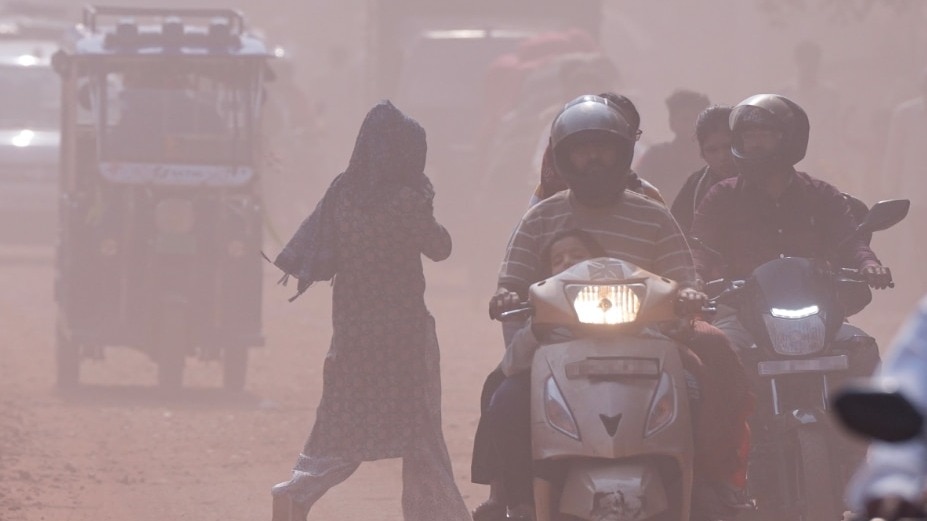
A day after a thick blanket of smog pushed Delhi's air quality into the severe category, the national capital saw a slight improvement in pollution levels on Saturday, November 14.
However, the relief remained limited, with the overall Air Quality Index (AQI) standing at 348 in the very poor category and two monitoring stations continuing to record severe pollution levels.
The city's AQI had touched 402 on Friday, with poor visibility reported across several areas as dense smog engulfed the capital. On Saturday, the overall reading declined marginally, but PM2.5 and PM10 continued to be the prominent pollutants.
The improvement in the citywide average also did little to ease conditions in some of the worst-affected neighbourhoods. IIT Delhi recorded an AQI of 419, while the ITO monitoring station registered 414. Both locations remained in the severe category.
Among other monitoring stations, Chandni Chowk recorded an AQI of 395, followed by Jawaharlal Nehru University (JNU) at 390 and Anand Vihar at 389.
Rohini reported an AQI of 366, while Narela registered 359, indicating that pollution levels remained significantly elevated across several parts of the national capital.
Delhi Airport recorded an AQI of 348, matching the city's overall reading, while the RK Puram monitoring station registered 315. Both locations remained in the very poor category.DELHI AIR QUALITY AFTER FRIDAY'S SEVERE READING
On Friday, Delhi's overall AQI reached 402, pushing the city into the severe category. Of the 58 monitoring stations across the capital, 33 recorded severe air quality, according to Central Pollution Control Board (CPCB) data.
IIT Delhi reported the highest AQI at 487, followed by Chandni Chowk and North Campus at 476 each. Pusa recorded 468, while Jaffarpur registered 461. Mathura Road reported 455, while ITO and Burari Crossing recorded 453 each. JNU registered 451 and Aya Nagar reported 433.
The India Meteorological Department (IMD) had forecast that Delhi's air quality could remain between the very poor and severe categories until November 16. Improved wind conditions were expected to bring some relief thereafter.
Delhi has been witnessing worsening pollution levels since Diwali, with stubble burning in neighbouring states contributing to the deterioration. Unfavourable weather conditions have also limited the dispersal of pollutants.
According to CPCB classification, an AQI between 301 and 400 falls in the very poor category, while readings between 401 and 500 are classified as severe.
While Saturday's reading of 348 marked a marginal improvement from Friday, the severe readings at IIT Delhi and ITO showed that several parts of the capital continued to grapple with hazardous levels of air pollution.- Ends
