Democrats regain ground on voter registration in key states after steep post-2024 drops
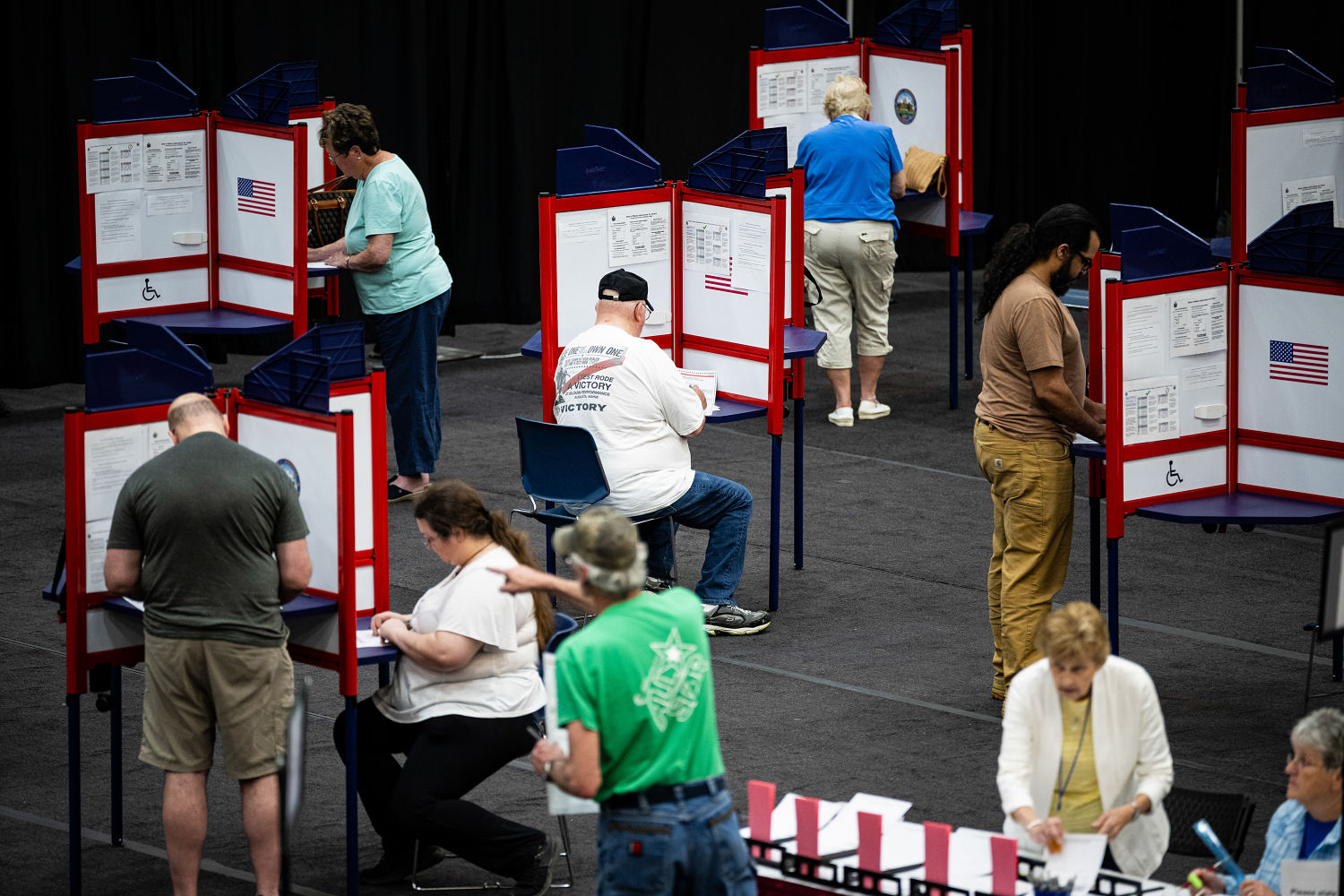
A polling location in Augusta, Maine, during a primary election in June.Graeme Sloan / Bloomberg via GettyShareAdd NBC News to GoogleOct. 2, 2026, 5:00 AM EDTBy Marc Trussler and Jane C. TimmAfter having suffered massive voter registration losses in the wake of the last presidential election, Democrats have stemmed the bleeding in several key states heading into this year’s midterms, according to an NBC News Decision Desk analysis.
NBC News’ Decision Desk analyzed voter file data from TargetSmart, a progressive data firm, for seven of the states that were the closest in the 2024 election and that registered voters by party: Arizona, Maine, Nevada, New Hampshire, New Jersey, North Carolina and Pennsylvania. From late 2024 through late 2025, Republicans significantly improved their voter registration margin over Democrats in all seven states, including by a net of roughly 100,000 in Pennsylvania and North Carolina.
But from late 2025 through the middle of this year, Democrats managed to reverse, though not completely erase, those losses in five of them, adding more registrants on net than Republicans in Arizona, Maine, Nevada, New Jersey and Pennsylvania. And in New Hampshire and North Carolina, Democrats have slowed the decline.
While party registration is not 100% predictive of vote choice, the recent movement toward Democrats on this front provides another reason for optimism for the party this fall. Arizona, Maine, Nevada, New Hampshire, North Carolina and Pennsylvania are all holding critical races for the Senate or governor (if not both), while New Jersey, which has become more competitive in recent years, is hosting a battleground House contest.
The trend comes not only amid a backlash to President Donald Trump that has grown over the course of the year, but also as Democrats campaigned in consequential primaries that often centered on what direction the party would take after its 2024 defeat.
Meanwhile, the pool of unaffiliated voters continued to expand in many of those states, reflecting a growing distrust of both major parties.
There are three primary ways the party registration margin can change: new voters signing up; registrants switching parties; or registrants being removed from the rolls after having moved out of state, routine maintenance or dying. A total of 30 states and Washington, D.C., register voters by party, while the rest — including battlegrounds like Georgia, Michigan and Wisconsin — do not.
To track recent voter registration trends, NBC News analyzed TargetSmart data after the 2024 election, at the end of 2025 and in mid-2026, with the most recently available data in each state ranging from late June to September.
Democrats’ biggest post-2024 issue on this front largely came from voters leaving the rolls. But the analysis of the voter registration data reveals that the problem was not as severe for Democrats as it might appear, as many of those people were infrequent voters to begin with.
In all seven states, turnout in the 2024 election was significantly lower among the people who subsequently left the rolls than among those who stayed. For example, in Pennsylvania, the 2024 turnout among people who subsequently left the rolls was 37%, compared with 81% for those who stayed.
In battleground Pennsylvania, Republicans had their biggest net gain in voter registration (more than 110,000) from late 2024 to late 2025 of the seven states analyzed. But from the end of last year to this summer, Democrats gained a net of around 46,000.
Despite those big 2025 losses, Democrats actually gained around 22,000 registrants from new voters over that period. But that was offset by net losses from party registration switches (about 43,000) and registrants leaving the rolls (about 90,000). It all adds up in a state Trump won by 120,000 votes in 2024.
The data through this fall tells a different story, though. New registrants and party switchers gave Democrats net gains of around 45,000 and 11,000, respectively. That was more than enough to make up for more modest losses among registrants leaving the voter rolls.
FOR SUBSCRIBERSCornell rape allegation pushes embattled New York prosecutor into national spotlightFOR SUBSCRIBERSJudge guts noncitizen voting law used in Trump administration’s election pushFOR SUBSCRIBERSTrump to campaign in at least 17 states ahead of the midtermsFOR SUBSCRIBERSThe prosecutor at the center of the Cornell maelstromFOR SUBSCRIBERSIt’s rarely been harder for people to find new jobsFOR SUBSCRIBERSCBP leaders cut out of Trump ad buy decisionFOR SUBSCRIBERSAmerican passenger drafted goodbye texts to her family as Flydubai plane plummetedFOR SUBSCRIBERSAbdul El-Sayed tries to woo MAHA voters as Democrats seek inroads with RFK’s supportersFOR SUBSCRIBERSKratom-like substances are popping up in a typically benign supplementFOR SUBSCRIBERSGOP super PAC increases its spending for Sen. Jon Husted in tough Ohio raceFOR SUBSCRIBERSRecords reveal tumultuous marriage between slain New York Times executive and wifeFOR SUBSCRIBERSFrom clean energy warrior to ‘wall of shame,’ James Talarico reverses on a fossil fuel money pledgeFOR SUBSCRIBERSCongressional staff planned official trip with luxury stops in Italy and France weeks before electionFOR SUBSCRIBERSA harrowing ordeal aboard an Israel-bound planeFOR SUBSCRIBERSOpenAI CEO Sam Altman to skip congressional hearing on rogue AI agentsPennsylvania Democratic Party Chair Eugene DePasquale said he aggressively prioritized voter registration efforts when he took over in September 2025.
FOR SUBSCRIBERSCornell rape allegation pushes embattled New York prosecutor into national spotlightFOR SUBSCRIBERSJudge guts noncitizen voting law used in Trump administration’s election pushFOR SUBSCRIBERSTrump to campaign in at least 17 states ahead of the midtermsFOR SUBSCRIBERSThe prosecutor at the center of the Cornell maelstromFOR SUBSCRIBERSIt’s rarely been harder for people to find new jobsFOR SUBSCRIBERSCBP leaders cut out of Trump ad buy decisionFOR SUBSCRIBERSAmerican passenger drafted goodbye texts to her family as Flydubai plane plummetedFOR SUBSCRIBERSAbdul El-Sayed tries to woo MAHA voters as Democrats seek inroads with RFK’s supportersFOR SUBSCRIBERSKratom-like substances are popping up in a typically benign supplementFOR SUBSCRIBERSGOP super PAC increases its spending for Sen. Jon Husted in tough Ohio raceFOR SUBSCRIBERSRecords reveal tumultuous marriage between slain New York Times executive and wifeFOR SUBSCRIBERSFrom clean energy warrior to ‘wall of shame,’ James Talarico reverses on a fossil fuel money pledgeFOR SUBSCRIBERSCongressional staff planned official trip with luxury stops in Italy and France weeks before electionFOR SUBSCRIBERSA harrowing ordeal aboard an Israel-bound planeFOR SUBSCRIBERSOpenAI CEO Sam Altman to skip congressional hearing on rogue AI agentsAbout 150 staffers are now “having conversations with people in every single corner of our commonwealth, listening to their concerns, listening to their issues and making a case of why they should register as Democrats,” he said, while also crediting Trump’s growing unpopularity.
North Carolina, however, has remained a bright spot for the GOP: For the first time in the state’s history, the party holds a lead in party registration. From late 2024 to late 2025, Republicans’ net voter registration gain was just shy of 100,000. Democrats managed to keep the net loss to around 16,000 from late 2025 to last month.
“Traditionally, the Democrats have always just been better at this than Republicans,” said Felice Pete, a Republican National Committee member from North Carolina.
But in recent years, she said, conservative groups like Turning Point USA and Americans for Prosperity helped Republicans in the state boost their registration numbers through door-knocking and events.
“It’s almost like evangelizing, if you will,” she said.
Below the surface, there is a promising trend for Democrats in North Carolina. While new registrants gave Republicans a net gain of around 11,000 last year, they gave Democrats a net gain of around 6,000 this year.
In North Carolina and four of the other states analyzed — Arizona, Nevada, New Hampshire and Pennsylvania — the number of people who either did not register with a party or registered with a party that was not the Democrats or the Republicans steadily grew from late 2024 to mid-2026. In Maine and New Jersey, that percentage slightly declined.
A significantly larger number of new voters in all seven states are registering as unaffiliated compared than are those currently on the rolls. And much of the movement away from the Democratic Party is from Democrats choosing to become unaffiliated, rather than registering as Republicans.
Marc Trussler is a senior elections analyst on the NBC News Decision Desk.
Jane C. TimmJane C. Timm is a senior reporter for NBC News.
/file/dailymaverick/wp-content/uploads/2024/09/Mbekezeli-benjamin.jpg)