
Did Anthropic help turn Washington against Jensen Huang?
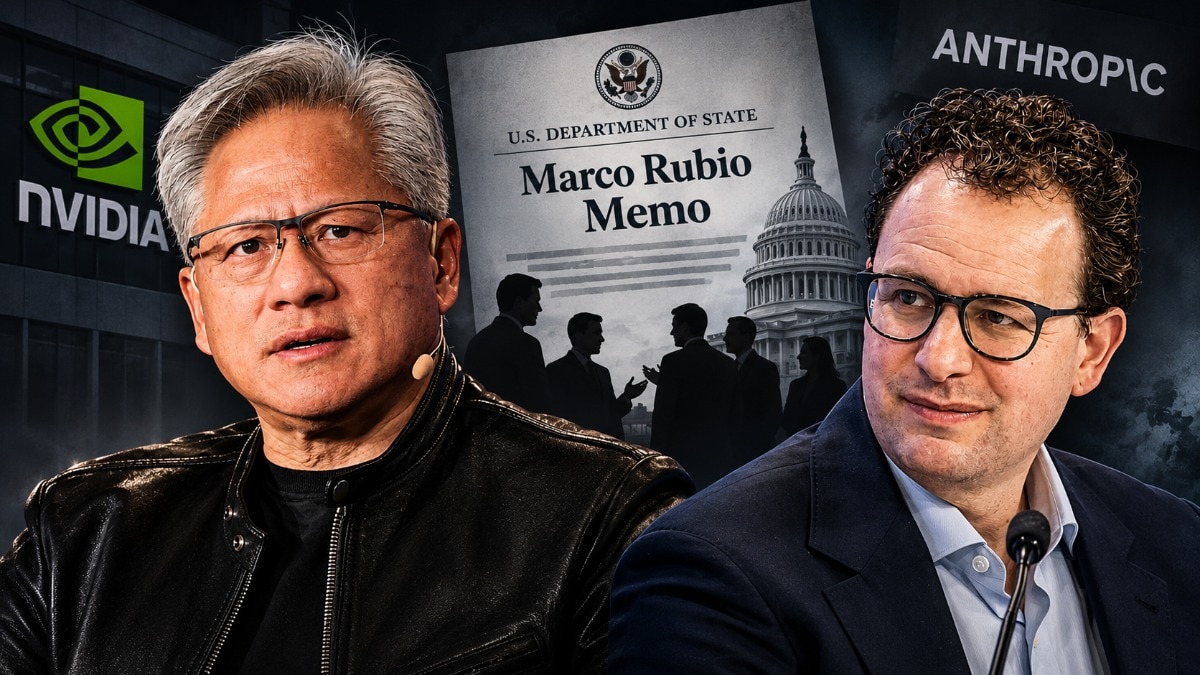
Jensen Huang’s fall from the summit of the tech world has been breathtaking. As the charismatic face of the AI boom, the 63-year-old Nvidia founder watched his reputation implode overnight, felled by romantic entanglements with a woman suspected of spying for Beijing and a high-ranking subordinate.
While personal indiscretions undeniably delivered the final blow, a compelling shadow play is emerging behind the scenes. Did trillion-dollar rival Anthropic quietly help pull the strings? Political spending records reveal that since 2025, Anthropic funnelled millions into premier Washington lobbying firms with deep, direct ties to top officials in the Trump administration.
Months after US Secretary of State and China hawk Marco Rubio drafted the memo that catalysed Huang’s fall from grace, Anthropic’s lobbyists were busy working the very halls of power Rubio commands. This has ignited speculation that the AI powerhouse orchestrated a corporate hit on its biggest rival.CLASH OF TITANS
The ideological chasm between Nvidia and Anthropic on AI policy is no secret.
Anthropic has championed strict oversight, backing global export restrictions on advanced chips to keep rival nations, mainly China, from leaping ahead in the AI race. Earlier this year, the company found itself blacklisted as a "supply chain risk" in an ugly legal feud with the US government after refusing to strip safety guardrails from AI tools for military use.
By contrast, Jensen Huang aggressively fought back against export caps, arguing that American tech firms deserve a fair crack at the Chinese market. He became Washington’s most vocal champion of open-weight AI models, the budget-friendly alternative threatening Anthropic's closed-system model.
In May 2025, the two publicly clashed when Anthropic alleged that China was getting away with smuggling chips in "baby bumps" or "alongside live lobsters". Nvidia fired back, accusing the AI giant weaponising policy to stifle competition.
Anthropic stood by its position, while Jensen Huang personally lobbied Trump to lift limits on Nvidia chip sales to China. Now, new disclosures indicate that Anthropic was already working behind the scenes to bring the White House around to its worldview.THE LOBBYING APPARATUS
Filings under the Lobbying Disclosure Act show Anthropic has shelled out $1.63 million (approx Rs 15.23 crore) since April 2025 to two elite lobbying firms.
The first is Continental Strategy: Paid $740,000 (approx Rs 6.9 crore) since April 2025, the firm was repped by Alberto Martinez, Marco Rubio’s former chief of staff when he was in the Senate.
Martinez lobbied the House, Senate, and the President's Office on AI security. Filings show that he was also in touch with the National Security Council and the State Department -- both headed by Rubio. Ballard Partners was on board in March 2026 shortly after the Pentagon's blacklisting of Anthropic. Susie Wiles, who served as Trump's chief of staff till earlier this month, was a managing partner at the firm until 2019.
Ballard's lobbying team included Micah Ketchel, formerly a senior adviser in the State Department under Rubio and Amaryllis Fox Kennedy, Trump’s health secretary RFK Jr’s daughter-in-law. Interestingly, she is also an ex-CIA officer.
Anthropic poured $890,000 (Rs 8.31 crore) into Ballard, whose portfolio expanded from engaging with the White House over defence procurement to broader national AI policy.
These lobbying disclosure filings list targeted offices and not meeting outcomes. They also do not have explicit mention of Nvidia or Huang. While not conclusive evidence that Anthropic orchestrated Huang’s ouster or that its lobbyists influenced Rubio’s memo, these documents indicate a timeline and connections behind a well-oiled influence campaign.THE MEMO AND THE COLD SHOULDER
The turning point arrived with a classified memo drafted under Marco Rubio in 2025. According to the New York Times, the memo warned very senior officials that Jensen Huang, a trusted ally of Trump, was intimately involved with Alice Huang, a senior executive at Singapore-based Megaspeed and a suspected Chinese intelligence asset.
The Justice and Commerce departments said Monday that a probe into Megaspeed had been underway since 2024, part of a larger investigation into shell companies suspected of smuggling restricted Nvidia chips to China.
Intelligence reports indicated that Alice Huang was having an affair with a US citizen -- that person was later “unmasked” to be Jensen Huang after officials requested full disclosure, reported CNN.
Rubio's memo, dated March 30, 2026, was circulated among a handful of Cabinet secretaries ahead of Trump's trip to China in May, NYT reported. He drew on a CIA report but presented the agency's findings "in his own more assertive terms", per The Washington Post.
Perhaps sensing the tide turning against him, Jensen Huang tried to secure a meeting with Rubio – twice last year and one in early 2026 -- only to be rebuffed all three times, according to the Washington Sun. Rubio’s office brushed him off citing scheduling conflicts.
These snubs stoked panic inside Nvidia that hostile government factions were actively working to undermine Huang and his pitch for closer economic ties with Beijing.advertisementWHEN THE CHIPS ARE DOWNAs the investigation into Megaspeed pressed forward and Rubio stonewalled Huang, Trump was briefed on the surveillance surrounding Alice Huang and her suspected ties to Chinese intelligence. According to the NYT, when the US President got to know of the then Nvidia chief’s close relationship with Alice Huang, he opted against taking any action.
Meanwhile, the Trump administration was also resisting calls for additional regulations to prevent foreign access to US superintelligence, and even greenlit sales of Nvidia’s powerful H200 chips to China, subject to conditions, late last year.
Then, while the links between Alice Huang and the Chinese government was still under investigation (and remains so), Rubio’s memo landed on the desks of Trump’s top policymakers, informing them that Huang may be compromised.
Shortly afterwards, on April 17, Trump's then-chief of staff Susie Wiles hosted Anthropic CEO Dario Amodei at the White House, alongside Treasury Secretary Scott Bessent. The White House described the meeting as "productive and constructive".
Soon after, the Trump administration began gradually tightening the clampdown on advanced chip exports, squeezing Nvidia's revenue pipelines.
The final executioner's stroke arrived when The New York Times accessed Rubio’s memo and went to town with it. The public revelation of Huang's affair vaporised his family-man persona, sent Nvidia shares plunging, and put its chip sales under renewed scrutiny.
Close on the heels of this came another bombshell report, this time alleging an affair between Huang and Nvidia executive Kimberly Powell. The chip giant called an emergency board meeting, followed by an announcement that Jensen Huang had stepped down.
Given the timing of the Nvidia scandal and Anthropic's backchannel connections to influential figures in the Trump administration, some people have smelt a rat and are wondering if there was a clandestine campaign to bring down a titan of the AI industry. But why?CORPORATE SABOTAGE?
Put simply, Nvidia posed a threat to Anthropic's business model.
Anthropic's revenue depends on spending heavily to develop closed AI models and charging customers to access them.
Jensen Huang was going all-in on producing frontier class open models, which meant users would no longer have to pay Anthropic for its services.
Nvidia has been investing heavily in developing cheaper, more open-source AI models that could compete with Anthropic's offerings. The chip giant was also backing startups working on such alternatives and helping make their models more widely available, according to Business Insider.
For Anthropic, Huang’s ouster couldn’t be more propitious. The firm will make its stock market debut on November 19, which could value it at $2 trillion.
Investigative journalist and Drop News co-founder Ryan Grim said that information regarding Huang’s private life could easily have travelled from Anthropic through its lobbyists directly into Rubio’s inner circle.
"The implication there would be that Anthropic brought it to Alberto [Martinez], who brought it to Mike Needham, Rubio's current chief of staff," Grim said during a conversation with geopolitical commentator Mario Nawfal.
Grim also speculated that the memo targeting Huang could have been developed through these connections and subsequently leaked to The New York Times.
Whether this was routine corporate lobbying or a calculated takedown, the outcome is clear. Anthropic's vision is now the law of the land: the US government has officially closed the loopholes that allowed Chinese firms to tap Nvidia GPUs via overseas data centres.
It’s a massive win for Washington's China hawks, and for Dario Amodei just as he invites Wall Street to bet on Anthropic's AI empire.- Ends


