Diplomacy falters as meeting on Strait of Hormuz proposal postponed
By continuing to browse our site you agree to our use of cookies, revised Privacy Policy and Terms of Use. You can change your cookie settings through your browser.
Houthi fighters gather around a vehicle at a seized camp during an offensive in the port city of Mokha, western coast of Yemen, September 13, 2026. /VCG
Middle East diplomacy appeared to falter with the postponement of a meeting between Iran and other Persian Gulf powers, while fresh attacks around the region's two most important oil transit routes deepened concerns over global energy supplies.
Oil prices jumped as markets reopened on Monday, following developments that threaten supplies from the world's biggest exporter, Saudi Arabia, which kept a key 1,200-kilometer (745-mile) east-west pipeline closed throughout the weekend after it was damaged in drone strikes on Friday.
Hopes for a diplomatic breakthrough in the near term faded when Oman's foreign minister, Sayyid Badr bin Hamad Al Busaidi, posted on X late Sunday that a regional meeting scheduled for Monday had been postponed "in the interests of consensus."
"We remain committed to fostering dialogue that supports stability and lasting cooperation in our region," Al Busaidi added.
Confirming the meeting's deferral in an interview with Iran's official news agency IRNA, Mohammad Ali Bak, director general of the Persian Gulf at the Iranian Foreign Ministry, said it was postponed to another date at the request of some regional countries and based on a joint decision by Iran and Oman.
The official stressed that Iran is in close consultation with Oman to ensure the necessary arrangements and coordination regarding the appropriate time for holding the meeting.
Iranian officials had said they would attend the gathering with Gulf Arab states to present an agreement with Oman on governing shipping routes through the Strait of Hormuz.
In Saudi Arabia, state media released video of damage to homes and a mosque from the latest purported cross-border attack by Yemen's Houthi group in Jazan Province in the south.
In a statement on social media platform X on Sunday, Houthi military spokesperson Yahya Sarea said "Saudi warplanes" had launched 58 airstrikes across six provinces of Yemen over the past 24 hours.
Sarea said F-15 fighter jets carried out the strikes after taking off from the King Khalid Air Base in Khamis Mushait, a southwestern Saudi city near the Yemeni border, describing the bombardment as Saudi "aggression."
The Houthis also claimed separately to have struck a Saudi military base in a neighboring province following their capture of Perim Island in the Bab el-Mandeb Strait, the "Gate of Tears" that controls the mouth of the Red Sea.
The Houthi advance along the Red Sea coast is part of the biggest eruption of fighting in Yemen for years.
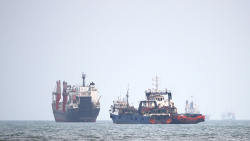
Commercial vessels remain at anchor in the Strait of Hormuz in Bandar Abbas, Iran, September 12, 2026. /VCG
The postponement of the regional meeting came as Saudi Arabia kept the pipeline shut, at least for now. It has served as a key route for exporting Middle Eastern oil while bypassing the Strait of Hormuz.
Traders and Saudi oil buyers told Reuters on Sunday that Riyadh had enough crude stored at its Red Sea port of Yanbu to sustain exports for only five to seven days if the pipeline damaged on Friday remained offline.
Beyond that point, as much as 4% of global oil supply could be put at risk, on top of the millions of barrels a day already affected by disruptions to shipping through the Strait of Hormuz.
Saudi Arabia has not disclosed the full extent of the pipeline damage or said how long the line will remain offline.
The Strait of Hormuz also continued to pose risks to oil shipping. The British maritime security agency UKMTO said on Sunday that a vessel had been struck by a projectile while transiting the strait, sparking a fire and forcing its crew to evacuate.
Qin Tian, deputy director of the Institute of Middle East Studies at the China Institutes of Contemporary International Relations, told China Media Group (CMG) that uncertainty surrounding the Saudi pipeline was compounded by disruptions to shipping through both the Strait of Hormuz and the Bab el-Mandeb Strait.
As a result, oil shipments from the Red Sea are being rerouted north through the Suez Canal, adding to transportation costs and extending delivery times, Qin said.
He also warned that many energy-consuming countries in the Northern Hemisphere, having drawn down strategic reserves during the first half of the year, now face stronger incentives to replenish inventories and increase purchases of oil and natural gas as winter approaches.
The impact has already been felt in energy markets. Oil prices surged above $100 last week for the first time since July, while US diesel prices hit another record high on Sunday, topping $6.20 a gallon.
US President Donald Trump, meanwhile, said during a weekend trip to Ireland that he still expected the Iran war to end this year, possibly just after the November midterm elections, and predicted that gasoline prices would "drop like a rock" afterward.