Ditch ‘enemy state’ label, Japanese PM tells UN - Bangkok Post
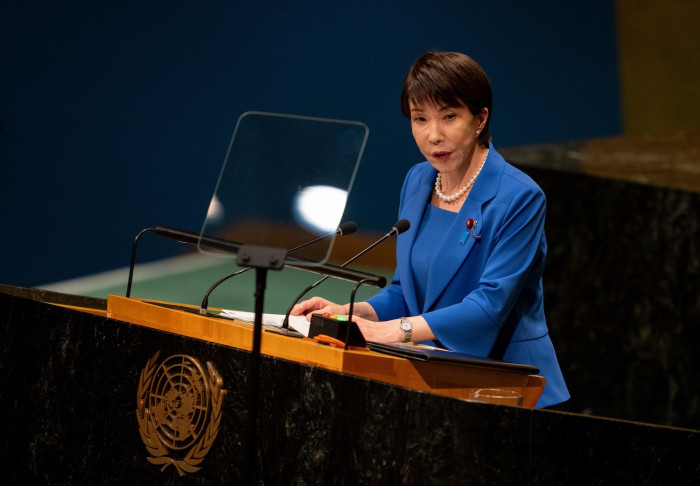
Prime Minister Sanae Takaichi of Japan addresses the United Nations General Assembly at UN headquarters in New York on Sept 22, 2026. (Photo: Lexi Parra/The New York Times) Japanese Prime Minister Sanae Takaichi has called on the United Nations to scrap references to former Axis powers as “enemy states” in its Charter — a World War II-era designation that China and Russia have recently used to attack Tokyo.
Takaichi, in her first appearance before the UN General Assembly in New York, described Japan as a “peace-loving nation” and said the references “must be deleted”.
“I would like to strongly emphasise this position as Japan has the pride and honour of its significant contributions to the efforts of the United Nations over the last 70 years,” she said.
The UN Charter, drafted during the final months of World War II, includes several references to “enemy states”. At the time, the Allies wanted to preserve a way to act against the reemergence of militarism or fascism among Axis powers such as Japan, Germany and Italy, without having to consult the newly formed UN Security Council.
Japan’s leaders have called the “enemy state” label anachronistic. In 2005 the UN General Assembly passed a resolution in support of removing the language.
But it has been difficult to get the backing of the UN Security Council; any of its five permanent members, including Russia and China, can veto any measure. Some are concerned that removing the language could open the door to other revisions, such as changing the makeup of the Security Council, that would dilute their influence.
China has seized on the “enemy states” term recently to attack Japan, part of a months-long effort to punish the country over comments Takaichi made about Taiwan. In November, Takaichi said that Japan could intervene militarily if China were to attack Taiwan, a self-governed democracy that Beijing considers part of its territory.
Beijing has since accused Tokyo of reviving World War II-era militarism, pointing to Takaichi’s efforts to rebuild the military. After Takaichi’s remark last year, the Chinese Embassy in Japan said the “enemy state” clause permitted the use of force against former Axis powers if they adopted a “policy of aggression”.
Russia has also invoked the term. Last month, its foreign minister, Sergey Lavrov, told reporters in Moscow that Japan was designated an “enemy state” in the UN Charter. He was answering a question about a territorial dispute between Russia and Japan.
Jeff Kingston, a professor of modern Japanese politics and history at the Tokyo campus of Temple University, said Takaichi wanted to remind the United States “whose side Japan has been on for the past eight decades as a model international citizen”.
She was also trying to “draw a line in the sand” with China’s leader, Xi Jinping, and Russia’s leader, Vladimir Putin.
“She is playing to an international audience and seeking to highlight how this outdated clause is politicised by Japan’s adversaries,” he said.
Takaichi had a full agenda in New York, where she met with President Donald Trump on Tuesday, a day before he was set to host Xi for a state visit in Washington.
Takaichi had been eager to meet Trump before the visit to brief him on China’s increasingly aggressive economic and military measures against Japan, and to highlight Japan’s investments in the American economy.
Seated next to Trump at UN headquarters, Takaichi said the meeting demonstrated “the strength of the Japan-US alliance to the world”.
Takaichi also used her appearance at the UN to promote her country’s desire to play a more active global role in defence and economic matters.
She issued a stark warning about the changing world order, saying the “stable post-Cold War era is now a thing of the past”.
She pitched her country as a force for stability and strength, ready to help on issues such as artificial intelligence, climate change and nuclear disarmament.