DMK's Autumn: From Kallakudi's rails to the smartphone trap
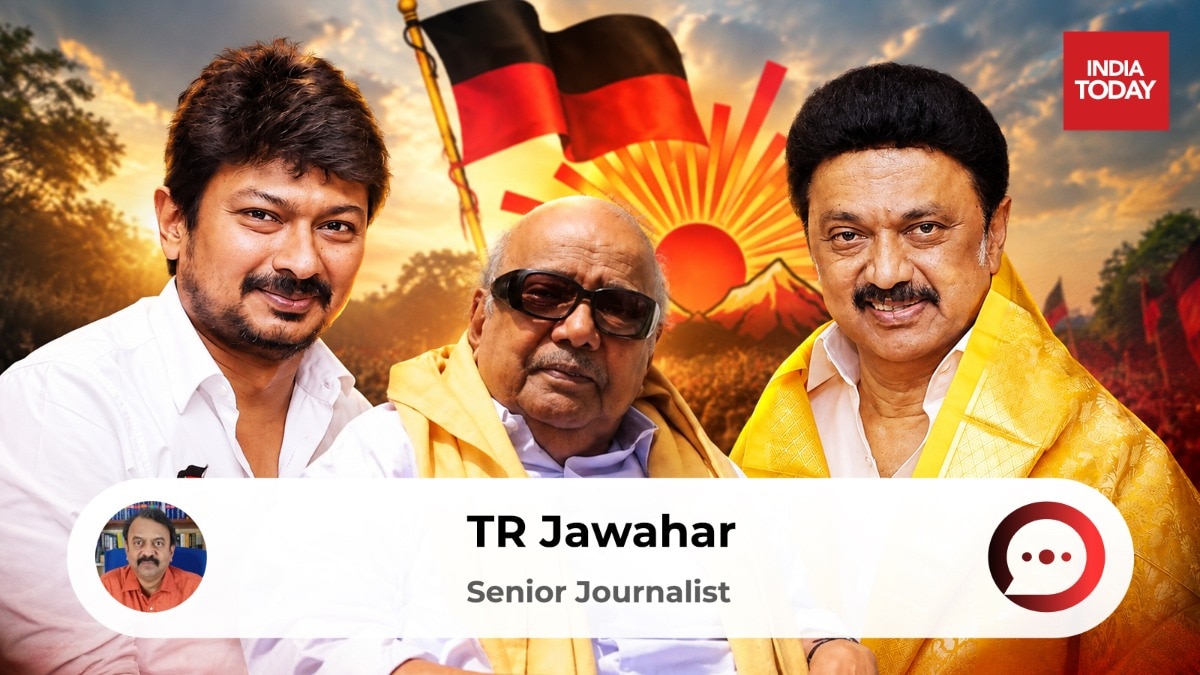
In parliamentary politics, defeat is an ordinary occupational hazard; ideological disorientation is an existential catastrophe.
The Dravida Munnetra Kazhagam (DMK) has known political winters before. Dismissed by presidential fiat in 1976, banished by MG Ramachandran’s charismatic spell for over a decade, and sacked again in January 1991, the party was decimated by Jayalalithaa to a two-seat rump post-Sriperumbudur.
Yet every freeze gave way to a roaring resurgence: romping back in 1996, engineering a resilient return to Fort St George in 2006, and reclaiming power in 2021. Even when shut out of the Lok Sabha without a solitary seat in 2014, the Kazhagam never lost its bearings—rebounding under MK Stalin to orchestrate crushing parliamentary sweeps in 2019 and 2024. It possessed an innate compass: it knew who it was, whose grievances it voiced, and which drumbeat would summon its faithful back to the ramparts.
Much of that durability was anchored in the political savvy of M Karunanidhi. From 1996 to 2013, the DMK remained one of New Delhi’s most consequential regional arbiters. Kalaignar played the national chessboard with exquisite, cynical dexterity -- transitioning effortlessly from Deve Gowda’s United Front to Atal Bihari Vajpayee’s NDA in 1999, then smartly switching sails to Manmohan Singh’s UPA in 2004 as the national tide turned. He extracted cabinet portfolios, federal patronage, and regional leverage while retaining his ideological camouflage.
That agile political instinct, that razor-sharp reading of the electoral weather, is precisely what the Kazhagam lacks today. In its place sits an exhausted, lumbering complacency.
The verdict of 2026 belongs to an entirely different, terrifying pathology. Being reduced to 59 seats in a 234-member Assembly while watching a novice political outfit capture 108 seats on its maiden voyage cannot be laughed off as conventional anti-incumbency.
For six unbroken decades, Tamil Nadu’s political universe was governed by a predictable Newtonian duopoly alternating between DMK and AIADMK with metronomic regularity. That duopoly has been shattered. The Kazhagam stares into the mirror only to discover that the image looking back is no longer that of a lean, insurgent movement that once rattled New Delhi, but that of a fatigued, overweight establishment whose ideological software has suffered a catastrophic system crash.
The party still commands an elephantine apparatus: district secretaries whose fiefdoms rival mediaeval baronies, municipal tentacles reaching into every panchayat ward, and deep financial reservoirs. Yet an army with elephantine supply lines is completely useless if the soldiers have forgotten why they march, or if the battlefield has moved to a terrain they can neither comprehend nor colonise.YESTERDAY'S YOUTH VS TODAY'S GEN Z
To diagnose the present paralysis, one must undertake an archaeological excavation of the party’s founding soul. The DMK did not enter Tamil consciousness as a prudent board of elderly trustees managing family endowments, publishing houses, and educational conglomerates. It began in 1949 as an unruly, audacious fraternity of generational heretics.
When CN Annadurai led his splinter group out from the austere shadow of Periyar’s Dravidar Kazhagam, the movement drew its oxygen from young rebels who owned little more than their inkwells, theatre scripts, and soaring prose. They were the original Gen Z of twentieth-century Thamizhagam.
These radicals turned college quadrangles into ideological workshops, published fiery weeklies from ramshackle garrets in George Town, and subverted the staid Congress monopoly through cinema dialogue. In 1953, a youthful Karunanidhi did not hire PR consultants to protest the naming of a railway station after an industrial magnate; he led cadres to lie flat across the sun-scorched iron tracks at Kallakudi, reportedly even placing his neck before the steam engine.
A decade later, during the cataclysmic anti-Hindi movement of 1965, the DMK became the undisputed vehicle of student fury. Across the state, students defied batons, marched into tear gas and boycotted examinations to defend their mother tongue. The DMK spoke their native grammar, offering an intellectual self-respect and a ferocious sense of collective ownership. It was a young movement speaking the idiom of the young.
Fast forward six decades to 2026, and observe the tragicomic generational inversion. Today, the party of student agitation has ossified into the very imperial establishment it once dynamited – and it confronts an 18-year-old voter whose psychic universe is negotiated six inches from a high-definition smartphone screen.
To the digital nerds, political loyalty is non-transmissible. The DMK operates under the aristocratic delusion that political reverence is an inheritable family heirloom: because a grandfather treasured Anna’s epistolary missives to his ‘Thambi’ like household scripture, and a father had his political awakening devouring Kalaignar’s blistering Parasakthi monologues alongside the morning Murasoli, the granddaughter must instinctively genuflect before the Rising Sun.
Nothing could be further from reality. To a tech-savvy youth juggling coding assignments, gig-economy livelihoods, soaring urban rents, and algorithmic feeds on Instagram, YouTube, and X, the anti-Hindi agitations of 1965 are as emotionally distant as the Carnatic wars and Robert Clive. When senior DMK patriarchs mount wooden pulpits to deliver scolding, fifty-minute orations tracing the Self-Respect Movement from the 1920s, the young voter does not feel educated; they feel trapped in a punitive, compulsory lecture.
The modern voter possesses an exquisite radar for condescension couched as counsel. While the Kazhagam treats history as a heavy ancestral debt to be repaid in votes, Vijay’s rookie TVK offered them something infinitely more digestible: concise, digitally portable punchlines that fit neatly into a fifteen-second vertical reel.
Like I have said before, the DMK leadership responded by publicly disparaging "reel culture" and lamenting the superficiality of modern attention spans, even while quietly spending heavily on private agencies to churn out stylised reels of its own. The hypocrisy blazed like the neon sign of a new Pizza and Burger outlet.advertisementTHE QUASI-AIADMK MUTATIONThe generational chasm is merely a symptom of a deeper, systemic rot: the Kazhagam’s unprincipled metamorphosis into a quasi-AIADMK.
Historically, the DMK distinguished itself from its offshoot by claiming a monopoly on ideological purity. The AIADMK, born out of MGR’s cinematic aura in 1972, was dismissed by DMK intellectuals as a populist fan club -- a transactional bazaar devoid of moorings, sustained entirely by personality cults, populist freebies, and feudal patronage. The DMK prided itself on being the party of cadres, internal debate, constitutional literacy and systemic reform.
Yet, in its desperate quest to monopolise power across every electoral season, the DMK systematically adopted the very vices it once derided. It opened its doors wide to absorb the AIADMK’s regional musclemen and factional heavyweights. From KKSSR Ramachandran to EV Velu, from absorbing O Panneerselvam and his followers to rolling out the red carpet for V Senthil Balaji, the Kazhagam transformed into a clearing house for mercenary political capital.
These leaders were not imported because they experienced a midnight epiphany regarding Anna’s federalism or Periyar’s rationalism; they were enlisted as satraps to deliver territorial turf, mobilise private transport fleets, and manage local cash machinery.
In doing so, the DMK altered its institutional DNA. The party of social emancipation mutated into an entrenched corporate syndicate burdened by recurring allegations involving real estate, family-linked institutional empires and the opaque patronage surrounding the TASMAC ecosystem.
By attempting to out-muscle the AIADMK at its own game of clientelism, the DMK absorbed so much of its adversary that victory over the AIADMK gradually became indistinguishable from becoming it. When two parties become identical in their lust for patronage, an electorate seeking disruption will naturally look past both.THE MORBID ARCHIVE: TAMIL NADU'S MACABRE CURRENCY
Nowhere has this degradation been more transparent than in the cynical exploitation of human tragedy. When 41 lives were snuffed out in a horrific crowd crush at Vijay’s campaign rally in Karur on September 27, 2025, the tragedy was immediately presented as an indictment of cinematic mania, reckless rally management, and failures of crowd control -- although the precise allocation of administrative and organisational responsibility remains under investigation. The spectacle of young supporters perishing in the rush of political ambition shocked the nation's conscience.
Yet, to anyone acquainted with Tamil Nadu’s grim political archives, the intersection of political power and freshly dug graves is an ancient, well-practised Dravidian ritual. The dead do not vote, draft manifestos, or interrupt Assembly debates; yet their corpses have perpetually served as the macabre foundation stones upon which the state’s political empires are erected.
These tragedies across the decades were neither causally nor morally identical; what united them was the political afterlife imposed upon the dead. The anti-Hindi movement was cemented in public memory through the sacrifices of Chinnasamy of Tiruchi, who immolated himself in January 1964, and Sivalingam of Kodambakkam, who followed during the climactic agitation of January 1965 -- cataclysms transformed by the Kazhagam into the liturgical holy text of Tamil linguistic nationalism.
When Anna passed away in February 1969, the Guinness-record funeral that brought Madras to a standstill degenerated into a grim carnival of mortality. Twenty-eight mourners travelling on the roofs of overcrowded trains were killed when they struck the girders of the Kollidam bridge; others were trampled amid the enormous convergence on Madras. In the Dravidian political lexicon, however, these mass fatalities were swiftly subsumed into the myth of unshakeable cadre devotion.
Two years later, in 1971, the tragedy turned overtly sinister at Annamalai University. According to enduring accounts of the protest, students tied a cardboard sign reading "Doctor" around the neck of a donkey and paraded the beast across the campus in derisive protest against the conferment of an honorary doctorate upon Karunanidhi. After the subsequent police lathi-charge, mathematics student KP Udayakumar disappeared. A body recovered from a campus water tank was identified by students as his, although the official inquiry disputed that identification. The unresolved circumstances became a lasting political chargesheet against the DMK government.
Two decades later, the cycle repeated itself under the AIADMK’s imperial watch. In 1992, during the Mahamaham festival in Kumbakonam, 48 pilgrims were killed in a stampede amid security restrictions and catastrophic crowd mismanagement surrounding the ceremonial dip taken by Jayalalithaa and Sasikala. The DMK seized upon those deaths to prosecute the Chief Minister across every public platform in the state.
Tamil Nadu’s political gladiators have never hesitated to trade in grief. Every corpse is evaluated for its electoral yield; every tragedy is immediately weaponised as a campaign weapon. When the DMK sought to paint Vijay’s fledgling TVK as a killer outfit over Karur, it was not inventing a new moral standard; it was merely attempting to play a time-tested Dravidian card, blissfully unmindful that its own historical attic was overflowing with skeletons. And a cine-crazed fan-state, ever forgiving of their favourite matinee stars, forgot the dead quickly and voted Vijay, no matter!
In Tamil Nadu's morbid milieu, leaders and cadres alike treat political victims as harvestible cadavers for successful experiments.OLD WINE IN A DESIGNER DECANTER
The fundamental tragedy of the 2026 election is that while the DMK was comprehensively rejected, the ideology it purported to champion was not replaced, it was simply stolen. Vijay’s TVK did not arrive with an alternative political philosophy, a conservative economic critique, or a radically new civilisational vision. TVK is not an ideological alternative; it is an ideological mimic.
Vijay’s brand of politics represents the exact same Dravidian vintage, decanted from the Kazhagam’s dusty earthenware pot and poured into a sleek, vertical-screen designer decanter. Vijay did not abolish the Dravidian operating system; he changed the wallpaper, accelerated the processor, and supplied a younger user interface.
Deconstruct the TVK manifesto, and you find that the clothes bear the unmistakable family resemblance of the Dravidian wardrobe. Not every promise was identical, but the governing grammar plainly was: free electrical units, monthly cash transfers to female heads of households, educational hardware for school students, agrarian relief, and the constant, ritualistic repetition of "Social Justice."
Look upon the backdrops of TVK’s lavish stages, and the ideological theft becomes absolute. There stand Periyar, Ambedkar, Kamaraj, Velu Nachiyar, and Anna. MGR and Jayalalithaa are invoked selectively. Vijay did not design a brand-new political mansion; he merely slapped a fresh coat of high-gloss emulsion onto the existing Dravidian bungalow, tweaked the atmospherics, installed more vivid glares, and mounted high-decibel woofers.
The DMK was defeated not by a revolutionary force that challenged its foundational tenets, but by a slick cover band that played its own signature tunes with tighter cinematic rhythm and better lighting. The initial composers stood bewildered on the sidelines, wondering why the youth preferred the remix to the original recording.THE MISA FIASCO AND THE TACTICAL SELF-GOAL
If the DMK’s ideological decay set the stage for its defeat, its conduct in opposition has transformed a setback into an unmitigated farce. A parliamentary opposition has one primary, unremitting vocation: the forensic cross-examination of the government of the day.
Barely four months into its tenure, the fledgling TVK ministry was already floundering under its own weight. Fumbling through bureaucratic shuffles and defending extravagant Rule 110 announcements, the treasury benches were ripe for an audit. A disciplined opposition would have brought fiscal scalpels to Fort St George, pinning the untested Chief Minister to the ledgers of current governance.
Instead, the DMK walked straight into an elementary political ambush. I laid out this DMK self-goal in considerable length in this article, so I will not go into the details here.
By erupting into self-righteous rage, the DMK stepped directly into the algorithmic slaughterhouse of handheld media. Their diatribes were promptly chopped into micro-clips, subtitled, set to mocking background scores, and beamed across the state. Within hours, the narrative shifted from TVK’s governing deficits to the unbridled vulgarity of the DMK frontbench, prompting MP Kanimozhi to issue a pointed, unmistakable reminder from the Thirukkural on restraint in speech.UDHAYANIDHI'S DILEMMA AND THE ASSEMBLY AS CRUCIBLE
This tactical bankruptcy lands squarely on the shoulders of the new Leader of the Opposition, Udhayanidhi Stalin. Inheriting a political title within the Kazhagam is an internal administrative transaction; commanding the respect of the House requires an entirely different order of intellectual mettle. Leading 59 members in a 234-seat Assembly cannot be sustained by youth-wing slogans, theatrical cameos, or curated social media reels. The Assembly is a relentless crucible. Under the sustained glare of live television, every hesitation, every petulant walkout, and every empty seat is beamed live to the electorate.
When the opposition is repeatedly evicted or walks out, it does not look like heroic resistance; to the modern viewer, it looks uncomfortably like surrendering the argument. Udhayanidhi must decide whether he intends to remain a privileged heir trading on dynastic capital, or whether he is willing to do the unglamorous forensic work of an opposition statesman who dissects government bills clause by clause, exposes administrative gaps with data, and holds the Treasury accountable to the Constitution.
For inspiration, he can look up to the portrait of his grandpa Nidhi in that very sanctum he now occupies.
The challenge is rendered perilous by the near collapse of the DMK’s traditional coalition umbrella. For over a decade, the party enjoyed the luxurious cushion of a pre-packaged front—herding the Congress, the VCK, the Left and the IUML into the tent to guarantee a formidable and consolidated vote base.
Today, that grand coalition lies largely dismantled. The Congress, VCK, IUML, and Vaiko’s MDMK have cheerfully clambered aboard Vijay’s Secular Social Justice Victory Alliance (SSJVA). Marooned in unaccustomed isolation, the DMK can no longer rely on external coalition arithmetic to mask its internal organisational exhaustion. It must learn to fight, persuade, and win largely on its own organisational and ideological strength.THE RECONSTRUCTION OR THE RELIC?
The DMK is not dead. More than three-quarters of a century of deep institutional roots, municipal networks, and cultural penetration cannot be wiped off the map by a single electoral reversal. But history, however glorious, cannot be eaten for dinner.
The Kazhagam’s profound identity crisis is that it has forgotten how to be an insurgent. It behaves like an anxious, besieged landlord desperately brandishing yellowed title deeds from the 1960s to evict a tenant who has already redecorated the living room, changed the locks, and invited the neighbours over for a housewarming party.
If the DMK spends its time in the opposition looking backward into the archives of 1976 – quarrelling with ghosts, trading street insults, nursing dynastic grievances, and demanding unearned reverence from an unimpressed generation – it will soon discover the cruel truth of modern mass politics: while its elderly patriarchs were busy dusting off Sarkaria Commission reports, an entire generation quietly picked up its mobiles, muted the audio, and subscribed to someone else.
The party's predicament concerns not just about a couple of by-polls around the corner but the longer haul. As the focus of modern Tamil politics shifts irrevocably to the digital arena and an incrementally younger demographic, the choice before the Kazhagam is whether to embark on a painful, unsparing reconstruction or fossilise into an irrelevant relic.- EndsPublished By: Prateek ChakrabortyPublished On: Sep 22, 2026 09:32 IST