Donald Duke: From Cross River record to PRP’s 2027 presidential gamble - Vanguard News
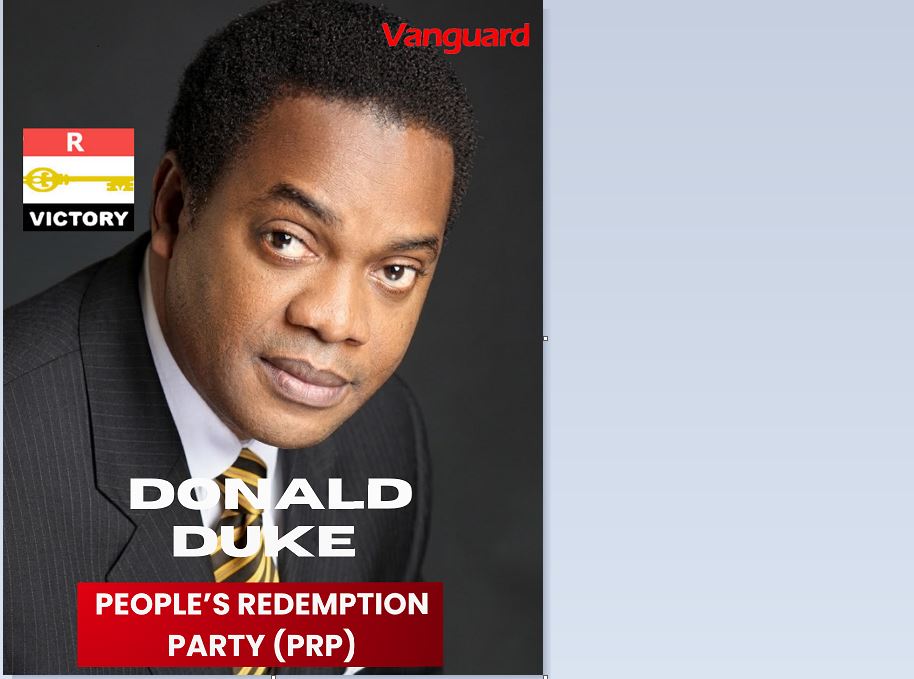
Donald Duke’s return to Nigeria’s presidential race is less a story of a new entrant than of a politician reopening a national argument that began nearly two decades ago.
The former Cross River State governor, now the Peoples Redemption Party, PRP, presidential candidate, is asking voters to reconsider an old proposition: that competence, institutional discipline and performance should matter more than political loyalty.
That proposition gives Duke a recognisable identity in a crowded field. But it also exposes his central difficulty. A record remembered beyond Cross River must now become nationwide organisation, a durable coalition and votes in a contest where the APC enjoys incumbency advantages.
Duke, a lawyer educated at Ahmadu Bello University, Zaria, entered elective politics after a private-sector career. INEC’s published particulars identify his qualification as a law degree from ABU. In 1999, he emerged as governor of Cross River State on the platform of the Peoples Democratic Party, PDP, beginning an eight-year tenure that ended in 2007.
His political reputation was shaped by the development agenda pursued in Cross River. Tourism, infrastructure and institutional reforms became central features of his administration. The Tinapa Business Resort and Obudu tourism project remain associated with that period, while his government also established a reserve fund backed by law, an attempt to create fiscal protection against future shocks.
Supporters point to such initiatives as evidence of a governor who thought beyond the immediate electoral cycle. Duke has revived that argument in the 2027 campaign. In an August interview, he said his record showed an intention to “leave a place better than I met it”, arguing that politics should end with the election, and governance should begin with capable appointments.
That is the core of his political identity today: not simply a former governor, but a candidate presenting administrative competence as an alternative to patronage.
Duke’s presidential ambition did not begin with the PRP. After leaving office in 2007, he sought the presidency on the PDP platform, but lost the party’s nomination to Umaru Musa Yar’Adua. He later contested the 2019 presidential election on the Social Democratic Party, SDP, platform after years away from frontline politics.
His return reflects Nigeria’s unsettled opposition politics.
In May 2026, Duke won the PRP presidential primary. The party affirmed him after its internal appeal process reviewed petitions arising from the exercise. The outcome was not without controversy.
Another aspirant, Yakubu Kingsley, went to court challenging Duke’s emergence, alleging that Duke was not a registered party member within the required timeframe and questioning aspects of the primary process. Duke and the PRP contested the challenge, while the matter entered judicial proceedings.
The dispute shows that Duke’s first test is not merely persuading Nigerians, but maintaining a credible candidacy amid battles.
Duke has sharpened his national argument. He says Nigeria needs competence rather than political loyalty in government appointments, and has called for a broader institutional reset.
His concerns span insecurity, agriculture, infrastructure, education and healthcare. He has also criticised high interest rates, rising public debt and spending priorities, calling for financial reforms, affordable credit, energy security and greater institutional efficiency.
His language has sometimes been blunt. In June, during the presentation of PRP certificates and flags to candidates, he accused the political class of capturing the country and weaponising poverty for electoral advantage. The statement positioned his campaign as an indictment of the existing political order, rather than simply another bid for office.
Its strength will depend on whether it becomes a governing programme and an organisation capable of delivering it.
Duke’s choice of the PRP is significant. The platform gives him a vehicle outside the established opposition parties, but it does not automatically provide the national structure enjoyed by the APC or historically by the PDP. His strategy, therefore, depends heavily on coalition building beyond the party’s existing footprint.
The question now is whether the Cross River governor can make his second act bigger than his first. Duke has experience, a defined governing philosophy and a record he can point to. What remains uncertain is whether those assets can overcome the organisational realities of a fragmented opposition and produce the national coalition he says Nigeria needs.
Comments expressed here do not reflect the opinions of Vanguard newspapers or any employee thereof.