Donald Trump Approval Rating Slumps in 7 of 8 States Canada Targeted - Newsweek
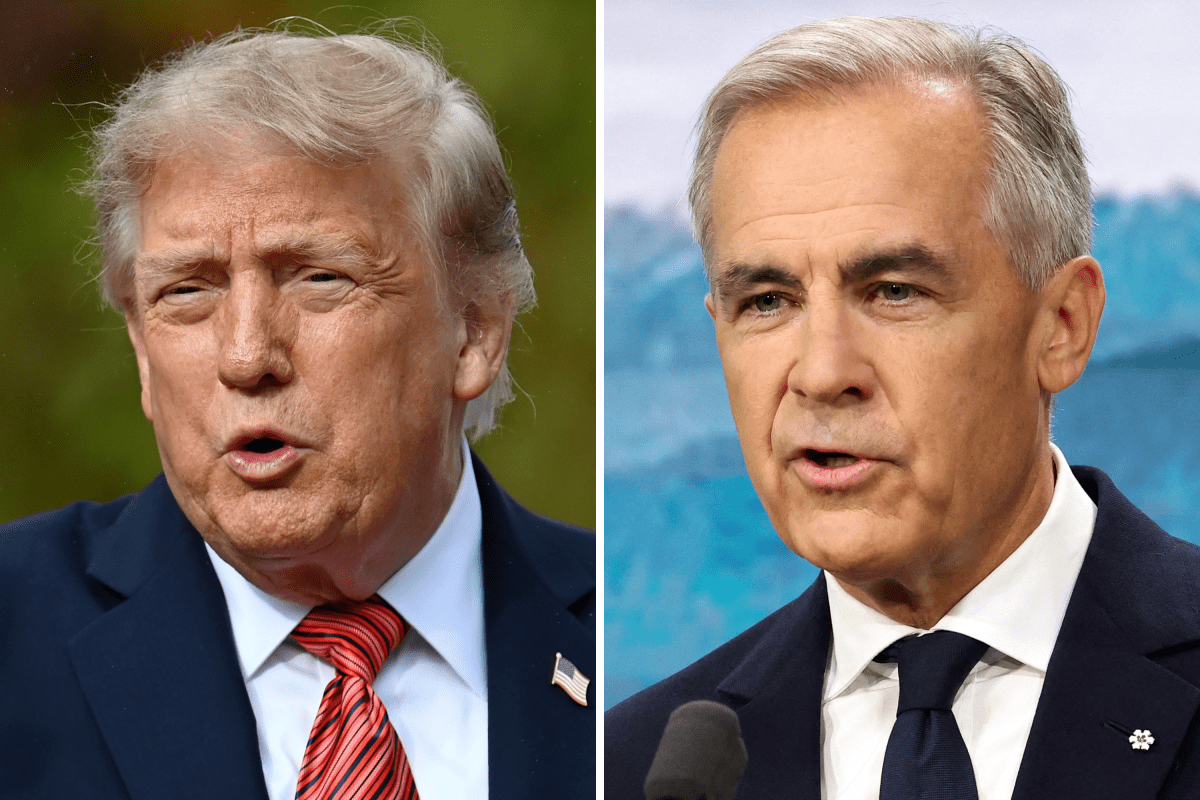
President Donald Trump’s net approval rating has fallen in seven of eight states that Ontario Premier Doug Ford urged Canada to target with additional tariffs because of their political importance to the president’s base, according to Civiqs tracking.
The change came between August 22, when trade negotiations between the United States and Canada collapsed and 50 percent American tariffs took effect on roughly $20 billion of Canadian imports, and September 16.
Washington and Ottawa’s deepening trade dispute could put pressure on American producers shortly before the midterm elections. Voters, exporters and Republican candidates face the clearest risks in places where economic ties to Canada collide with weakening support for the president.
While the movement does not establish that the U.S.-Canada trade war caused voters to turn against the president, it gives fresh relevance to Ford’s explicitly political argument that Canada should direct economic pressure toward states closely connected to the administration’s electoral base rather than treating retaliation as a purely nationwide trade measure.
The development also lands amid a potentially historic shift in Canada’s foreign economic strategy.
European Commission President Ursula von der Leyen said Wednesday that she wanted to work with Prime Minister Mark Carney on opening the door for Canada to deepen trade ties with the Brussels bloc. Carney has said Canada is not seeking full European Union membership, instead describing the objective as a “unique alliance” with Europe.
Presidential approval can shape the political environment in which congressional candidates run, particularly when voters connect federal policy with household costs or local industries.
Civiqs does not ask what caused each state’s movement, so the figures cannot prove that the trade fight drove the declines.
Civiqs’ rolling tracker of registered voters covers Trump’s second term from January 20, 2025 and includes 130,338 responses through September 15, 2026.
Arkansas still gave the president a positive rating, but its cushion narrowed from 12 points on August 22 to 7 points in the latest reading. Approval slipped from 53 percent to 50 percent as disapproval rose from 41 percent to 43 percent.
Florida experienced the same five-point net decline from a weaker starting position. Its rating fell from -9 to -14, with 40 percent approving and 54 percent disapproving. Montana lost four points, changing from a +4 to 0 as approval and disapproval converged at 46 percent apiece.
Three states shifted against Trump by smaller margins. Alabama fell from +7 to +4, Wisconsin moved from -16 to -19, and both Missouri and Texas deteriorated by 2 points.
That left the president underwater in five of the eight states. His deficits stood at 26 points in Texas, 19 in Wisconsin, 14 in Florida, 12 in Iowa and 11 in Missouri.
Iowa broke the broader pattern. Approval rose 6 points to 43 percent, while disapproval edged up 1 point to 55 percent, improving the net result from -17 to -12.
The state picture matches a difficult national backdrop. On September 16, the live Civiqs tracker showed Trump at 34 percent approval and 60 percent disapproval among registered voters nationwide.
Canada’s countermeasures followed bilateral negotiations that broke down and the U.S. imposition of additional duties on Canadian goods. Ottawa’s response targeted American imports across sectors including dairy, agricultural equipment and electronics.
The White House said its own measures addressed Canadian treatment of American commerce in the alcohol, dairy and motor-vehicle sectors. A September 8 fact sheet said five proclamations would modify existing tariff lists and prohibit selected Canadian imports. Product changes took effect September 15, while import bans are scheduled for September 29.
Those restrictions apply to covered goods regardless of whether they qualify for preferential treatment under the United States-Mexico-Canada Agreement, the Trump administration said.
Ford named Alabama, Arkansas, Florida, Iowa, Missouri, Montana, Texas and Wisconsin in an August 17 letter to Carney, arguing that they were “politically significant states to the current administration’s base of support.”
He called for a “coordinated dollar-for-dollar, tariff-for-tariff response” if Washington imposed additional levies and warned Canada against accepting an agreement that failed to give meaningful relief to workers and businesses.
“We cannot back down in the face of economic coercion,” Ford wrote. “Capitulation in response to Section 338 tariffs will only weaken Canada’s position. We must remain strong.”
Ford also argued that Canadian electricity, energy and critical-mineral infrastructure should be treated as strategic negotiating assets. His proposal did not itself impose tariffs. National customs and trade policy is controlled by the federal government in Ottawa.
The states are economically exposed to Canada in different ways. Canada was Alabama’s largest goods-export market, receiving roughly $4.3 billion in goods during 2025. It was Arkansas’ second-largest market, accounting for about $1.3 billion, and Florida’s second-largest, at approximately $5.6 billion.
Iowa sent about $5 billion in exports to Canada, representing roughly 30 percent of the state’s total. Canada was Missouri’s largest market, taking $6.7 billion in exports, or 34 percent of the state total. Nearly half of Montana’s exports, worth about $1 billion, went to Canada.
Texas had the largest exposure in dollar terms. The state exported just under $35 billion in goods to Canada in 2025, making Canada its second-largest foreign market after Mexico. Wisconsin sent approximately $7.6 billion in goods to Canada, or 28 percent of its total exports.
The Globe and Mail’s editorial board subsequently backed the political logic behind targeting U.S. voters, while rejecting the economic case for tariffs.
The board described the economic rationale as “zilch, nada, zero” because tariffs would increase prices on both sides of the border.
It nevertheless said there was “a limited (and time-limited) political case to be made” for ensuring American politicians and voters understood the consequences of the trade dispute.
“But it is very much in this country’s interest for American politicians, in both parties, to be fully aware of the consequences of Mr. Trump’s trade war,” the editorial said, adding that voters should know which candidates were willing to break with the president and call for an end to the conflict.
“A new Congress that is willing to enforce U.S. law and to halt Mr. Trump’s trade tantrums: that is retaliation worth pursuing,” it added.
An Economist/YouGov poll conducted August 28 to 31 found 58 percent opposed raising tariffs on Canadian goods, 68 percent said Trump’s tariffs had hurt average Americans, and 64 percent viewed Canada as an ally or friendly.
A CBS News/YouGov poll, conducted September 8 to 11 among 2,460 U.S. adults, found 58 percent of likely voters considered tariffs very important, 56 percent preferred a candidate opposed to Trump’s approach, and 45 percent saw their vote as opposition to him.
In her annual State of the European Union address in Strasbourg on September 16, von der Leyen told Carney: “I would like to work with you on opening the door for Canada being the first associate member of the EU.”
Her proposal would represent a change in EU practice.
“Associate membership” is not provided for in the bloc’s existing treaties, and the EU has historically resisted creating flexible categories between membership and an ordinary external partnership. Carney had previously sought to distinguish membership and a custom-built partnership.
“We’re not looking to become a member of the European Union,” he said on September 13. “What we are looking, and will begin discussions for, is a unique alliance between Canada and the European Union.”
White House spokesman Davis Ingle has repeatedly argued that Trump’s 2024 election victory is a more meaningful measure of public support, saying that the administration’s economic agenda is still taking effect.
“The ultimate poll was November 5th 2024, when nearly 80 million Americans overwhelmingly elected President Trump to deliver on his popular and commonsense agenda,” Ingle told Newsweek in emailed comments he has used multiple times.
“No other President in history has accomplished more for the American people than President Trump, who is working tirelessly to create jobs, cool inflation, increase housing affordability, and more. The President has already made historic progress not only in America but around the world, and this is just the beginning as his agenda continues taking effect.”
Newsweek’s reporters and editors used Martyn, our AI assistant, to produce this story. Learn more about Martyn here.
Contact Newsweek editors on this story: Ben Kelly and Sam Wilson.