Donald Trump Says Ohio Arena Was 'MAXED OUT': Timeline of Rally Crowd Size Clashes - Newsweek
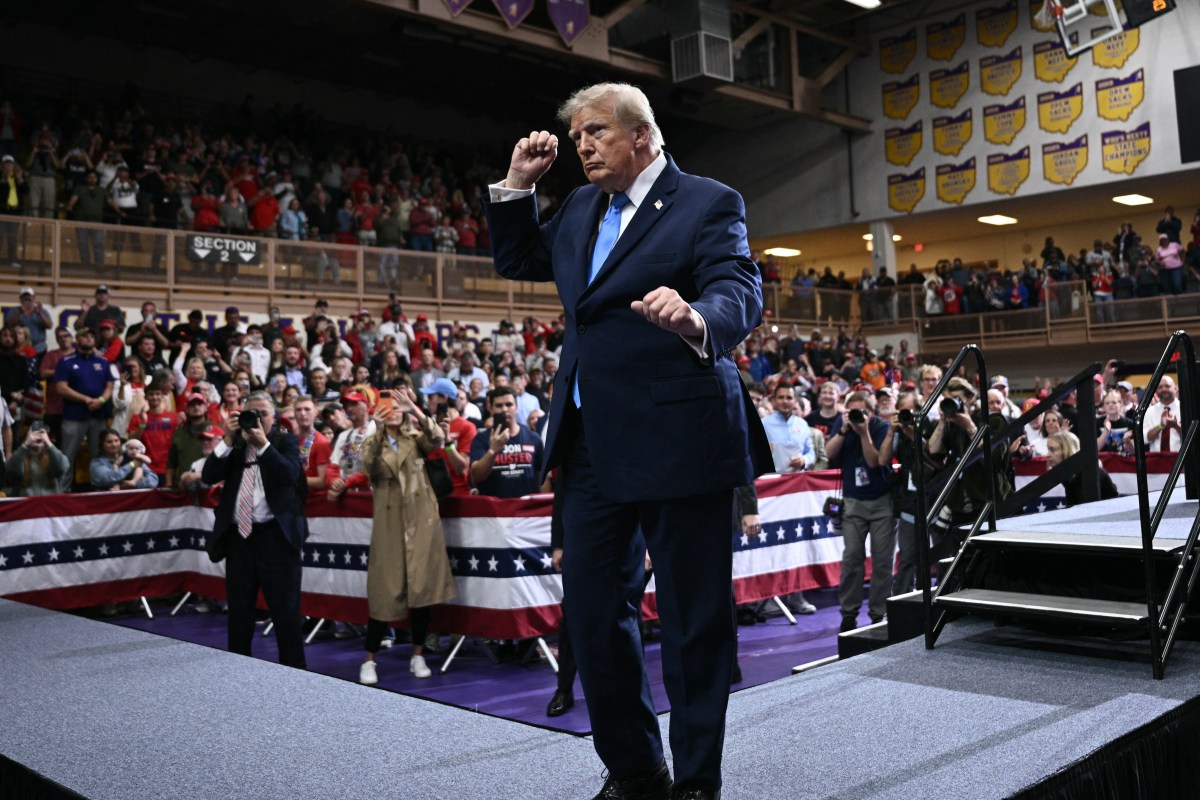
President Donald Trump pushed back Monday against reporting about attendance at his recent rally in Ohio, insisting the venue was “totally MAXED OUT” and claiming thousands of supporters were unable to get inside.
Trump made the claim in a lengthy Truth Social post after coverage of his Saturday rally at Butler High School in Vandalia, Ohio, and his Friday rally at the Mitchell Center at the University of South Alabama in Mobile, highlighted empty seating in the upper bleachers.
The president said supporters routinely move from upper sections toward the main floor at his sold-out events, describing the process as “migration.” He also said he has begun having cinematographers record his rallies to counter what he described as inaccurate media coverage.
The dispute is the latest in a long-running series of controversies over Trump's claims about the size of crowds at his political events.
On Monday, Trump attacked The New York Times as "Fake News," accusing them of reporting that his October 3 Ohio rally "was not full" with some upper sections "almost completely empty."
“In actuality, thousands of people were unable to get in. The Arena was totally MAXED OUT, including all upper sections,” Trump wrote, adding that people seated in upper sections routinely move closer to the stage once the event begins.
“What does happen at all of my SOLD OUT Rallies, is that the people in the upper sections tend to migrate down to the Main Floor — The ‘migration’ process always happens!” Trump wrote. “I never have empty seats — Never have, and never will!”
Trump also claimed that his events for Republican candidates are “probably more crowded than ever."
NBC News reported that several stretches of upper-bleacher seating were empty when Trump took the stage in Vandalia, with more seats empty by the end of his 93-minute speech.
California Democrat Rep. Ted Lieu also mocked the president for boasting about filling such a small venue.
“The trump rally was at a … high school gym," he posted on X.
But The Times report Trump quoted did not refer to the Ohio rally. The wording he cited — that “the place was not full” and that “some upper sections were almost completely empty” — came from a New York Times article about Trump's October 2 rally in Mobile, Alabama. Photos from that event showed rows of empty seats as Trump talked. Trump held the Ohio rally the following day.
Trump held the rally at the Butler-Vandalia Student Activity Center, part of Vandalia-Butler High School in Vandalia, near Dayton, Ohio on Saturday.
The Ohio High School Athletic Association lists the Student Activity Center's capacity at 4,500. The facility is primarily known as a basketball venue and regularly hosts postseason tournaments.
The Trump campaign's official event listing also identified the venue as the Butler-Vandalia Student Activity Center at 600 S. Dixie Drive in Vandalia.
Local reporting showed substantial interest before the event. Supporters had begun gathering hours before Trump's arrival, while a local reporter described thousands lining up outside the 4,500-seat venue.
Photographs and video from the rally show a large crowd inside the gymnasium, particularly on the main floor, but they also show unoccupied areas in the upper seating sections.
NBC News reported that several stretches of the upper bleachers were empty when Trump began speaking and that the empty areas increased by the conclusion of his speech.
Other photographs from the event show the gym with substantial attendance, illustrating the difficulty of determining an exact crowd size from individual images. The Washington Post described the crowd inside as boisterous and enthusiastic, while other reporting noted the empty upper sections.
Trump's explanation is that attendees moved from the upper sections toward the main floor. That is possible, but there is no publicly available attendance count establishing how many people entered the building, how many were denied admission or whether movement toward the floor fully accounts for the empty sections.
Trump's crowd-size battles began with his first inauguration.
Before taking office, Trump predicted an "unbelievable, perhaps record-setting turnout." His inauguration committee reportedly expected between 800,000 and 900,000 attendees, although no official government crowd estimate was ever issued. The National Park Service had stopped releasing official attendance figures in the 1990s after disputes over earlier National Mall events.
The following day, then-White House press secretary Sean Spicer declared that Trump's inauguration had drawn “the largest audience to ever witness an inauguration, period.” The claim was quickly contradicted by aerial photographs and other measures showing that Barack Obama's 2009 inauguration drew a substantially larger crowd. Independent crowd analysts later concluded Trump's audience was around one-third the size of Obama's 2009 crowd.
The dispute became one of the defining controversies of Trump's first days in office, with Trump and his administration arguing that photographs had been deliberately framed to minimize the size of the crowd.
At a February 2019 rally in El Paso, Texas, Trump claimed the venue could accommodate 8,000 people and thanked the local fire department for allowing about 10,000 people inside.
The El Paso Fire Department said the venue's capacity for the event was approximately 6,500 and that it had not authorized Trump to exceed that limit. Contemporary reporting said the venue was filled to capacity.
Trump's 2020 return to the campaign trail in Tulsa, Oklahoma, generated another major crowd-size dispute.
His campaign had promoted more than 1 million ticket requests ahead of the event at the 19,000-plus-seat BOK Center. But the Tulsa Fire Department reported that just under 6,200 people attended. The campaign disputed the figure and said approximately 12,000 people had gone through metal detectors.
The event also featured large sections of empty seating, while a planned outdoor overflow event was canceled because turnout was far below expectations.
Trump's large beach rally in Wildwood, New Jersey, produced one of the biggest crowds associated with his political career.
Trump said more than 100,000 people attended. Wildwood officials gave an estimate of 80,000 to 100,000 people, a figure also reported by The Associated Press.
While exact numbers were difficult to verify, Wildwood stands as one of the few Trump events where outside estimates were broadly consistent with the campaign's claim of an exceptionally large turnout.
Trump's fixation on crowd size resurfaced at his Great American State Fair kickoff on the National Mall.
Trump subsequently claimed that at least 45,000 people attended his speech. He also said that “everybody stayed right until the end” of his remarks.
That figure was disputed by news reports and photographic and video evidence. The Washington Post described the crowd as thinly covering a relatively limited portion of the Mall, while video circulated showing attendees leaving during Trump's speech.
The event did not produce a definitive official attendance figure that established Trump's 45,000-person claim.
The latest dispute began with Trump's rally for Republican candidates in Ohio, including Senator Jon Husted and gubernatorial candidate Vivek Ramaswamy.
Images and reporting showed a substantial crowd inside, alongside unoccupied stretches of the upper bleachers. Trump later said the venue was “totally MAXED OUT” and that thousands had been unable to enter.
The episode nevertheless continues a pattern that has followed Trump since the beginning of his political career: disputes over crowd size often become a story of their own, with Trump's estimates, venue capacities, official counts and photographic evidence offering different measures of how many people actually attended.
Trump is expected to be visible on the campaign trail as republicans make their final push ahead of the November 3 midterms. He's in Grand Island, Nebraska, today. His next appearance will be at a rally in San Antonio, Texas, on October 7.
Newsweek’s reporters and editors used Martyn, our AI assistant, to produce this story. Learn more about Martyn here.
Contact Newsweek editors on this story: Kate Nalepinski and Gray R. Thomas