Donald Trump ‘Underestimated’ Mark Carney as EU Floats Canada Membership - Newsweek
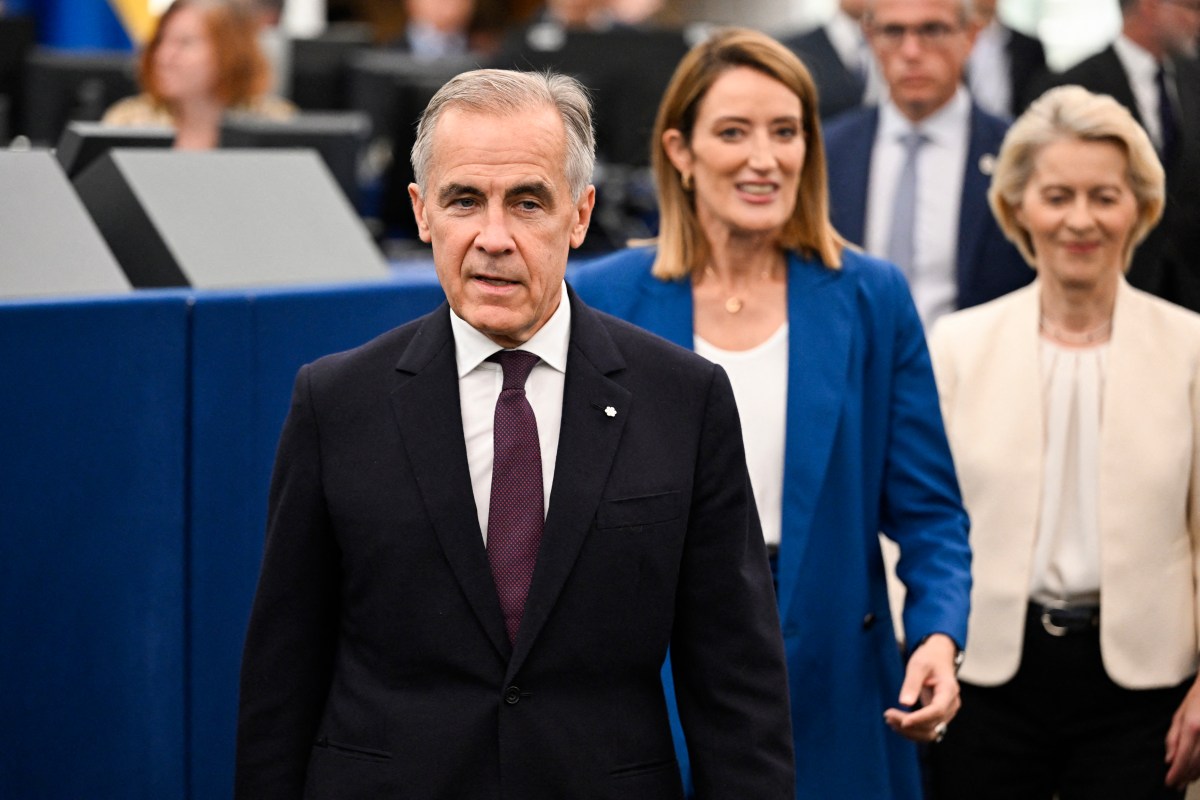
Canadian Prime Minister Mark Carney spent the past year arguing that Canada should stop taking orders from Washington and start building its own alliances. This week, Europe answered him directly with an open invitation that many see as a direct rebuke to President Donald Trump's handling of America's closest neighbor.
European Commission President Ursula von der Leyen proposed making Canada the European Union's first associate member, a status that doesn't exist yet, with no rulebook for how it would work. "Above all, dear Mark, Europe and Canada believe in democracy," von der Leyen said to Carney, who received a standing ovation at the European Parliament in Strasbourg.
Ottawa was reportedly exploring ties with the EU that could stop just short of membership, but von der Leyen's offer became the clearest signal yet that something was in the works. An official who spoke with The Associated Press said Canada would seek an arrangement allowing its citizens to live and work in Europe without visas as part of a broader strategic partnership.
None of this happened in a vacuum. It followed months of tariffs, threats and a president who has openly floated absorbing Canada as a 51st state. Todd Belt, a professor of political management at George Washington University, thinks the White House never saw any of it coming.
"Donald Trump underestimated Carney's resolve," he told Newsweek. "He probably thought that since he was new in office, he would be able to boss him around. And that didn't happen."
Belt says Trump also failed to anticipate the shape retaliation would take.
"The Canadians would respond in kind, and they would do so in a fashion where they deliberately targeted Senate toss-up seats," he said, referring to states like Michigan, Ohio and Alaska.
Washington's biggest trade weapon starts to lose its edge the moment Canada can replace what it loses from the U.S. with new partners elsewhere, according to Belt. "If you disentangle yourself from your primary trade partner and you are able to replace the trade partner with other new trade partners, then that former trade partner has very little leverage."
Jovita Neliupšienė, the EU's ambassador to the United States, framed the door as open but the outcome as undecided. Asked whether other countries might be offered similar status, she was careful to draw a distinction. "It's not a joining," she told Newsweek. "Association is not joining. It's still for the member states to discuss the issue."
What comes next is still an open question. Because this kind of associate status has never existed before, there's no process for approving it, no clear answer on how long it would take, and no guarantee all 27 EU member states would agree to it, since any step toward membership currently requires unanimous approval.
Von der Leyen described the expanded partnership as covering advanced manufacturing, technology, defense production, the Arctic, energy, critical minerals, batteries, artificial intelligence, quantum computing, cybersecurity and economic security. "This is a partnership not against anyone else, but for our common strength," she said.
The existing EU-Canada free trade deal, CETA, would serve as the foundation. Canada has already taken one concrete step in this direction: it became the first non-European country this year to join the EU's SAFE defense program, a 150-billion-euro fund giving Canadian firms access to joint European procurement.
Jonathan Wilkinson, Canada's ambassador-designate to the EU, also said Ottawa isn't interested in full membership. That would mean surrendering some sovereignty, he argued. What Canada wants instead is a relationship close enough to unlock real benefits, without the institutional strings that come with joining the bloc outright.
"We want to get as close as we possibly can," he told reporters, in a way that strengthens Canadian sovereignty rather than diminishing it.
Wilkinson said the two sides are deliberately putting off the question of what to call the arrangement until they've settled what it actually contains. The shape of it, he added, should come into focus at the Canada-EU summit in October.
For all the symbolism in Strasbourg, the numbers haven't moved. Roughly 70 percent of Canadian exports still go to the United States, and experts agree that in a long trade war, Canada would have more to lose.
The gap between what's on offer and what Ottawa actually depends on is stark. Canada's trade with the United States is still far larger than its trade with Europe. U.S.-Canada trade in goods and services totaled $872.3 billion in 2025, nearly six times the $150 billion traded between Canada and the EU.
Brad Setser, a senior fellow at the Council on Foreign Relations and a former senior adviser to the U.S. Trade Representative, sees the announcement as symbolic more than substantive, at least for now. "This move doesn't change the reality that the bulk of Canada's current trade is with the United States, and exports to the U.S. are far more important to the Canadian economy than exports to Canada are to the U.S. economy," he said. "Canada cannot escape from its geography."
Tariffs between Canada and Europe are already low, he noted. Under CETA, roughly 98 percent of tariff lines between Canada and the EU have been eliminated. "Realistic estimates of the economic impact of this move are modest," Setser said.
Fergus Hodgson, director of Econ Americas and a Canadian national based in Calgary, goes further. "Canada does not have a credible alternative path to US trade," he told Newsweek. "Yes, closer China and EU relations can offer partial respite. However, massive trade dependence on the United States cannot and will not be replaced any time soon." The United States, in his view, still holds advantages no other partner can match: purchasing power, geographic proximity, decades of cultural and economic integration.
Setser leaves the door open to this changing over time, even if he doesn't expect it to change soon. Canadian agricultural standards could start converging with Europe's rather than America's, he said, and with enough investment, new infrastructure could eventually move Canadian oil, green aluminum and other commodities to European ports instead of American ones.
"Symbolism over time can turn into substance," he added.
Expanding that relationship means venturing into largely uncharted territory. Associate membership has come up in the past for Ukraine and post-Brexit Britain, but neither case moved beyond the talking stage. Canada would be the first real test of whether the idea works.
Augusto Lopez-Claros, executive director of the Global Governance Forum and a former World Bank economist, has argued for months that Canada already functions like an EU member in most of the ways that matter, except for the geography. "This is good news for Canada because it opens the way to a quicker path to reduce Canada's dependence on the U.S. market for its exports," he told Newsweek.
The EU is already Canada's second-largest trading partner, and there is room to grow that relationship. Canada mainly sells Europe crude oil, aircraft, metals and mining products, with oil and aircraft alone making up about 16.5 percent of its exports to the bloc.
Trump has spent months betting that Canada has nowhere else to go. Carney is betting he can prove otherwise. The bigger question is whether Canada is an isolated case, or the first sign that other countries are making the same calculation.
Trump's numbers give that question some weight. He stood at 35 percent approval and 59 percent disapproval nationally as of late August, according to Civiqs polling, a net of minus 24. He's underwater in every major battleground state, including Ohio and Michigan, two states with deep trade ties to Canada that will help decide control of Congress in November.
Belt sees that decline shaping how other countries read the moment already. He pointed to Brazil, where elections in two weeks could produce a government with its own history of standing up to Washington, though he doesn't think a Canada-Brazil alignment would be aimed at Trump directly. The signal, in his view, reaches other nations regardless. "I think that they will just turn their sites towards one another and away from the United States," he said. "That's a message that's indirect, but I think that it's still a message."
Neliupšienė said any further deal on the EU's side depends on partners who share more than economic interests. "It takes two to tango," she said. "We are looking for partnerships which are not only of interest for the economic cooperation or tech cooperation, but as well where we actually share" deeper values.
Setser is skeptical the fear is broadly dissolving. Geography still constrains what any country can realistically do, Canada included. If low tariffs and a decade of trade growth still add up to only "modest" impact for a country as close to Europe as Canada, the calculation looks weaker for nations with less to build on.
Hodgson doesn't think this is really about Trump at all. He sees Canada's EU pivot as partly domestic politics, a way for Ottawa to do what it wanted to do anyway. "The trade dispute has proved an opportunity to both strengthen the patronage system and appeal to anti-U.S. sentiments among many Canadian voters," he said. Countries with fewer alternatives than Canada, tied more deeply to the U.S. economy, will find another market even harder to build.
"Massive trade dependence on the United States cannot and will not be replaced any time soon," Hodgson said. Whatever Canada gains from Europe this week, that math hasn't changed yet, and for most of the world watching, it still won't.
Newsweek’s reporters and editors used Martyn, our AI assistant, to produce this story. Learn more about Martyn here. Contact Newsweek editors on this story: Jason Lemon and Gray R. Thomas