Donald Trump’s Net Approval Rating Hits Lowest Point of Second Term—Poll - Newsweek
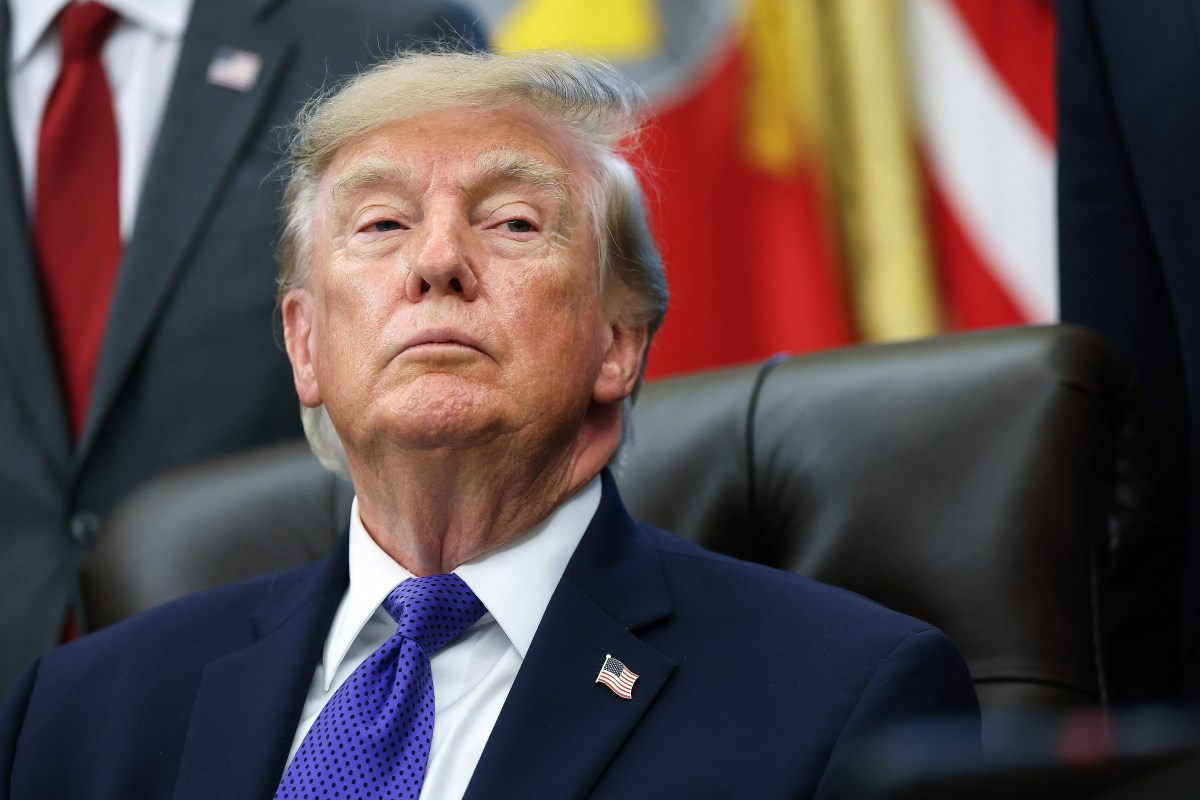
President Donald Trump’s net approval rating fell to its lowest point of his second term in a new Quinnipiac University poll released on Tuesday.
Trump’s net approval rating fell to -27 points, his worst showing yet in any of the pollster’s surveys. He received positive marks from 34 percent of respondents, while 61 percent disapproved of him.
It marks a shift from a Quinnipiac poll released September 10, when his net approval rating was -26 points, with 59 percent disapproving and 33 percent approving of the president.
Trump’s approval rating holds major implications for the midterm elections, and Election Day is now only five weeks away.
Historically, the president’s party loses seats in the midterms if he is unpopular in the polls, and Democrats have sought to make this year’s elections a referendum on Trump. His approval rating has fallen as Americans grapple with economic concerns around inflation, the cost of living and soaring gas prices amid the Iran war.
Jacob Neiheisel, a political science professor at the University at Buffalo, told Newsweek that there are a few factors that are “likely pulling Trump's numbers downward.”
“The war in Iran is certainly one of these. Gas prices and the broader affordability crisis may also be doing some work here,” he said.
The new poll surveyed 1,032 registered voters from September 24 to 27, 2026, with a margin of error of plus or minus 3.8 percentage points.
Newsweek reached out to the White House for comment via email.
The poll found that Trump is broadly unpopular with most voter groups. Among independents, only 25 percent said they approve of his job performance, compared to 69 percent who said they disapproved of him.
Only 4 percent of Democrats approved of Trump, with 96 percent disapproving of him. Among Republicans, his approval rating stood at 81 percent, with 13 percent disapproving.
Women were also less supportive of Trump compared to men, with 26 percent of women and 41 percent of men saying they approve of the president.
Trump’s overall approval rating did reach -27 points during his first term in January 2021, after the January 6 riot at the United States Capitol, when a group of his supporters violently protested the 2020 election results. But it has not returned to that low point during his second term in office.
Trump’s approval rating was also low on key issues voters are concerned with in the midterms. Only 31 percent of respondents said they approved of Trump’s handling of the economy, while 34 percent approved of his handling of foreign policy. When it comes to the Iran war, only 28 percent of respondents gave him positive marks.
Trump has criticized polls showing his approval rating has fallen. On August 30, the president hit back at polls in a post on Truth Social.
“THE FAKE POLLS USED BY OUR CROOKED MEDIA ARE OUT OF CONTROL, AND SOMETHING MUST BE DONE ABOUT IT. FCC TO THE RESCUE! President DJT,” he wrote.
On August 24, he wrote that Democrats are “going CRAZY with Fake Polls.”
“They’re putting them out at levels never seen before. They’re called, ‘Demoralization Operations,’ where they try to demoralize Republicans so that they don’t go out and vote — But the actual Polls are tremendous, and the Spirit in our Country has never been higher,” Trump wrote.
Trump's approval has critical implications for the midterm elections, as Democrats are hoping to take back control of Congress. Democrats are hoping that his low approval rating means they can expand the battleground to compete in more traditionally conservative states, rather than the competitive swing states. Democrats are targeting Senate seats in states like Alaska, Iowa, Kansas, Ohio and Texas, states that backed Trump by 14 points in the 2024 election.
Flipping some of those states is a requirement for Democrats if they want to flip control of the Senate, where Republicans currently hold a 53-47 majority.
Trump’s approval rating “certainly doesn't look good for Republicans” ahead of the midterms, according to Neiheisel.
“Barring a sharp break with historic patterns, they are on track to suffer losses in the midterms,” he said. “The only outstanding question in my mind revolves around the magnitude of the losses that they are going to suffer.”
Republican candidates are in a “tough spot,” he said.
Typically, members of the president’s party would try to distance themselves from the administration, but these candidates are relying on Trump’s supporters to turn out to support them in the midterms, he said.
“They need the kind of energetic support that goes along with Trump among the party's base. They also need to show that they stand apart from the president. This is a needle that is very, very difficult to thread,” he said.
Democrats had a 62 percent chance of flipping the Senate on Kalshi and a 63 percent chance on Polymarket as of Tuesday.
Prediction markets allow traders to buy and sell contracts tied to political outcomes and current events, aggregating real‑money wagers into probability estimates. Prices fluctuate as traders react to polling, fundraising, candidate developments and broader political trends. They measure trader sentiment at a given moment but do not always accurately predict the future.
The House is seen as an easier lift for Democrats. Republicans hold a 218-214 advantage, so even a blue ripple could endanger the GOP majority, since Democrats need to flip only a few seats to take control of the chamber.
Democrats had nearly a 92 percent chance of flipping the chamber on Kalshi and a 93 percent chance on Polymarket as of Tuesday afternoon.
A flurry of other recent polls reveal that Trump’s approval rating has fallen since his return to office.
His net approval rating in a new YouGov poll was -26 points, 62 percent disapproving and 36 percent approving of him. It surveyed 1,429 registered voters from September 25 to 28, 2026, with a margin of error of plus or minus 3.4 percentage points.
A survey from American Research Poll published last week found his lowest approval rating yet, with only 29 percent of respondents giving him positive marks, compared to 68 percent disapproving of his job performance. It surveyed 1,100 adults from September 16 to September 20, with a margin of error of plus or minus 3 percentage points.
In a recent Emerson College poll, his net approval rating stood at -19 points, 58 percent disapproving of him and 39 percent approving. It surveyed 1,000 likely voters from September 21 to 22, 2026, with a margin of error of plus or minus 3 percentage points.
The latest Morning Consult poll gave Trump a -14 point approval, with 56 percent disapproving and 42 percent approving. It surveyed 2,202 registered voters from September 25 to 27, according to The New York Times.
Trump’s approval rating will be closely watched over the coming weeks as the battle to control the House of Representatives and Senate heats up. Developments around the Iran war and economy could shape how Americans view his presidency ahead of the midterms.
Newsweek’s reporters and editors used Martyn, our AI assistant, to produce this story. Learn more about Martyn here. Contact Newsweek editors on this story: Edward T. Cummins