Dov was surrounded by doctors when he had a mental breakdown. None of them helped
You have reached your maximum number of saved items.
Remove items from your saved list to add more.
It was at the end of his second year of medical school that Dr Dov Degen became convinced he was the incarnation of Jesus.
Frantically writing a manuscript and barely sleeping, he wandered the streets at night, wide-eyed and flooded with thoughts about how to better mankind.
“I just wanted to help everyone,” the award-winning nephrologist and general physician says.
“I had this idea of bringing a new Earth to the planet and healing everyone.”
He did not realise it then, but he was in the grips of his first episode of psychosis.
Degen was diagnosed with bipolar disorder at 19, less than two years before.
But looking back, a perfect storm was brewing, he says on a sunny late-winter afternoon over lunch at Lady of St Kilda, one of his favourite haunts.
Degen had realised he was gay. A recent break-up had plunged him into another depressive episode, and he was prescribed antidepressants without mood stabilisers by a psychiatrist, which triggered full-blown mania.
Then came the psychosis. An unstoppable stream of consciousness barrelling through him like a freight train.
I am curious about what he remembers of being in this extreme mental state so often marked by its disturbing and uncontrollable symptoms, such as intense delusions, hallucinations, paranoia, grandiosity, bursts of sudden aggression and shattering loss of reality.
Starman by David Bowie hums quietly in the background of the restaurant, a track about a cosmic saviour, with a message of hope for a troubled Earth. It feels like an uncannily fitting soundtrack.
Degen, 42, pauses and takes a deep breath before continuing.
“Well, I felt happy and high all the time so it’s not a state you want to come out of,” he says.
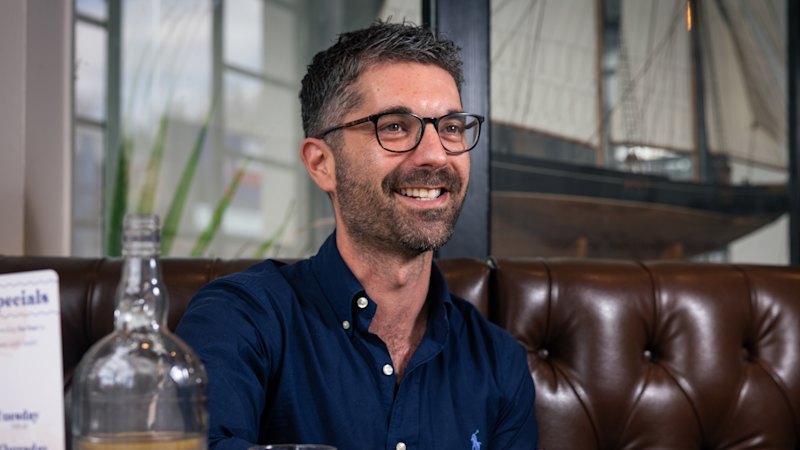
Degen’s experience of bipolar disorder has helped in his advocacy for people with mental health.Ruby Alexander AdvertisementPsychosis does not feel like disaster at first. It can seem more like enlightenment. It is intoxicating, like existing in technicolour. Every moment is more vibrant, Degen says, pulsating with excitement, light and beauty.
“It accentuates parts of you that are already there. You feel spiritual, creative. It can be a really beautiful state to be in, but I really don’t want to glorify it because it’s so incredibly destructive. You’re argumentative. You’re living in an alternate reality. You lose relationships.”
Coming out of psychosis is like waking up from a wild, fever dream, he says.
Disjointed memories flickered in his mind, like strange vignettes. He describes it as like being left trying to piece together the fragments from a wreckage.
“When you hit reality, you realise just how catastrophic the whole event is,” he says.
Degen ended up being admitted to the psychiatric unit at The Alfred hospital in Melbourne.
“I had some of the best conversations of my life with patients in the psych ward there with schizophrenia and all sorts of labels,” he says. “It was just a different plane of existence and, I mean, who’s to say what’s normal?”
A waiter comes to our table, in a quiet corner of the restaurant, bathed in golden winter light.
We realise we have been so engrossed in the conversation we are yet to even look at the menu.
Za’atar pita and dips at Lady of St Kilda.Ruby Alexander We peruse it quickly, ordering freshly baked Za’atar pita and a trio of homemade Mediterranean dips, hummus, tzatziki and spicy vegetable.
For his main, Degen opts for the baked salmon with sauteed vegetables and lemon. I order the Chop Chop: thinly sliced porterhouse steak mixed with garlic and a spicy herb sauce served on a baked sweet potato.
I ask what he was like as a child and Degen’s face softens as he breaks into a wide smile.
“Very inquisitive and passionate,” he says.
He grew up in a Jewish family in the nearby suburb of Caulfield. His father was a dentist and his mother a kindergarten teacher.
Degen always loved helping people, he says, which is why he wanted to be a doctor and why he was a tutor at school. It is also what drew him to become a nephrologist, a specialist who treats any affliction of the kidneys.
He admired the humble nature and compassion of the nephrologists who trained him as a junior doctor.
It was the perfect mix of intricate physiology and human connection, too. The kidneys interact with nearly every system in the human body, he explains, so you often treat the person over many years, sometimes until their death.
Chop Chop: thinly sliced porterhouse steak mixed with garlic and a spicy herb sauce and served on a baked sweet potato.Ruby AlexanderAdvertisementDegen’s parents tell him he was always advanced as a child. At age four, his father found him teaching himself how to play the piano. He had scribbled on the piano keys to map out the music himself, transposing the notes from a music book before anyone had even taught him how to read a score.
He still plays the piano. He loves to sing karaoke, too.
“I tend to always go with I Will Survive or Whitney Houston’s I Have Nothing … something diva like that,” he laughs.
The first stirrings of bipolar emerged in Degen when he was in year 12, perplexing his family and friends.
Always a conscientious student, Degen lost focus. He was only sleeping two or three hours a night. He was hyperactive, excessively talkative, overconfident and spending money recklessly. Despite being in this state of hypomania for six months, Degen still excelled in his studies.
The crash came during schoolies in Byron Bay. He should have felt on top of the world, but he cried every day.
Baked salmon with the sauteed vegetables and lemon.Ruby Alexander “I had just had this six-month high, so I couldn’t explain what was going on, and that’s when I knew something wasn’t right,” he says.
A diagnosis of bipolar brought with it relief and a profound understanding of what he had gone through.
Characterised by extreme shifts in mood, and as old as humankind, historians believe the condition has both plagued and likely fuelled the brilliance, creativity and original thinking of world leaders, writers and artists who have shaped history. Winston Churchill and Vincent van Gogh are thought to be among them.
I ask how being hospitalised shaped the kind of doctor he became. He says the insight, empathy and curiosity that grew from being the patient and then the doctor is the arc of his entire story.
As a doctor, he says, he noticed how patients with mental health conditions were not treated the same way by his colleagues as those with physical ailments.
“Stigma is what’s killing people. It’s not a mental illness,” he tells me frankly.
His experience of bipolar also spurred his advocacy work, which he has undertaken for more than a decade, for SANE Australia and Beyond Blue.
In June, Degen was made an officer of the Order of Australia in recognition of his years of outstanding work de-stigmatising mental health and his accomplished medical career.
“A big part of my advocacy work has been demonstrating that you can be high functioning with a label, that you can have a successful career, a successful life,” he says.
From his first experience of psychosis, it would be more than a decade before it reared again. This time during a devastating manic episode while he was working as a doctor at a Melbourne hospital during the height of the coronavirus pandemic in 2021.
Degen was taking his medication meticulously and thriving professionally, but he was severely burnt out and bone-achingly fatigued.
“I worked through COVID for two years. I took on extra duties. I was always a ‘yes’ person. I was beyond exhausted. I stopped sleeping,” he says.
The breaking point came when he wrote a resignation email one night, uncharacteristically littered with spelling errors and clearly composed while not of sound mind.
Instead of intervening to support him, the hospital accepted his resignation.
“Much like in med school, when I had a manic episode, a lot of people knew that I was unwell, but they couldn’t sufficiently raise the alarm to help and support me,” Degen says.
“That’s something that’s always rung in my head. If a doctor going through a mental health crisis can’t get the help and support they need, what hope does someone in wider society have?”
Life as he knew it was obliterated overnight. He felt discriminated against, stigmatised, demoralised.
“Every time I’ve had a mental health symptom, it’s always been met with stigma and discrimination,” he says.
The bill, please“There’s never been a comfortable, safe return-to-work plan. I’ve always been treated like a leper. If you had a relapse of cancer, you get cards and flowers. If you have a relapse of mental health, you’re met with stigma, shame, stipulations on your working conditions.”
It is the discrepancy between the way physical and mental health are treated that Degen finds so hard to reconcile. It’s what he hopes to change through his advocacy work.
“It’s an illness that affects the mind, but because it can’t be visualised it is seen as less legitimate,” he says.
“It doesn’t define me any more than someone with high blood pressure or diabetes. People need to see the person, not the label.”
He describes the year everything fell apart as a “severe professional death”.
But as our conversation continues, it becomes clear it was so much more than that.
“I was so ashamed of myself. I felt so guilty for all the things I said and did when I was unwell,” he says.
“I was apologising to people. Some wouldn’t accept my apology. I lost everything. I had insomnia. I had no quality of life.”
His body was riddled in rashes. A tooth fell out from stress. He thought about suicide.
“It wasn’t even depression, it was worse than depression,” he says. “I just had no hope.”
Even after the manic episode passed, and Degen’s psychiatrist cleared him to work, the hospital network refused to let him return to his job.
Degen was left stacking shelves at a pharmacy to make ends meet. He is still unsure how he survived that year.
He poured himself into volunteer work (he still works with the homeless), he became a university tutor, and slowly built up his private practice again.
Degen began to speak more about his experience of living with bipolar. A video he was in for SANE went unexpectedly viral online. Suddenly, he was inundated with messages from colleagues.
“One said, ‘I’ve got panic disorder’, another said they had experienced drug-induced psychosis, another had an eating disorder,” he says.
“I realised we had all lived siloed within our experiences, but suddenly, there was a safe space to share.”
Degen now works at Epworth Hospital, in an environment he finds extraordinarily supportive.
Knowing that night shifts and sleep deprivation can be triggers for a bipolar relapse, they have adjusted his roster to ensure he gets rest.
“I’ve realised the darkest days can become light again, and the clouds of the storms can reveal the sun behind, but you have to hang on, even if you’ve got no faith, no hope,” he says.
Degen works as an accredited voluntary assisted dying doctor too, helping terminally ill people to die on their own terms.
“It sounds a bit morbid, but it’s just such a special way of helping people,” he says.
Etched in his memory is the first woman he ever helped to die. She was malnourished, too weak to move. In her final moments she was patting her beloved cat, surrounded by her family and the photos of all the people she loved.
“She said ‘thank you’ as we were pushing the medicine,” he says. “It was the first time I’ve seen someone transition from life to death like that. In the hospital they’re dying very slowly.”
The night after our lunch, Degen is due to be a guest speaker at an annual general meeting for one of Melbourne’s major healthcare networks, which coincidentally, includes the same hospital network that failed to support him during his last bipolar relapse.
“The irony is not lost on me,” he says with a rueful smile.
It is a bittersweet moment. A quiet vindication of sorts. The weight of it hangs heavy in the air. He is taking his parents with him. If his story helps just one other person, it will all be worth it.
“There’s an empowerment in owning your story because then no one’s got anything on you. The whole world knows my diagnosis now. There’s nothing left to hide.”
Start the day with a summary of the day’s most important and interesting stories, analysis and insights. Sign up for our Morning Edition newsletter.