Drishyam 3 movie review: Terrific Ajay Devgn-Tabu give Drishyam the conclusion it deserved - The Indian Express
Drishyam 3 Movie Review & Rating: Does the much-awaited concluding part of Drishyam live up to its expectations? Yes, it absolutely does.
A very quick recap, before we jump into the details. In 2013, came the original, headlined by Mohanlal as the not-very-educated cable-TV operator who gets embroiled in a dark cover-up involving his family. Loosely borrowing from the chief plot twists of the globally popular Japanese thriller The Devotion of Suspect X by Kiego Higashino, the Malayalam-language film gained an instant cult following and was remade in a bunch of languages, including Hindi, in which Ajay Devgn jumped into the part and ran with it, in 2015.
The 2022 second part, in which the remains of a body are discovered from a spot no one could ever think of, sustained both audience interest as well as box-office loyalty, making it one of the year’s biggest hits, a bright spot in an industry badly hit by Covid closures.
Now comes the conclusion, in which the Goa-based Salgaonkars, Vijay (Devgn), his wife Nandini (Shriya Saran), and his daughters Anju (Ishita Dutta) and Anu (Mrunal Jadhav) are still living under the cloud of that long-ago murder, in constant dread of discovery. The dead boy’s mother, former senior cop Meera Deshmukh (Tabu) is struggling with deep hopelessness; the father, Mahesh (Rajat Kapoor) finds himself propping her up till the arrival of can-do Crime Branch officer Rajveer Tomar (Jaideep Ahlawat) threatens to blow the cold case wide open, holding out promise of relief.
Deviating significantly for the first time from Mohanlal’s film which came out a few months back, and with its trusty ensemble sexed up by new additions – Ahlawat as the perpetually wreathed-in-cigarette-smoke cop, and Prakash Raj as the seemingly invincible prosecutor Indrajit Shetty – director Abhishek Pathak give us a conclusion which feels right: never taking away the palpable, stunned grief of the victim’s parents, but also never letting the righteous Salgaonkars down by mealy-mouthed court proceedings. The pronouncement, which comes at the end of a tetchy exchanges between junior defence lawyer Gayathri Mohan (Samvedna Suwalka) and the crestfallen Shetty, feels like a vindication.
The reason why we’ve gone along with these characters – the younger daughter has grown, as they say, in front of our eyes – is the moral complexity that surrounds the crime: even if the perpetrator is the worst person in the world, is he improved by killing? Does the guilt ever entirely go away, much as the people involved would like it to? What kind of human can smile and hide such dark secrets without corroding their soul?
While Pathak and his co-writers Aamil Keeyan Khan and Parveez Sheikh take care not to fall too far into the abyss, because that’s what a serious engagement with these questions would bring out (the portly Saurabh Shukla is made the conveyor of these thoughts, which he spells out briefly, before vanishing), the film never abandons its familiar pacy thriller feels and dramatic, dialogue-laden blocks in tight close-up, with spurts of uneasy laughter and the occasional tense moment thrown in.
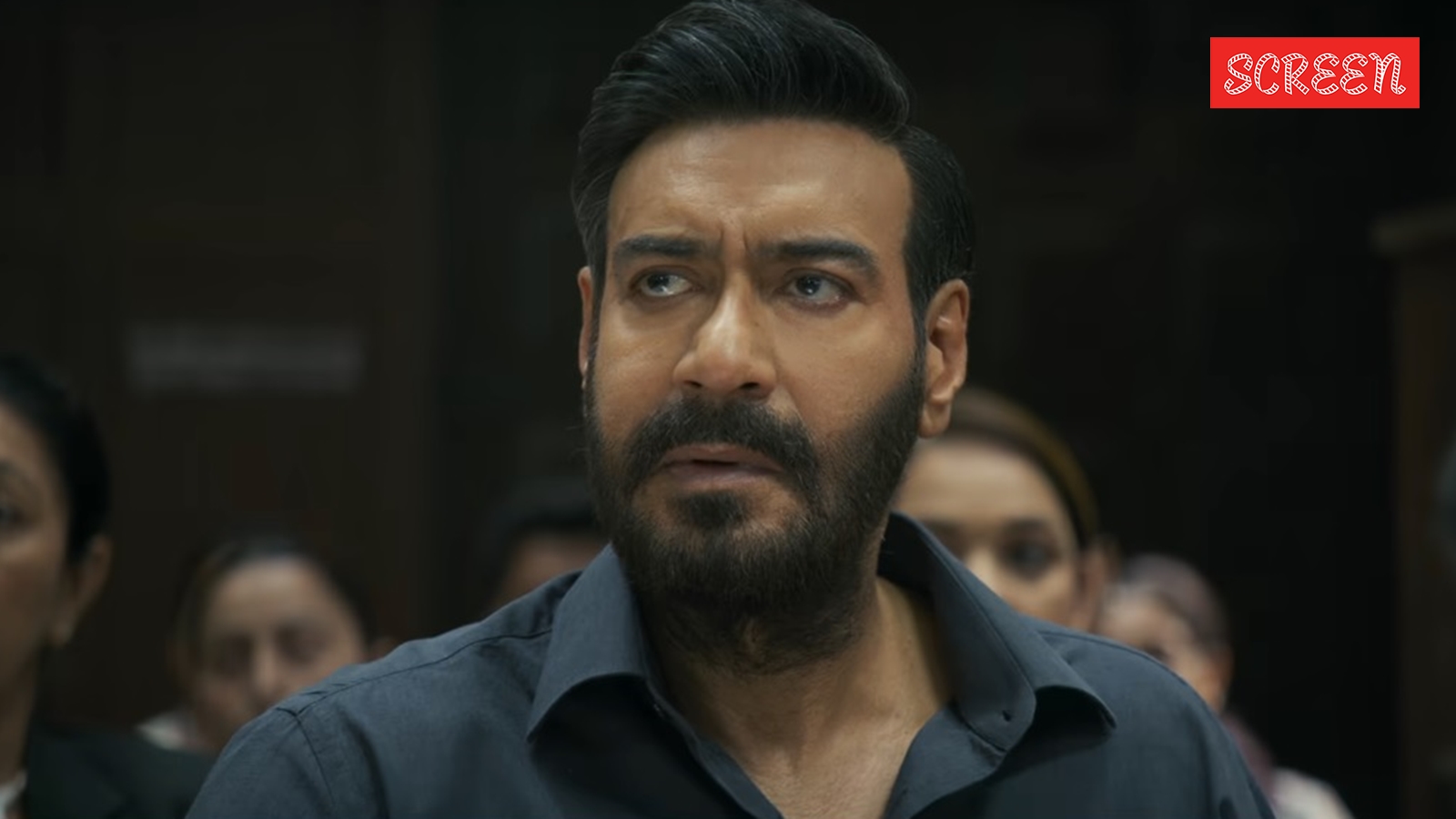
Devgn is as solid as ever as the unflappable, cinema-obsessed Salgaonkar who is always two steps ahead of the law, getting his slo-mo stride to the camera. Prakash Raj thunders effectively. And Jaideep Ahlawat’s jaunty tilt – I’m never going to look at a plate of jalebi in the same way – never once lets me miss the smirky Akshaye Khanna, who played the same part in part 2.
But while the men do most of the heavy lifting, I don’t think I will be able to forget Tabu’s wounded eyes, which belong to a mother unable to comprehend a world which doesn’t have her only child. She’s terrific, as always.
If only the film didn’t wreathe itself in ear-shattering bgm, I would have liked it even more: why do even the most confidently-told films not trust its telling? The final part gives the sense of an ending, and a beginning.