Drishyam The Conclusion review: Good thriller, but not the farewell it deserved
Vijay Salgaonkar has spent two films staying ten steps ahead of the law, constructing lies, planting evidence and turning October 2 into an alibi that became pop-culture folklore. So when Drishyam: The Conclusion arrives four years after the second part, promising to finally close every loop, the expectation is not merely to watch another thriller but to see how Vijay’s elaborate game ends. You want that final twist to make you sit up, applaud and say, “Wow, kya ending hai!”
Sadly, that moment never quite arrives. Drishyam 3 is good. It is clever, entertaining and packed with enough twists to keep you invested for most of its runtime. There are moments that make you smile, root for Vijay and sometimes even genuinely wonder how he will wriggle out this time. But for a film that has been marketed as the final chapter of one of Bollywood’s most loved thriller franchises, it never quite reaches the high of the films it is trying to conclude. The strange thing is, you cannot even say it is a bad film. It is simply not the grand farewell you were hoping for.
The film opens six months after the events of Drishyam 2. Vijay Salgaonkar and his family are desperately trying to rebuild their lives, but the fear of the police case continues to hang over them. And then comes Rajveer Singh Tomar, played by Jaideep Ahlawat, a police officer given the responsibility of reopening the case. Within minutes, he brings in new evidence that can potentially put Vijay and his family right back under the scanner.
The next two-and-a-half hours are essentially another elaborate game of cat and mouse. Only this time, the cat knows exactly who the mouse is.
There is a brilliant line in the film when Murad (Saurabh Shukla) points out that Ravana had ten heads and Vijay has ten stories. And there is one thing common to all of them: “Hero kabhi jail nahi jaata.” It is almost the thesis statement of the franchise.
Vijay is not a conventional hero, and yet you root for him. You know this man and his family have killed someone. You know they have deliberately obstructed an investigation and kept a grieving family from getting closure. And still, when Vijay manages to outsmart the law, you find yourself cheering. And that moral contradiction is the real magic of Drishyam.
There is also a genuinely funny moment when Gaitonde (Kamlesh Sawant) talks about his children sending him memes (pronounced mee-mee) about October 2, because Vijay’s ability to evade him has become a running joke even inside his own family. It is a small scene, but it captures just how much the character has seeped into popular culture.
This time, however, the law appears to be closing in. Prakash Raj enters as lawyer Shetty, the “lawyer ka goonda”, while Tabu’s character, still grieving her son’s death, returns with a renewed desire for revenge. Vijay, meanwhile, is again setting the chakravyuh himself and figuring out how to derail the people trying to trap him. And without giving away spoilers, there are enough moments here that will make Drishyam fans cheer.
The film moves with confidence, but the problem comes in when it occasionally becomes too indulgent. There is a lot of dialogue-baazi, and while some of it is entertaining, most of it begins to feel like the writers are enjoying their own cleverness a little too much. There is a courtroom exchange where the judge tells everyone to come to the “mudde ki baat”, and honestly, there are moments when you want to say the same thing to the film.
Because the courtroom should have been where the film really explodes. Instead, it is strangely one of the biggest disappointments. The twists are there, the evidence keeps changing, the stakes keep rising, but the pulsating drama you expect from the final confrontation never quite arrives.
The film’s treatment of religion as a way of diverting attention from the central issue is particularly interesting, especially in today’s context. It is a smart narrative device and one of the more intriguing ideas in the screenplay.
Interestingly, Drishyam, as a franchise, expects its audience to watch the previous films to understand what’s playing out. While that could potentially alienate a new audience, for franchise fans it actually works.
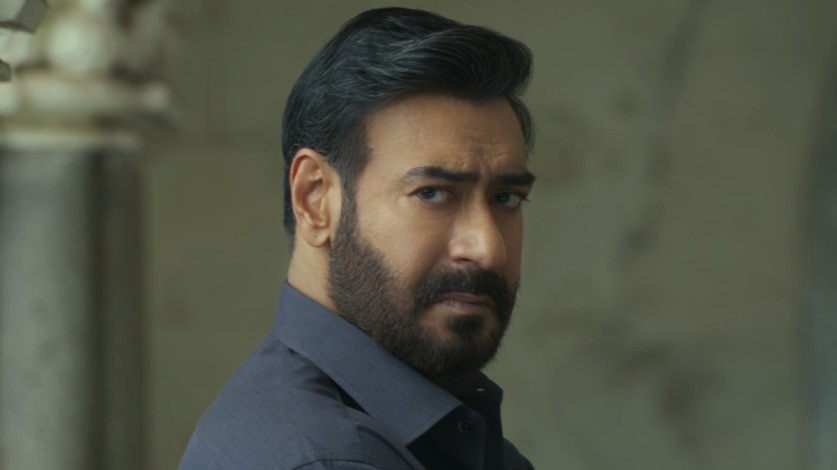
Ajay Devgn is fabulous as Vijay Salgaonkar. Eleven years after first stepping into the character, he has made Vijay completely his own and so different from Mohanlal’s Kutty. The brooding eyes, the intense stare, the almost straight-faced calm even when the world around him is collapsing, everything has become synonymous with this character.
Shriya Saran gets some strong emotional moments, while the two daughters continue to carry the fear of their past. Tabu and Rajat Kapoor return with revenge replacing some of their earlier helplessness, though their characters are not given enough to do.
Prakash Raj, meanwhile, is terrific. His one-liners are among the film’s funniest moments. Jaideep Ahlawat, too, makes a strong impression. After Akshaye Khanna’s memorable presence in the previous film, Ahlawat arrives as the new face of the opposition, sporting crisp white shirts, gelled hair and a cigarette, and brings a controlled swagger to Tomar. He is positioned almost like the stylish new hero of the franchise, standing on the opposite side of Vijay.
The music adds to the atmosphere, and the supporting cast does its job well. But eventually, everything comes down to the climax. And that is where The Conclusion stumbles.
The twists and turns will impress you. The plotting will keep you engaged. There are moments when Vijay’s ability to manipulate the system remains as fascinating as ever. But when the final curtain comes down, you are left thinking: “Was that it?”
After four years of waiting to see how Vijay Salgaonkar’s story finally ends, you wanted a mic-drop moment, you wanted to raise a toast. Instead, you find yourself applauding politely.- EndsALSO READ | You don't know the audience: Ajay Devgn on why Hindi filmmaking is 'most difficult'
Growing up immersed in the enchanting realm of movies and television, Sana's fascination with all things on-screen quickly blossomed into an irrevocable love affair. While words continue to be her greatest strength, Sana has discovered a penchant for stepping into the spotlight, engaging in profound dialogues with celebrities on camera.