
Durban refugees scattered after Che Guevara Road eviction - IOL
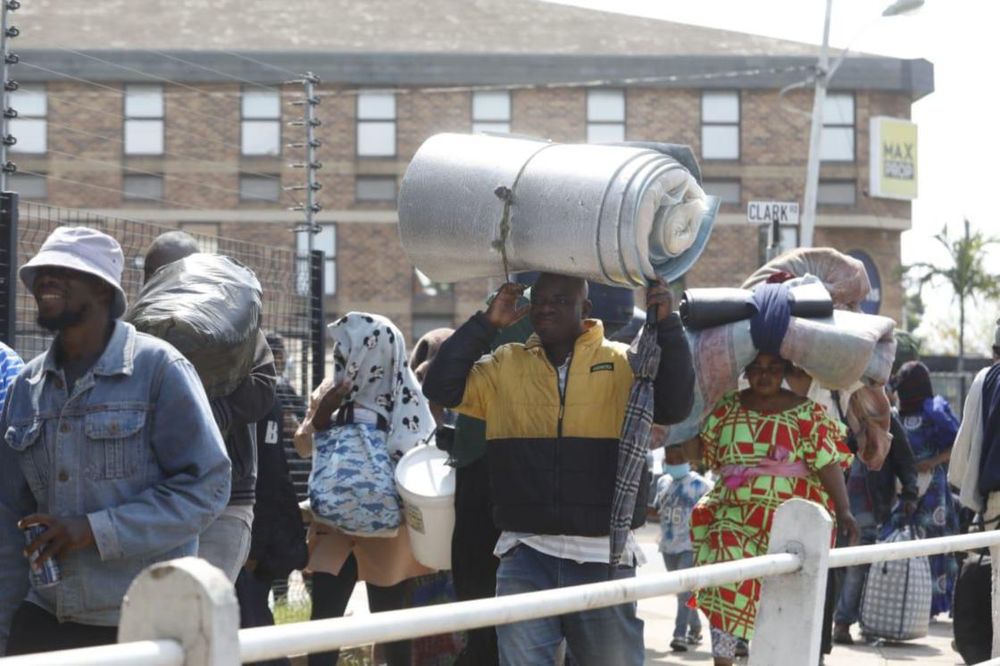
The relocation of asylum seekers and refugees marks the end of the four-month encampment in Durban.
After a four-month standoff, authorities have cleared the refugee encampment on Che Guevara (Moore) Road in Durban. While 274 asylum seekers and refugees were relocated to the Lindela Repatriation Centre in Gauteng, those who remained were dispersed among shelters and communities across the city.
The Inter-Ministerial Committee (IMC) on Migration had given the affected individuals two pathways: relocation to Lindela or remaining in Durban to attempt local community reintegration.
On Tuesday, 274 asylum seekers and refugees were loaded into five buses to be taken to Lindela, while those remaining were temporarily moved to Bulwer Park for further arrangements to shelter them.
However, the latter resulted in concerns over whether the refugees were moving to the park permanently.
Home Affairs communication head Ndileka Cola confirmed the successful relocation of the asylum seekers and refugees.
“Those transferred include nationals from the Democratic Republic of Congo (191); Burundi (76); Uganda (5); Mozambique (1); and Ghana (1). The Inter-Ministerial Committee (IMC) on Migration had presented the displaced communities with two options: returning to their areas of residence or relocating to Lindela,” Cola said.
“Law enforcement officers escorted the group during the relocation process while Che Guevara Road was cleared to ensure compliance with municipal by-laws and to maintain public order.”
Durban Cares founder Cathryn Aylett shared that, as per their final headcount on Tuesday, the remaining group consisted of 139 men, 56 women, and 24 children.
“We have separated the group. Those whom we were able to shelter have been separated into different shelters around the city. And then those whom we were unable to shelter unfortunately have to seek refuge wherever they could find. We are doing our best to assist the rest of them,” Aylett explained.
“We’re actively working to reintegrate these individuals into their communities, and this is exceptionally difficult if we don’t have a central point where we can meet with refugees, get them in contact with the correct social services and the correct resources safely.”
NGOs assisted asylum seekers and refugees at Bulwer Park after the Che Guevara Road encampment was cleared.
She further explained that their gathering at the park was viewed as a land grab rather than a central point to organise transport. The show of force and interference severely hindered their operations.
However, while many supportive people helped keep things calm, officials hampered their efforts through unhelpful public statements and actions.
“I totally understand why the whole neighbourhood was up in arms because it’s a very scary thing to see, and if you don’t understand what’s happening, it’s very easy to be intimidated,” Aylett said.
“But that’s when we were depending on leadership to communicate confidently that we were there to organise transport and that we would be gone by nightfall.”
DRC refugee Kafuti Muyumba confirmed that they were separated into various groups (women, children, and men) and sheltered across the city.
Glenwood/Bulwer Ratepayers’ and Residents’ Association (GBRRA) deputy chairperson Heather Roos said they received information that the refugees had moved from Che Guevara Road into Bulwer Park, and were stunned upon seeing them there because it was not planned or noted.
“A lot of people thought that everybody was being insensitive, that they were saying that they can’t stay there, and we were sort of pushing for a timeline for them to go… It was not the ideal place for them to have come from; neither was Che Guevara Road, but they were coming from one area not suited to another area; definitely not suited,” Roos explained.
“From the Glenwood/Bulwer Ratepayers’ and Residents’ Association, we sympathise with the refugees. We understand it’s terrible to be moved from pillar to post. But people can’t keep saying, ‘Oh, the residents must just accept it’, ‘Oh, the residents must just live with it’, or ‘It’s not affecting the residents’. They are also people.”
Meanwhile, Immigration Enforcement head Stephen van Neel reiterated that the operation was less an immigration enforcement operation than it was a refugee matter.
He explained that while Lindela is typically used as a transit facility for deportees, a slightly different arrangement was made in this case to provide a safe space while they transition into communities.
Home Affairs KwaZulu-Natal manager Cyril Mncwabe said they are promoting reintegration because negotiating relocation to another country is a lengthy process that can take years.
/data/photo/2022/11/07/6368e4ce3339b.jpg)

/https://i.s3.glbimg.com/v1/AUTH_da025474c0c44edd99332dddb09cabe8/internal_photos/bs/2026/2/5/YlFVRlTseoYP6KS3KkHg/hon-vopwkaehjyt.jpg)