DUSU elections: Why candidates spend lakhs despite a Rs 5,000 campaign limit
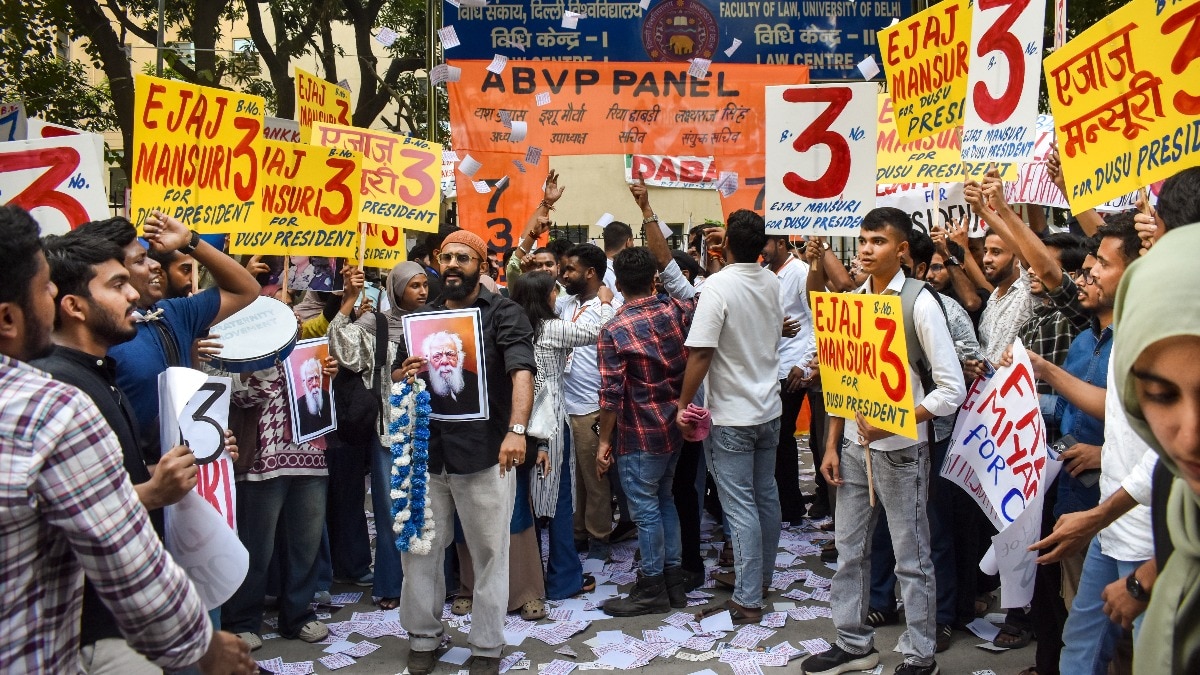
Delhi University’s student elections come with an official spending limit that sounds almost absurd against the scale of the campaign: Rs 5,000 per candidate.
Yet every election season brings luxury SUVs, campaign convoys, food and large-scale mobilisation around North Campus. In 2026, the question of where the money comes from has again come into focus.
A Facebook post on the DUSU elections shared by Sunny Kumar, an assistant professor at IIT Delhi, asks an interesting question: why would candidates spend huge amounts of personal money on an election that offers little direct financial return? (Photo: (l) India Today/Rishabh Chauhan | (r) screenshot Instagram/@pushtiiy) advertisement❮❯ Read Full StoryTHE Rs 5,000 RULE VERSUS THE REAL CAMPAIGNDelhi University’s 2026 election guidelines capped expenditure at Rs 5,000 per candidate, a ceiling that dates back to the Lyngdoh Committee recommendations of 2006, which laid down guidelines for student elections across universities.
The rules also prohibit vehicles and loudspeakers for canvassing and restrict candidates to four bona fide student campaigners while canvassing on campus.
Nearly two decades later, the Rs 5,000 ceiling remains unchanged even as the scale and cost of DUSU campaigning have grown dramatically. The mismatch between the old spending cap and the visible campaign machinery has repeatedly drawn scrutiny.
The gap between the rule and what campaign season looks like has been noted by courts and journalists before.
In 2024, the Delhi High Court observed that expenditure in DUSU elections appeared to have reached crores and questioned how such spending was being financed. The court also asked whether candidates would eventually seek to recover the money.
Reporting in 2026 has again documented fleets of SUVs and allegations of campaign spending far beyond the official ceiling.
Kumar's post takes the question further. "Those who aren’t from Delhi wouldn’t believe that DUSU candidates from the ABVP and the NSUI spend many crores of their personal money."
There is no publicly verified accounting establishing that individual 2026 candidates spent “many crores” of their personal money. But the broader question of excessive campaign expenditure is not new. (Photo: PTI) SO WHERE DOES THE MONEY GO?
Kumar argues that the answer cannot be found simply by looking at the four DUSU posts.
He points instead to the networks surrounding student politics, including local caste and community mobilisation, and argues that candidates benefit from access to networks extending beyond the student electorate.
And then asks a simple but pointed question: "Then why do they spend all this money, mobilise thousands of kins and friends from their locality...?" What's the ROI?
One explanation is that DUSU is not necessarily valuable because of the union's budget.
It can be valuable as a political launchpad and network-building exercise.
That does not mean every candidate is investing for a future political payoff. But DUSU has historically been connected to wider student and party politics, making visibility, organisational experience and political networks possible incentives.
A 2015 Times of India report, citing sources in ABVP and NSUI, said candidates for senior posts were expected to contribute substantially towards campaign costs, while organisations themselves spent large sums. The report also noted that the official Rs 5,000 ceiling was far below the practical cost of campaigning across DU colleges. (Photo: PTI) THE DEEPANSHU RESULT ADDS ANOTHER TWIST
This year's result also complicates the money-power argument.
Independent candidate Deepanshu Shokeen, a former NSUI member, won the Vice-President post with 30,615 votes, more than 13,000 ahead of ABVP's Ishu Maurya. Shokeen has said he received support from politically active students as well as neutral students who were not involved in student politics.
That does not disprove the influence of money or networks.
But it does show that DUSU's electorate can still produce outcomes that disrupt the established organisational script.
The more uncomfortable question therefore may not be simply how much money is spent.
It is why an election meant to represent students has developed a campaign ecosystem where the official expenditure ceiling and the visible scale of mobilisation can appear worlds apart.- EndsPublished By: Roshni Published On: Sep 22, 2026 19:39 ISTRead | DUSU polls: ABVP retains president seat in close battle, sweeps two other postsRead | Meet Deepanshu Shokeen, the NSUI rebel who won DUSU Vice President post