
Earth's twin Venus ate its own moon and didn't even burp
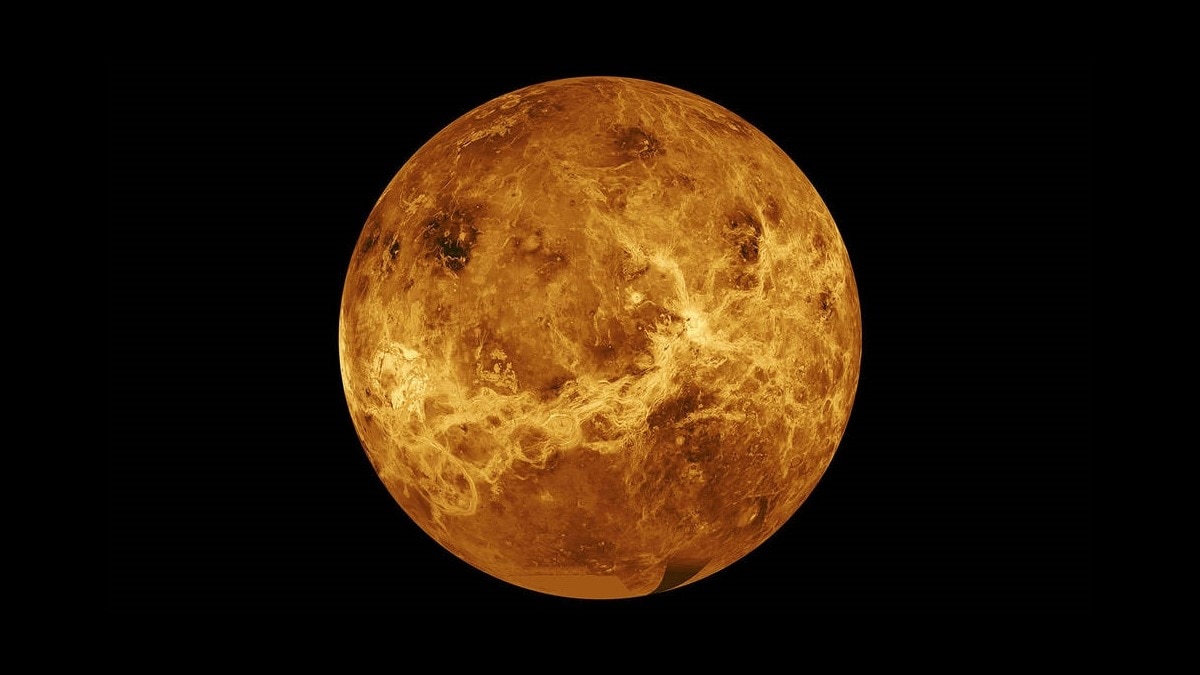
Venus may have once had a moon, but instead of watching it drift away into space like Earth’s Moon, the planet’s slow spin could have pulled it back in and swallowed it whole.
A new study by scientists at the University of California, Riverside suggests that Venus did not need a catastrophic event to lose a moon. If the planet once had a natural satellite, its own gravity and unusually slow rotation could have caused the moon to spiral inward and eventually crash into the planet.
The research, published in The Astrophysical Journal, tackles a long-standing mystery. Venus is remarkably similar to Earth in size, mass and internal structure, yet Earth has a large Moon while Venus has none.
Previous theories suggested that Venus either never experienced the giant collision that created Earth's Moon or that a moon it once possessed was destroyed by another massive impact. Venus as seen passing next to Earth's Moon. (Photo: Nasa)
The new modelling points to a very different possibility.
Earth completes one rotation in about 24 hours, while Venus takes a staggering 243 Earth days to rotate once. On Earth, the planet's rapid spin transfers energy to the Moon, causing it to gradually move away at roughly four centimetres per year.
Venus, however, spins so slowly that the gravitational interaction would work in the opposite direction. Instead of being pushed outward, a moon would gradually lose orbital energy and spiral towards Venus.
To test the idea, lead researcher Stephen Kane developed computer simulations modelling the gravitational interaction between Venus and hypothetical moons. He first reproduced the known Earth-Moon system before varying Venus' rotation rate and the size of its possible moon.
The simulations repeatedly produced the same outcome: the moon eventually crashed into Venus. Larger moons, meanwhile, tended to collide with the planet faster.
The research does not prove that Venus actually had a moon. Instead, it shows that if one existed, it could not have remained in orbit indefinitely under Venus' current slow rotation. Venus is seen in the skies of Earth next to the Moon. (Photo: Reuters)
Finding evidence of such a collision could be difficult. Around 80% of Venus' surface appears similar in age, suggesting a massive resurfacing event roughly a billion years ago may have erased much of the planet's older geological record.
Scientists may therefore need to look beneath Venus' surface for clues. Seismic observations could potentially reveal deep structures left behind by an ancient collision.
Such an impact could also have dramatically altered Venus' rotation, geology and climate, potentially changing the planet's ability to support conditions suitable for life.- EndsPublished By: Sibu Kumar TripathiPublished On: Sep 15, 2026 15:27 IST


_2026_09_15_17_27_47.jpg)