Ed Sheeran's political past resurfaces amid Macklemore uproar - Newsweek
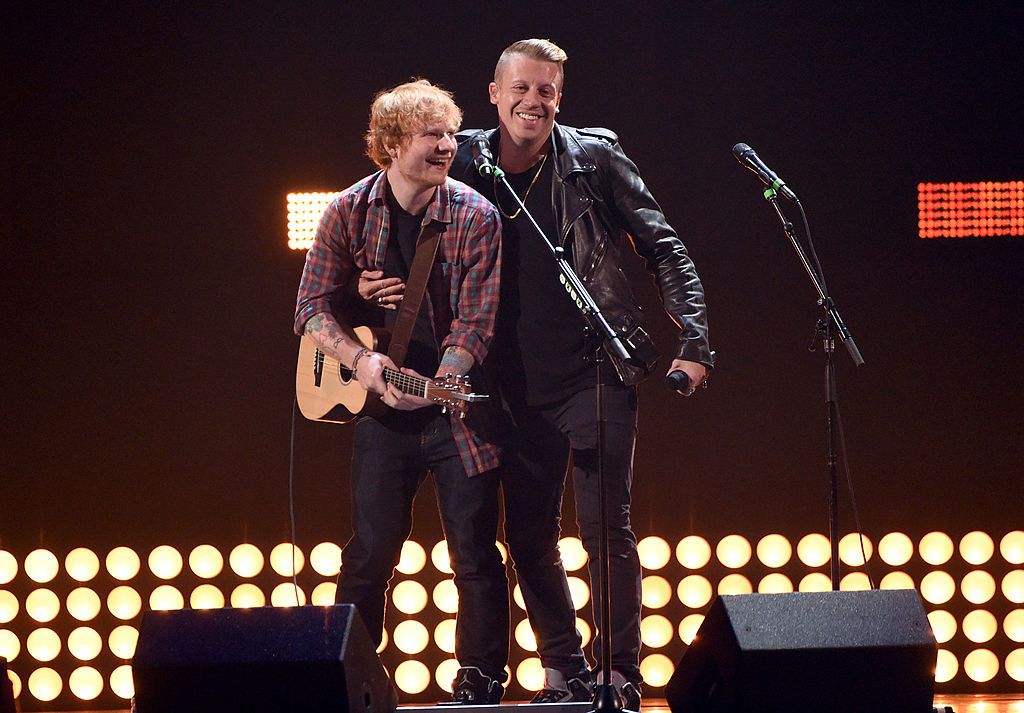
Ed Sheeran is facing intense political scrutiny after Macklemore was dropped as an opener from the U.S. leg of his Loop Tour for pro-Palestinian remarks onstage. Sheeran publicly defended his apolitical stance, but fans, critics and fellow artists immediately pointed to his long record of weighing in on political and humanitarian issues.
The fallout has already reshaped the tour, with every remaining support act quitting and Sheeran’s team confronting questions about consistency, accountability and what may happen next as the tour resumes in Philadelphia.
Sheeran’s statement that “There is a reason I do not use my professional platform for politics," collided head‑on with years of documented political engagement. His past advocacy on Ukraine, Brexit, anti‑racism, and support for Jeremy Corbyn now sits under a microscope, raising questions about why Gaza is the exception.
The moment has also intensified scrutiny of his relationship with Robert Kraft, the billionaire stadium owner who pushed for Macklemore’s removal, and has reignited debate over whether major artists can ever remain neutral on global conflicts.
Newsweek reached out to Sheeran’s representatives for comment.
Sheeran’s claim that he avoids politics is contradicted most visibly by his outspoken support for Ukraine following Russia’s 2022 full-scale invasion.
He headlined the televised Concert for Ukraine, telling viewers, “To all Ukrainians, I love you, I stand with you,” and released a charity version of “2step” with proceeds going to humanitarian relief.
Sheeran also responded directly to Ukrainian band Antytila, welcoming them to perform remotely from Kyiv, a moment widely praised as an example of artists using their platforms for geopolitical advocacy.
His involvement wasn’t passive. Sheeran leveraged his global reach to raise money, awareness and solidarity, positioning himself firmly within the Western cultural response to the war. That history now sits in contrast to his insistence that his concerts are “not a political forum."
The Macklemore controversy has revived these comparisons. Macklemore’s statement noted that “more than 20,000 children have been killed in Gaza alone,” while Sheeran’s critics argue that if he can speak publicly about Ukrainian suffering, silence on Palestinian casualties feels inconsistent.
Sheeran has also weighed in repeatedly on British political issues. In 2017, he spoke warmly about then‑Labour leader Jeremy Corbyn, saying he “loves everything Corbyn is about” and praising his focus on “all classes, races, and generations.” Though Sheeran insisted he wasn’t a political figure, he made his ideological leanings clear publicly.
He also joined more than 100 musicians in signing an open letter urging ministers to address Brexit's impact on touring artists, calling for “paperwork‑free travel in Europe.” The letter directly intervened in a major political debate that affected the livelihoods of British performers.
In 2019, Sheeran participated in the Love Music Hate Racism campaign, aligning himself with a movement explicitly aimed at countering far‑right influence in the United Kingdom. The campaign’s organizers framed the effort as a cultural response to rising nationalism and xenophobia—unmistakably political terrain.
These examples complicate Sheeran’s claim that he avoids politics for young fans. His past actions show a willingness to speak out when the cause aligns with his values or public sentiment. The question now is why Gaza and Macklemore’s “Free Palestine” message triggered a different response.
Before this week, Sheeran had not taken public positions on Israel or Gaza. His statement Tuesday, “I am appalled by the conflict between Israel and Palestine," is the first time he has addressed the issue directly.
He emphasized suffering “on both sides,” stressed his desire for “peace,” and reiterated that he does not use his platform for political messaging.
The comments came only after Macklemore accused him of bowing to pressure from stadium owners, including Robert Kraft, who said Macklemore’s remarks and imagery crossed a line. Sheeran’s statement also arrived as every remaining support act quit the tour, citing opposition to the silencing of pro‑Palestinian speech.
The backlash has also intensified scrutiny of Sheeran’s ties to Kraft, who owns Gillette Stadium, where Macklemore made his remarks, and played a direct role in pushing for the rapper's removal.
Kraft said Macklemore’s “recent actions” and “material shared from the stage” were “deeply offensive,” citing what he called a “broader history of antisemitic rhetoric and imagery.”
Sheeran has previously described Kraft as “super sweet,” and performed at his wedding in 2022. That relationship is now being reexamined as fans question whether Sheeran’s neutrality is shaped by billionaire venue owners' interests rather than personal conviction.
Sheeran said he spent the week “trying to build bridges” between Kraft, promoters and activists “on both sides,” but ultimately accepted the decision to drop Macklemore.
The consequences of Macklemore’s removal were swift. Within hours of Sheeran’s statement, Finneas, Aaron Rowe, Lukas Graham, and Sheeran’s touring band Beoga all quit the Loop Tour.
Rowe, who had been opening Sheeran shows since February, said he could not stay on a tour where billionaire venue owners dictated which political messages were acceptable. Rowe framed his decision through Ireland’s own history of colonial violence, saying he could not ignore parallels between that past and the suffering of Palestinians today.
Shortly afterward, Finneas, an Oscar and Grammy winner slated to join the tour in October, issued a brief statement, writing that artists have a responsibility to speak for people facing oppression and making clear that continuing on the tour would contradict that principle.
Lukas Graham, part of the U.S. supporting lineup since August, followed with a message that balanced gratitude for Sheeran with a refusal to perform under the current conditions. The band said it could not reconcile its values with a tour environment where political speech was being constrained, noting that affection for Sheeran did not outweigh the moral stakes of the moment.
The final blow came from Beoga, Sheeran’s longtime collaborators who performed a mini‑set with him each night. The Irish folk group said it could not continue playing in venues where pro‑Palestinian advocacy was being shut down.
Contact Newsweek editors on this story: Samantha Beech and Sam Wilson.