Elavenil, Sonam, Vidarsa: 3 unique paths to India’s 1st Asian Games 2026 medal - The Indian Express
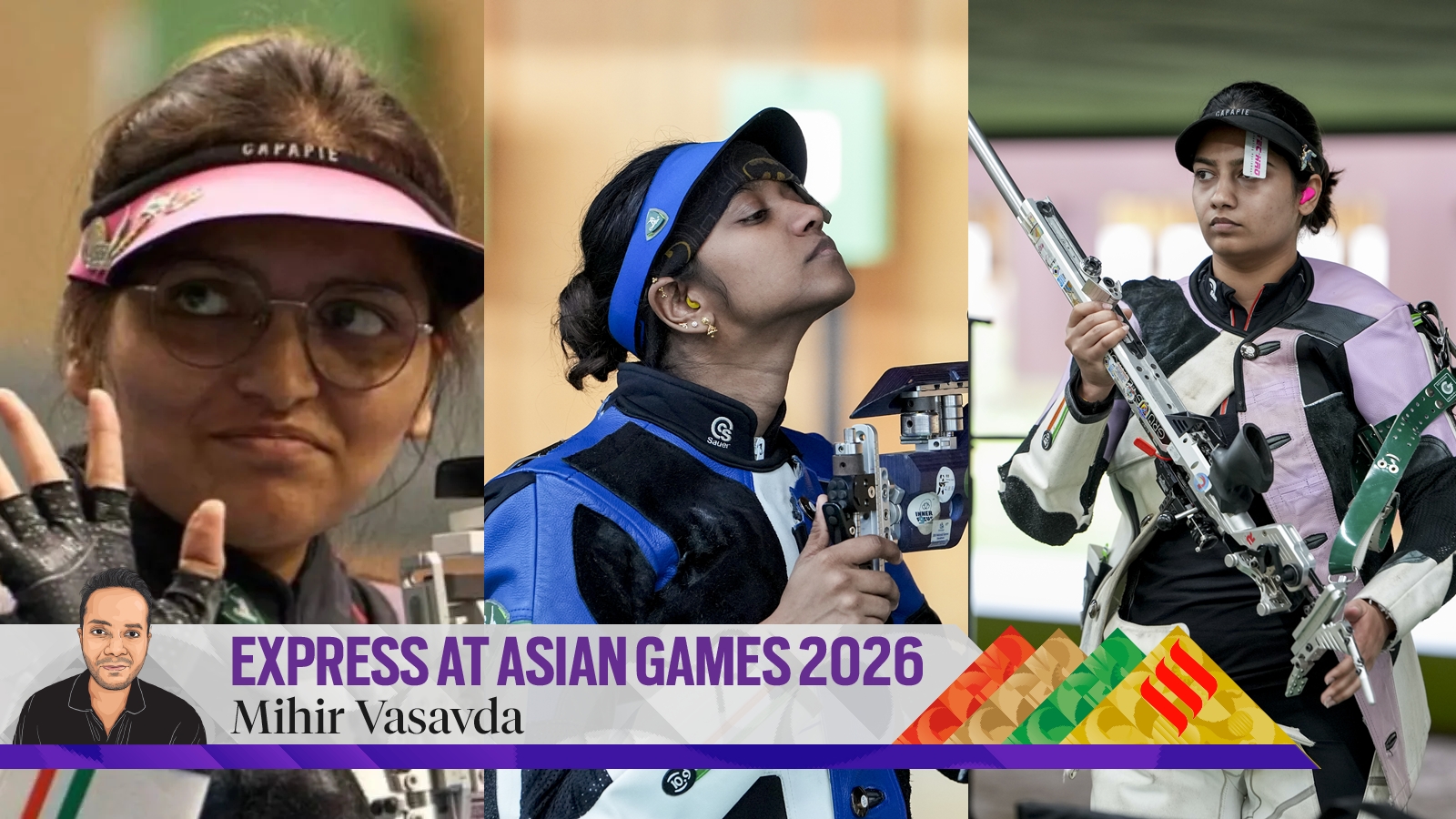
Something about India’s first medal at the Aichi-Nagoya Asian Games is unusually neat.
Three women took very different routes to reach the same shooting range near Toyota City. One who stumbled into the sport through a friend’s daughter, another who began shooting almost as a college hobby before her family sold property to keep the dream alive, and a third who picked up a rifle through the NCC while hoping, at first, that it might lead to a government job.
On Sunday morning in Nagoya, those three stories converged.
Elavenil Valarivan, Sonam Maskar and Vidarsa Vinod combined for a total of 1898 points to win silver in the women’s 10m air rifle team event, giving India its first medal of the Games. China finished on top with a Games record of 1904.2, while hosts Japan took bronze with 1897.1.
It was a fitting opening medal for an Indian shooting team that has grown increasingly deep: experience in Elavenil, a recent breakthrough in Sonam and sheer persistence in Vidarsa. “India’s depth in rifle and pistol events makes us a force in not just Asia but also the world. That depth is the reason we can be hopeful of team medals in most shooting events at the Asian Games,” rifle coach Deepali Deshpande had told The Indian Express before the Games.
That depth is reflected in the stories of the three medal winners.
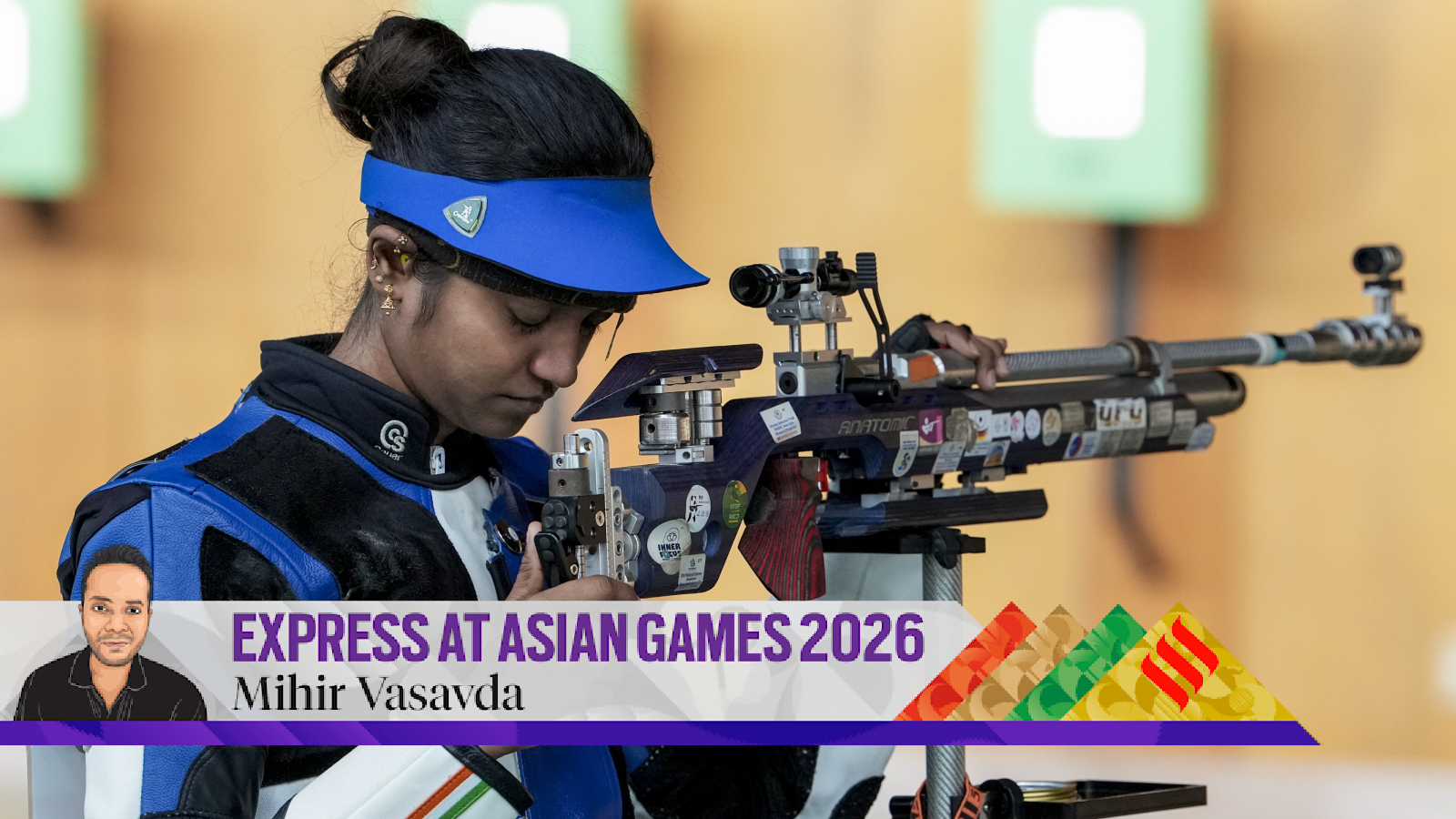
For Elavenil, shooting was never supposed to be the plan. Born in Cuddalore and raised in Ahmedabad, she had tried almost every sport going — athletics included — before a chance visit to a shooting range changed her life. A friend’s daughter was a shooter and offered Elavenil a rifle to try. The teenager borrowed it for three months and began training.
There was little sporting legacy at home. Both her parents were academics; her father was a scientist. Elavenil had once imagined becoming a scientist herself. Instead, the borrowed rifle became a vocation. By 15, she was serious about shooting. The journey took her from a beginner who once scored 128 out of 400 at a district championship to a junior world champion and, eventually, a two-time Olympian.
At 27, she was the senior member of this team — having already seen the Olympics, World Championships and the pressure of being expected to deliver.
She applied the finishing touch with a score of 633.5, ensuring India finished just ahead of hosts Japan.
Before she stood on the firing point, it was Sonam who led the charge with a total of 634.1, the highest among the three Indians. The 24-year-old’s introduction to shooting was casual.
In 2018, while studying commerce at a Mumbai college, Sonam was looking for something different. She played chess, enjoyed sport and decided to try shooting.
The transition came with a price. The Covid-19 pandemic hit her family financially just as she needed professional equipment. Her father, Uttam Maskar, sold a family property so that she could buy the rifle and equipment required to progress. “I can’t imagine reaching this far without that decision my father took,” Sonam told The Indian Express. “It was a very big sacrifice. After that, I just kept going.”
She resumed serious training in 2021 at the Kolhapur range and, within a few years, had announced herself internationally. She has since won medals at ISSF World Cups.
The third member had perhaps the least conventional route.
Vidarsa grew up in Kozhikode in a middle-class family. She first picked up a rifle through the NCC in 2018. She enjoyed the sport, but a government job was one possibility she had in mind. Even after becoming Kerala state champion, buying a professional rifle was beyond her family’s means. She trained on borrowed equipment. Eventually, in 2021, her family took a loan to buy her first rifle.
Then came another leap of faith. Vidarsa moved to Delhi to train at the Dr Karni Singh Shooting Range, leaving behind Kerala and her family. She did not even speak Hindi. She cooked for herself, managed her own chores and trained twice a day.
By early 2024, the pressure had become overwhelming. She was missing selection marks, the family had sacrificed heavily, and she had begun contemplating quitting. However, her husband and former shooter Manu S Ravi kept pushing her, along with coach Manoj Kumar. Eventually, Vidarsa found her way into the SAI National Centre of Excellence, where equipment, nutrition and training support eased some of the financial anxiety that had followed her career.
Now she was standing alongside an Olympian and a World Cup medallist at an Asian Games. “She did what was expected of her,” Manoj said. “Her stronger event is the 3-position, so she has a shot to win another medal.”
That is what made Sunday’s medal more than just three cumulative numbers. Three backgrounds. Three routes. And India’s first medal in Nagoya.
Over the course of a 18-year-long career, Mihir Vasavda has covered 2010 FIFA World Cup; the London 2012, Tokyo 2020 and Paris 2024 Olympic Games; Asian Games in 2014 and 2022; Commonwealth Games in 2010 and 2018; Hockey World Cups in 2018 and 2023 and the 2023 ODI Cricket World Cup. ... Read More