Elon Musk Reveals Grok Developer Rebrand After Trump AI Order - Newsweek
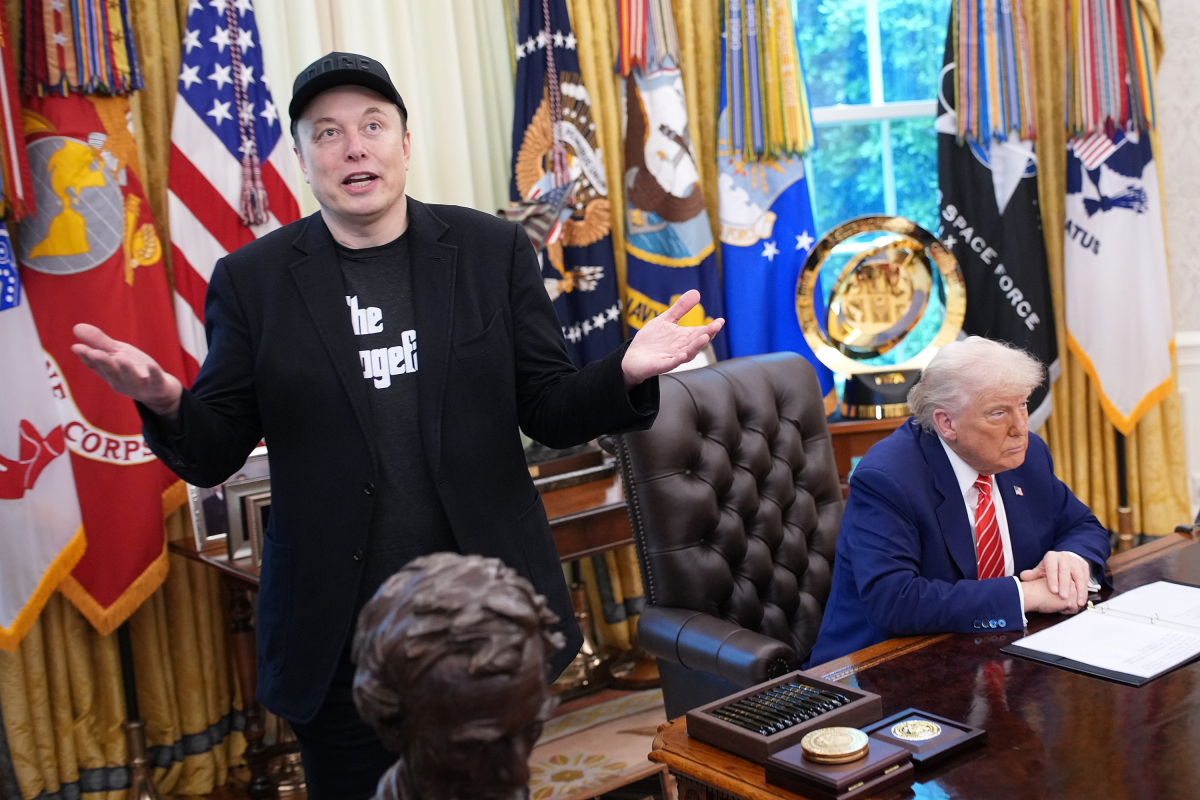
Elon Musk said on Sunday that SpaceXAI, the company behind Grok, will be renamed "SpaceXSI," a move that comes as President Donald Trump announced a new federal Super Intelligence Force.
Musk's comment was in response to an X user suggesting the rebrand on Sunday.
Newsweek contacted Musk and the White House for comment on October 4.
Last month, Trump signed an executive order replacing the terms "artificial intelligence" and "AI" with "Super Intelligence" and "SI" across executive branch communications.
Analysts previously told Newsweek the shift would be difficult to establish unless major industry leaders embraced the new terminology.
Musk appeared to endorse the terminology change in a brief exchange on October 4.
The Tesla CEO said on X: "No more AI. SI It’s better."
In response, X user XFreeze asked: "Any possibility of renaming to SpaceXSI??"
Musk replied: "Yes, we will make that change."
SpaceXAI develops Grok, the chatbot platform that competes with products from OpenAI, Anthropic, Google and Microsoft.
While Musk did not provide further details, the comment suggests a willingness to adopt the language promoted by the White House. Despite Musk's informal social media reply, no official corporate name change has been formally announced.
In a post on Truth Social, Trump said the Super Intelligence Force would coordinate the federal government's approach to super intelligence and oversee engagement with consumers, public-interest groups, religious organizations, critical infrastructure providers and technology companies.
He noted that the effort follows a "Historic White House Accord on Super Intelligence" involving major technology firms and is intended to help maintain U.S. leadership in the field.
Trump described super intelligence as a technology that could have a greater impact than both the Industrial Revolution and the internet. He said the task force would be led by Director of National Intelligence Jay Clayton, Federal Trade Commission Chairman Andrew Ferguson, Under Secretary of War for Research and Engineering Emil Michael and Office of Personnel Management Director Scott Kupor, while reporting to both the president and White House Chief of Staff Susie Wiles.
According to The Wall Street Journal, the task force has been given 120 days to deliver a report assessing the risks and opportunities of super intelligence and outlining what role the federal government should play in overseeing the technology.
Under Trump’s executive order, agencies are instructed to use "Super Intelligence" and "SI" instead. The document argues that modern AI systems have advanced far beyond what was originally envisioned when the technology first received its current name.
Trump had previewed the change during remarks to the United Nations General Assembly, saying the word "artificial" makes the technology sound "fake" despite its growing capabilities.
Before issuing the order, Trump also asked Truth Social users whether they preferred "super intelligence" or "superior intelligence." More than 50,000 people responded, with 65 percent backing "super intelligence."
Whether the new terminology spreads beyond government remains uncertain.
Marketing expert Jean-Pierre Dubé of the University of Chicago previously told Newsweek that "super intelligence" already has an established meaning in technology circles, where it is commonly used to describe systems that exceed human cognitive performance across a wide range of domains.
Dubé said that the existing definition could create confusion and make widespread adoption difficult. He added that any successful rebranding effort would likely depend on support from leading companies and executives.
Trump's order was signed on the same day he hosted a White House summit with technology leaders including Musk, Amazon founder Jeff Bezos, Nvidia CEO Jensen Huang, Anthropic CEO Dario Amodei, OpenAI co-founder Greg Brockman and Microsoft CEO Satya Nadella.
Discussion at the event centered on the rapid development of AI systems and their potential impact on society.
The administration has also launched America.gov, a chatbot-style government portal designed to help people navigate federal programs, services and benefits.
Attention is likely to turn to whether other major AI companies adopt the new terminology.
Industry support was identified by experts as the key factor that could determine whether Trump's effort remains a government branding change or develops into a broader shift across the technology sector.
Newsweek’s reporters and editors used Martyn, our AI assistant, to produce this story. Learn more about Martyn here.
Contact Newsweek editors on this story: Tobias Meyjes and Cristina Diciu.