Emfuleni municipality CFO ordered to pay manager R100,000 after calling him a “renowned bully” and “looter” - IOL
Emfuleni CFO ordered to apologise and pay R100,000 to SCM manager.
The Johannesburg High Court appeal has ordered a municipal Chief Financial Officer (CFO) to pay R100,000 in damages after he accused a Supply Chain Management (SCM) manager of having “normalised corruption” and described him as a “renowned bully” and a “looter”.
The court found that the statements made about Jason Mkhwane were defamatory and unlawful.
The court also ordered the CFO, Andile Philip Dyakala, to issue an unconditional written apology and retraction on the same WhatsApp group where the statements were published.
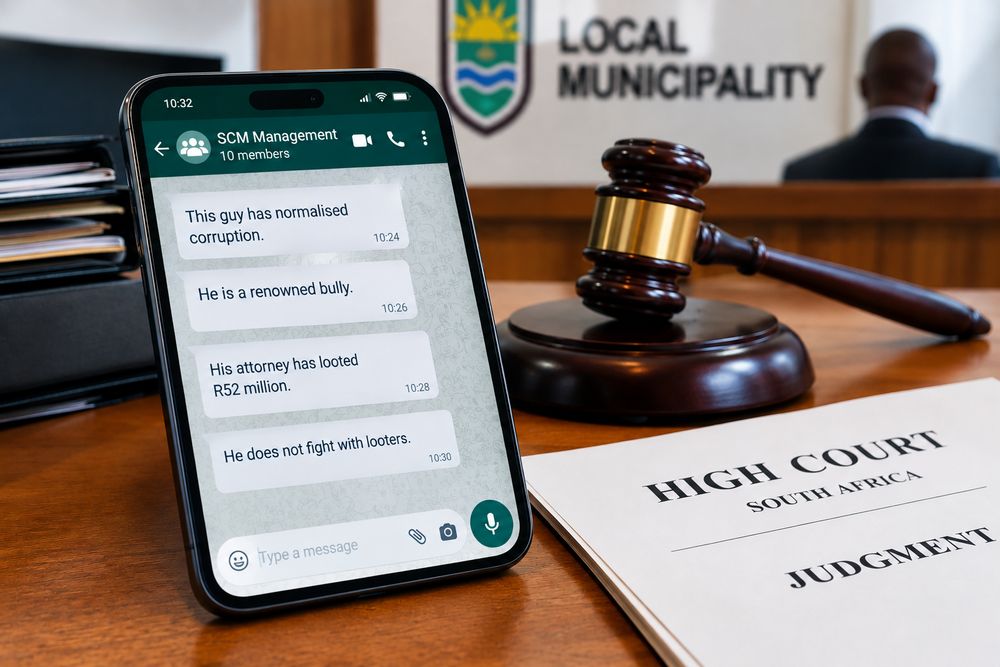
The case arose from a series of WhatsApp messages sent by Dyakala in December 2019 on a group called “SCM Management”.
The group had about 10 managers and senior employees working in the Supply Chain Management division of Emfuleni Local Municipality. At the time, Dyakala was the municipality’s CFO, while Mkhwane was its Manager of Supply Chain Management and reported to him.
Mkhwane took legal action over messages which he said conveyed that he was personally corrupt, had “normalised corruption”, was associated with an attorney who had “looted R52 million”, was a “renowned bully” and was a “looter”.
Dyakala admitted publishing the messages but denied liability.
In July 2024, the court hearing the matter initially found that the WhatsApp statements were defamatory and that a reasonable reader would understand them as implying that Mkhwane was personally corrupt.
However, the court dismissed Mkhwane’s claim after accepting Dyakala’s defences of truth and public benefit and fair comment.
Unhappy with the outcome, Mkhwane subsequently took the ruling on appeal.
The appeal court said the central question was not whether there had been procurement problems at the municipality, but whether the evidence established the substantially more serious allegation that Mkhwane himself was corrupt and had “normalised corruption”.
The appeal court acknowledged that the municipality had experienced serious procurement and financial problems.
However, it drew a distinction between irregular expenditure and corruption.
“Irregular expenditure demonstrates non-compliance with applicable procurement or financial requirements. It does not without more establish dishonesty, bribery or corrupt intent,” the court found.
The court noted that reports relied upon by Dyakala identified procurement deficiencies and irregular expenditure but did not establish that Mkhwane had personally participated in a corrupt transaction.
There was also no identified service provider shown to have received a municipal tender through Mkhwane’s intervention.
One of the key pieces of evidence concerned an alleged conversation between Mkhwane and Dyakala after the latter arrived at the municipality.
Dyakala testified that Mkhwane had told him he had a political “mandate” to ensure that businesses or people favoured by the ruling party were appointed as municipal service providers.
The trial court accepted that the conversation had occurred substantially as described by Dyakala.
The appeal court said that, even if the conversation was accepted, it did not automatically prove that Mkhwane was personally corrupt.
The court noted that the alleged conversation was not identified in Dyakala’s detailed amended plea as part of the factual basis for the allegation that Mkhwane had “normalised corruption”. It also found that no specific corrupt tender or transaction involving Mkhwane had been identified.
The appeal court also dealt with the description of Mkhwane as a “renowned bully”.
Dyakala had pleaded that the allegation was true, but he had not specifically pleaded fair comment as a defence.
The court found that fair comment only emerged after the evidence had been completed, raising procedural concerns because Mkhwane had not prepared his case on that basis.
In any event, the court found that the evidence did not adequately establish the factual foundation for describing Mkhwane as a “renowned bully”.
Dyakala referred to complaints allegedly made by other employees, but those employees did not testify to establish the conduct attributed to Mkhwane.
The court also said the word “renowned” suggested that bullying was an established or generally recognised characteristic of Mkhwane, which had not been proved.
The court considered another message in which Dyakala said Mkhwane’s attorney had “looted R52 million”.
Although the statement was literally directed at the attorney, the trial court found that it was made in a context that associated Mkhwane with “looting” and implied that he was a “looter”.
The appeal court found that the factual basis for suggesting Mkhwane himself had looted, facilitated looting or could properly be characterised as a looter had not been established.
The court rejected the argument that employees in the WhatsApp group would necessarily have known enough about the municipality’s problems to supply the missing factual foundation.
The appeal court also upheld the finding that Dyakala had not rebutted the presumption that the defamatory publication was wrongful and intentional.
It described the messages as personal, confrontational and accusatory rather than neutral reports of suspected misconduct.
The trial court had found that Dyakala intended to discredit and hurt Mkhwane and was at least reckless about the injury to his dignity. The appeal court found that this conclusion was supported by the record.
Because the original court had dismissed the claim, it had not determined how much Mkhwane should receive in damages.
The appeal court therefore assessed the damages itself.
It said corruption was an exceptionally serious accusation, particularly when made against a municipal official responsible for supply chain management and public procurement.
The court also considered the fact that the allegation had been made by Mkhwane’s own CFO and line manager to professional colleagues, managers and subordinates.
Although the WhatsApp group had only about 10 members, the court said the limited numerical reach did not diminish the professional significance of the publication because the recipients were people before whom Mkhwane’s reputation for integrity was particularly important.
The court also noted that Mkhwane had not established specific financial or patrimonial losses, such as losing his job, salary or a particular professional opportunity.
Taking all the circumstances into account, it awarded him R100,000 in general damages.
The court ordered Dyakala to pay interest on the R100,000 at the prescribed rate of 11.75% per year from 15 July 2024, when the original judgment was delivered, until the amount is paid in full.
Dyakala must also, within 10 days of being served with the order, publish an unconditional written retraction and apology on the SCM Management WhatsApp group.
Any copies of the defamatory statements that remain accessible on platforms or WhatsApp groups under Dyakala’s control must also be removed within 10 days.
The appeal court further ordered Dyakala to pay the costs of the original action and the appeal.