Essar eyes $18-billion US steel plant: Why Indian firms are investing in US amid tariffs - The Indian Express
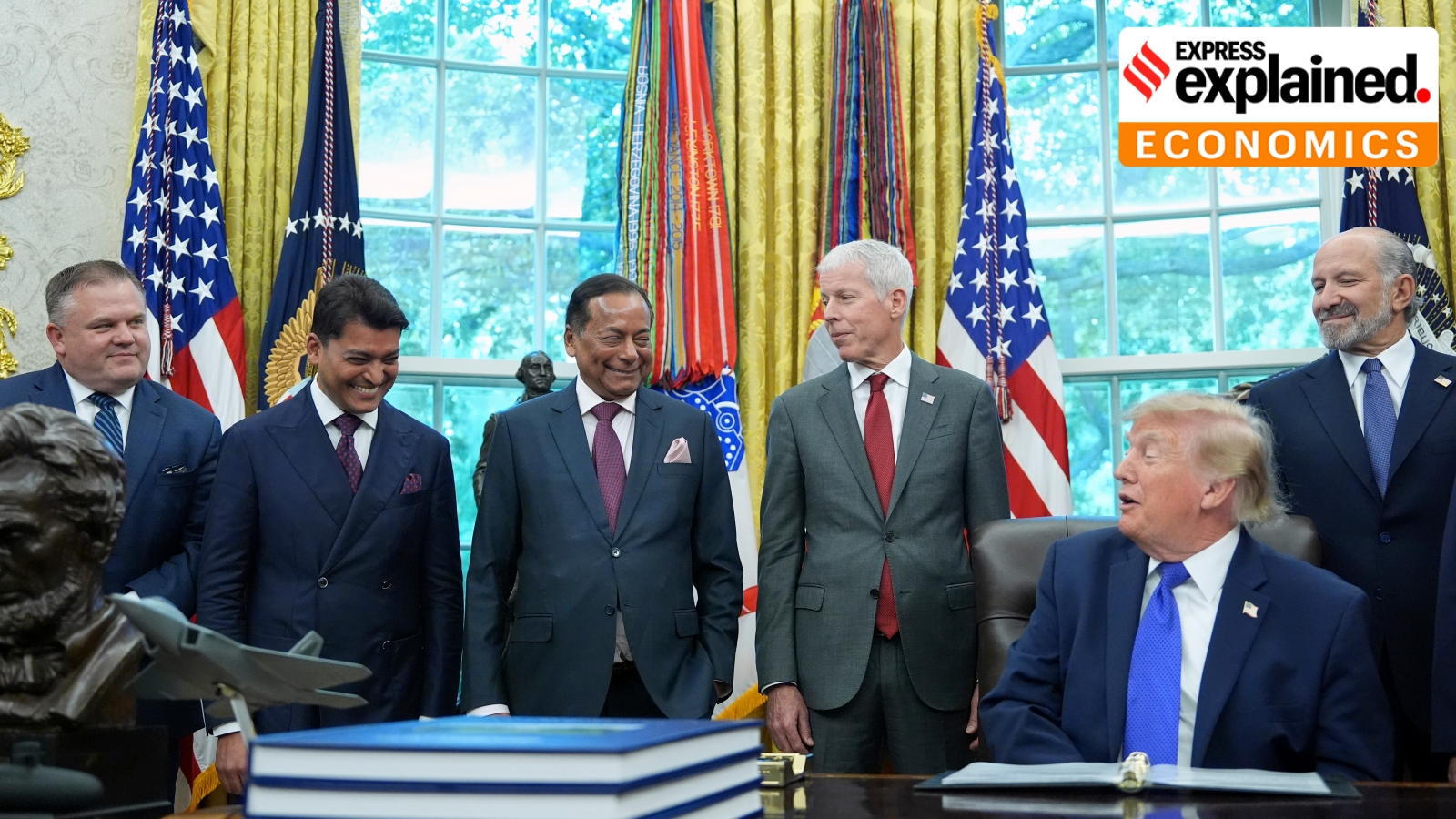
Indian companies are stepping up investments in the US. Mesabi Metallics, an Essar Group company, announced an $18-billion investment to build a fully integrated American steel company, the “largest single location investment in an integrated steel complex” in the US.
During the announcement by US President Donald Trump in White House, Ravi Ruia, Vice Chairman & Founder of Essar Group, said the investment “also reflects Prime Minister Narendra Modi’s vision for a stronger India-US economic partnership”.
This coincides with Union Minister of Commerce and Industry Piyush Goyal’s six-day visit to the US for the G20 Trade Ministers’ meeting starting Thursday — during which both countries are also expected to hold talks to close the long-pending trade deal.
While Essar Group’s investment pledge is one of the largest in the last few months, several Indian companies are boosting investment in the US.
JSW Steel in June had announced investments worth $500 million. JSW Cement Managing Director Parth Jindal had said that investment “has all been possible due to the policies of the Trump administration”.
Indian pharma companies have also announced big-ticket investments, led by Sun Pharmaceutical’s plans for a $11.75 billion acquisition of New Jersey-based Organon & Co. For the year ended December, 2025, Organon reported $6.2 billion in revenue and adjusted earnings of $1.9 billion (before interest, taxes, depreciation and amortization). Organon had a debt of $8.6 billion and cash balance of $574 million.
While outflow of investments strengthens companies and the home economy through productivity gains, several investment decisions by US trade partners in the last 12 months are driven by protectionist measures in the US.
The Trump administration had earlier this year doubled tariffs on steel, aluminium and copper from 25% to 50% under Section 232 of the Trade Expansion Act of 1962, which is not part of the negotiations for a trade deal.
Trump in June had said that tariffs on generic drugs in the US will be raised 100% after two years and to 200% thereafter to “reshore” generic pharma production in the US, adding that companies deciding against building plants in the US will be “penalised”.
Trump’s threat comes after several such ultimatums, largely designed to attract investment in the US. Actual tariffs on drugs have been exempted in most tariff instruments his administration has used, starting with those under the International Emergency Economic Powers Act, Section 122 of the 1974 Trade Act, and Section 232.
According to the CBS News, the company was earlier known as Essar Steel Minnesota LLC, which started working Minnesota mines in 2008. But due to delays and financial stress, the company filed for bankruptcy in 2016. Later, it was bought by Chippewa Capital Partners. However, Essar Group eventually regained control starting in 2019 and the company was reborn as Mesabi Metallics.
The company is seeing fresh investment this year after the Trump administration raised the steel duty to 50%. While investment banking company Macquarie Group has announced $150 million, Breakwall has announced $520 million in investments. The Export-Import Bank of the US also approved a $770 million direct loan for the company’s iron ore mine in Minnesota on Monday.
However, the Essar group has been debt-ridden for a long time and entered bankruptcy for many of its subsidiaries. Essar Steel India Limited was once one of the biggest loan defaulters and was later acquired by ArcelorMittal Nippon Steel India. Similarly, Essar Power M P Limited was acquired by Adani Power and renamed Mahan Energen Limited. Essar’s oil company was sold to Russia’s Rosneft.
Investment announcements in the US by Indian companies also come amid negotiations for a trade deal and demands by US negotiators to attract investment in exchange for market access. All major American trade partners have agreed to invest in the US under the bilateral trade deal. Japan agreed to invest $550 billion, South Korea $350 billion and the European Union $600 billion.
Trump has been threatening to reimpose tariffs on South Korea and the EU because of slow progress on investment. South Korea confirmed its first project under a $350-billion US investment pact on Tuesday and said it is considering two others. US officials had criticised Seoul for moving too slowly on the investments, especially compared with countries such as Japan.
While corporate investment has shown signs of revival during the last quarter, weak investment has been a major worry for Indian policymakers.
Data showed that India saw a jump in net foreign direct investment (FDI) inflows in July, with data released late Friday by the Reserve Bank of India showing that it soared to an over five-year high of $7.35 billion. This is the highest monthly inflow since May 2021’s $8.80 billion.
On a gross basis, FDI in July was $14.58 billion, the third-highest in the last six years. Compared to July 2025, the latest net and gross FDI figures are up 64% and 24%, respectively.
The latest FDI print comes even as the government warns of challenges on the external front, with Chief Economic Advisor V Anantha Nageswaran cautioning on Friday that “even if we tick (all the) boxes”, money may not flow in immediately.
The government and the RBI have tried to encourage foreign inflows in the last four months, with the concessional swap window for Foreign Currency Non-Resident (Bank) deposits turning out to be overwhelmingly successful. However, the rupee is not too far away from its all-time low of 96.96 per dollar. It closed at 95.82 on Friday.
Ravi Dutta Mishra is a Principal Correspondent with The Indian Express, specializing in economic policy and financial regulations. With over five years of experience in business journalism, he provides critical coverage of the frameworks that govern India's commercial landscape. Expertise & Focus Areas: Mishra’s reporting concentrates on the intersection of government policy and market operations. His core beats include: Trade & Commerce: Analysis of India's import-export trends, trade agreements, and commercial policies. Banking & Finance: Covering regulatory changes and policy decisions affecting the banking sector. Professional Experience: Prior to joining The Indian Express, Mishra built a robust portfolio working with some of India's leading financial news organizations. His background includes tenures at: Mint CNBC-TV18 This diverse experience across both print and broadcast media has equipped him with a holistic understanding of financial storytelling and news cycles. Find all stories by Ravi Dutta Mishra here ... Read More