
EU chief von der Leyen pushes Canada as ‘associate member’ - Toronto Star
Von der Leyen arrived in Canada ahead of the two-day summit.
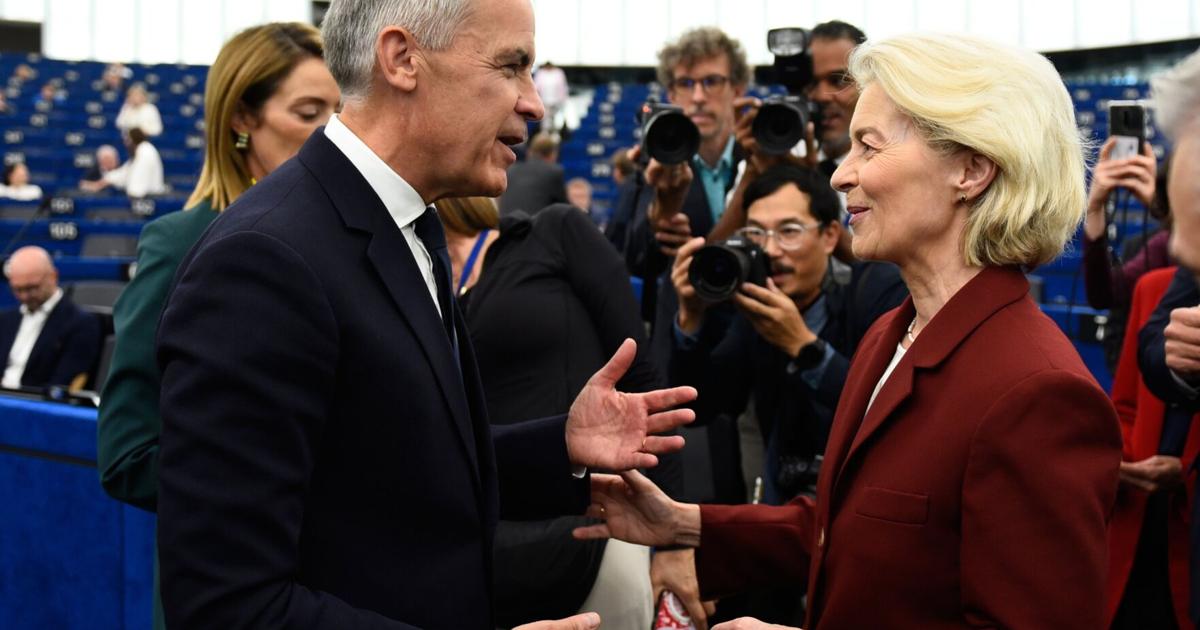
Canada’s Prime Minister Mark Carney, front left, speaks with European Commission President Ursula von der Leyen at the European Parliament in Strasbourg, eastern France, Sept 17, 2026.
MONTREAL — Unperturbed by objections to the name, EU chief Ursula von der Leyen says she hopes to put Canada on a path to “associate membership” with the European Union.
Von der Leyen arrived in Canada ahead of the two-day summit and posted her ambition on X, “bringing Canada closer to us than ever before, as Associate Member of the EU.”
She reiterated that notion in a speech here, hosted by McGill University and the C.D. Howe Institute, despite the fact that, for now, both Canadian and EU negotiating teams have agreed to settle on wording that underscores they are dealing with “an ever closer association.”
“Canada cannot become a full-fledged member of the EU because of geography, but we both want to bring our relationship to the highest level possible,” the European Commission president told an invitation-only audience.
“This is why we are discussing the idea of Canada becoming the first associate member of the European Union. Our idea is simple: It is an accession that we of course would not look at. But it is an ‘association without accession,’” she said. “We can replace accession with a ‘common ambition and vision’. We can build a partnership that comes closer to membership than anything we have done before,” she said in Montreal.
Von der Leyen went on to describe how she sees the relationship evolving.
First, she cited closer alignment on policies “from AI to climate to energy or security.”
Second, she said “it means closer alignment on governance. It means more work shared by the European Commission and the Canadian government... Parliament to Parliament, between our two parliaments, and court to court.”
Third, she said it means “closer alignment in each other’s programmes.”
Canadian and European officials have separately said the effort is not targeted at the U.S. or any other particular government.
But von der Leyen leaned into the troubled international environment, including Russia’s aggressions, and shared Arctic security concerns.
She stressed the need to strike “partnerships that are built on trust and driven by common interests and beliefs.
“As Mark Carney has said, the international order will also be built from Europe, with Canada as part of it...In a world of growing rivalries, sovereignty and independence are no longer just the freedom to act alone. It is the capacity to act together.
“This is why we will build an alliance for the future, and we start with Canada,” she said, adding the goal is to create a “common space for growth and prosperity, resilience and economic security.”
With economic pressure being used against countries, “We are seeing in real time our sovereignty being attacked,” said von der Leyen.
The two options are to “go it alone, to see this as a zero-sum game where each country or economy focuses on building up its own leverage or its own capabilities with the result that everyone feels less secure and more isolated.
“Or we can take a more strategic approach with trusted partners that face the same challenges – but have different assets to respond.”
Canadian officials in the room included Prime Minister Mark Carney’s top aides on the Canada-EU file, academics, businesspeople like former Parti Québécois leader party leader and Quebec media mogul Pierre-Karl Péladeau, along with members of the EU team.
The notion of what to call the relationship is the least of Carney’s concerns, except insofar as it has stirred criticism of his effort to forge deeper defence and economic ties with Europe.
The Conservatives have criticized it as potentially ceding sovereignty to Brussels-based decision-makers, when Canada already has partnerships via NATO and the Canada-EU free trade agreement, still to be ratified by nine European countries. It is provisionally in effect for about 95 per cent of trade, however.
Péladeau said in an interview with the Star he welcomes Carney’s efforts to diversify trade with Europe given the United States trade war. “Alternatives in life are always, you know, the best thing you can do. It’s a little bit like in business. If you only have one supplier, you’re not positioning yourself in the best position. So then, therefore, having you know a larger amount of customers, a larger amount of suppliers. It certainly helps.”
Péladeau suggested, however, that Carney should be more transparent about trade negotiations with the U.S. and consult more with provinces like Quebec, if not involve them in the trade negotiations, with the U.S. and the EU.
“The premier of Quebec doesn’t really seem to know what’s happening, he’s being kept in the dark,” Péladeau said, adding he was speaking simply as a citizen and businessman. “In fact, if the prime minister was looking to have a stronger relationship with the premier, he should include them as much as possible to make sure that you know they will be all together trying to have a larger consensus.”
Error! Sorry, there was an error processing your request.
There was a problem with the recaptcha. Please try again.
You may unsubscribe at any time. By signing up, you agree to our terms of use and privacy policy. This site is protected by reCAPTCHA and the Google privacy policy and terms of service apply.
Tonda MacCharles is Ottawa Bureau Chief and a senior reporter covering federal politics. Follow her on Twitter: @tondamacc.

