Europe’s gas squeeze: What kind of winter lies ahead? - Anadolu Ajansı
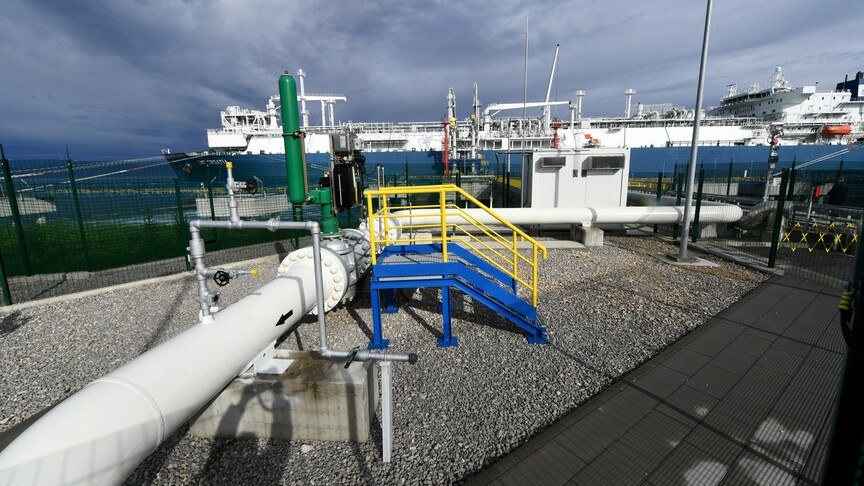
Europe is heading toward the winter season with relatively low gas storage levels as disruptions to liquefied natural gas (LNG) supplies push prices higher.
On Sept. 8, European natural gas prices climbed to their highest level in more than three-and-a-half years, as escalating tensions between the US and Iran continued to disrupt LNG supplies from the Gulf amid the closure of the Strait of Hormuz.
Reduced LNG inflows have slowed the pace of gas storage injections ahead of winter.
Qatar, one of the world’s largest LNG exporters, has largely suspended shipments and extended force majeure on cargoes to European and Asian markets through autumn.
According to Gas Infrastructure Europe, EU storage facilities were about 68% full as of Sept. 14, with roughly 772 terawatt-hours of gas in storage.
The level remains below the 90% storage target the EU normally seeks ahead of winter, raising questions over how quickly inventories can be replenished and how the market could respond if supplies remain tight or temperatures fall.
What do rising prices and low storage mean?
“We are now at the highest price since the start of the Iran crisis but still much lower than the peaks we saw in 2022," said Bill Farren-Price, a distinguished research fellow at the Oxford Institute for Energy Studies, referring to the sharp rise in energy prices following the Russia-Ukraine war.
He told Anadolu that the current pressure reflected “the tightness of global LNG markets due to the closure of the Strait of Hormuz and the loss of Qatari LNG.”
A July analysis by Wood Mackenzie also linked the rise in prices to historically low European storage, renewed disruption around the Strait of Hormuz and stronger Asian demand for LNG.
“Low European inventories, strong Asian demand and limited new LNG supply growth almost guarantee elevated prices through this winter and into 2027,” said Massimo Di Odoardo, vice president of Gas and LNG Research at Wood Mackenzie.
Erisa Pasko, lead European gas analyst at Energy Aspects, said the storage situation was not merely about the amount of gas held underground.
“The issue is not simply whether Europe has enough gas in volumetric terms, but whether storage can deliver that gas quickly enough during periods of peak demand,” she told Anadolu.
She noted that European withdrawal capacity begins to decline materially once inventories fall below roughly 40%, or around 44 bcm, and deteriorates significantly below 20%.
The current situation also differs from the last major European energy crisis.
“The closest useful comparison is 2021–22, when Europe entered winter with around 75% of storage capacity filled,” Pasko said.
The key difference, she said, was that Europe had considerably more supply and demand flexibility at the time, including greater Russian pipeline optionality, more coal-to-gas switching capacity and greater flexibility from European production.
“Much of that flexibility has disappeared,” Pasko said.
Farren-Price cautioned that storage refilling was running behind recent years.
“If storage is not sufficient, it means that there is a higher risk that storage is depleted if there were to be a very cold winter or supply disruptions in the global system elsewhere,” he said.
Farren-Price added that insufficient storage would also mean more gas storage would need to be refilled in 2027.
What are the projections for prices and storage?
Pasko said they currently expect Europe to reach around 75bcm, or 69% of capacity, by the end of October, which “would leave inventories at around a 14-year low going into winter.”
She noted that they would consider 88–90 bcm of European inventories by the beginning of November sufficient to provide “a relatively comfortable buffer” against a colder-than-normal winter.
“At present, reaching that level looks unrealistic even if there is government intervention,” Pasko, however, added.
She also stressed that their current trajectory would take Europe to around 18.5 bcm, or 16%, by the end of March even under normal weather assumptions.
“That leaves very little protection against a late-winter cold spell,” Pasko underscored.
Wood Mackenzie's analysis similarly points to a low-storage scenario.
Even assuming Qatar reaches full operational capacity by the end of September, the consultancy estimates European storage would reach only 75% by Nov. 1, compared with a five-year average of 90%.
If the Strait of Hormuz remains closed for another two months, storage would end up below 70%, it added.
Goldman Sachs, cited by Bloomberg, has also projected higher prices under a prolonged Middle Eastern supply disruption.
“European gas prices will likely need to rise above €100 ($117) a megawatt-hour in December for the continent to rebuild enough inventory to last the winter,” they wrote in August.
Meanwhile, Pasko said Energy Aspects’ base case does not foresee Europe running out of gas.
“Our base case does not imply that Europe runs out of gas,” she said. “We expect the market to balance, but prices will have to remain sufficiently high to conserve inventories and attract LNG.”
Wood Mackenzie also said no significant new LNG supply growth was expected over the next nine to 12 months, while new Qatari capacity is not expected to return before the second half of 2027.
“Germany, France, Netherlands and Slovakia are well behind the curve,” Farren-Price said.
Gas Infrastructure Europe figures show Germany's storage at 55.8%, the Netherlands at 52.5%, France at 76.7% and Slovakia at 52.4% as of Sept. 14.
“Germany stands out as the most exposed major market,” Pasko also said.
Germany's storage trajectory is particularly weak, she underlined, while the country's role as a transit market means lower German inventories “matter beyond Germany itself.”
“Germany is likely to need stronger imports from Norway, Belgium and other neighboring markets this winter and may have to reduce exports toward Austria, Italy and Eastern Europe,” Pasko added.
France also deserves attention, she said, noting that Energy Aspects expects the country to reach its 85% target, although that remains below the roughly 92–99% levels it has typically reached before winter.
“Because French storage is predominantly aquifer-based, declining inventories constrain withdrawal rates relatively quickly,” Pasko underscored.
She added that France is expected to reduce exports to neighboring countries during winter to preserve domestic deliverability.
“The UK presents a different vulnerability: it has very little seasonal storage and depends heavily on Norwegian supply and LNG during periods of high winter demand,” Pasko also argued.
She estimated that the UK could compete with Germany on Norwegian supply.
What kind of winter is Europe heading for?
“Europe is prepared for a normal winter, but it is not well insulated against a severe one,” Pasko said.
She noted that what concerned them was the lack of margin of error.
“At current projected storage levels, Europe is increasingly dependent on three things going reasonably well simultaneously: Middle Eastern LNG supply gradually recovering, winter temperatures remaining around normal, and Norwegian and other pipeline supply remaining reliable,” Pasko added.
“Cold conditions, lower storage and further disruption to LNG or pipeline supplies” could create a serious gas supply crunch this winter, Farren-Price further said.
Farren-Price stressed that windless and cloudy conditions could “mean more pull on gas to power.”
There is also a potentially more favourable weather scenario. Goldman Sachs' outlook assumes average winter temperatures, while a Rystad Energy report cited by the bank said a “super” El Nino pattern adding at least 2C (3.6F) to historical averages could reduce gas demand and partly offset low inventories.
The European Commission, meanwhile, stressed that the current storage situation does not amount to an immediate supply crisis and that there was no reason to intervene.
“Despite lower gas storage levels compared to previous years, the Member States and the Commission consider there is no immediate risk for security of gas supply in the EU,” the commission said earlier this month.
The commission reaffirmed that the EU is better prepared than in 2021–22 because of increased diversification, higher LNG import capacity and reduced gas demand.
“Based on historical projections, the EU is on track to achieve an adequate level of winter preparedness,” it said.
For Farren-Price, one factor could ease pressure on the market. “A reopening of the Strait of Hormuz,” he said.